
Thanksgiving reflections on Psalm 46
Psalm 46
1 God is our refuge and strength,
an ever-present help in trouble.
2 Therefore we will not fear, though the earth give way
and the mountains fall into the heart of the sea,
3 though its waters roar and foam
and the mountains quake with their surging.[c]
4 There is a river whose streams make glad the city of God,
the holy place where the Most High dwells.
5 God is within her, she will not fall;
God will help her at break of day.
6 Nations are in uproar, kingdoms fall;
he lifts his voice, the earth melts.
7 The Lord Almighty is with us;
the God of Jacob is our fortress.
8 Come and see what the Lord has done,
the desolations he has brought on the earth.
9 He makes wars cease
to the ends of the earth.
He breaks the bow and shatters the spear;
he burns the shields[d] with fire.
10 He says, “Be still, and know that I am God;
I will be exalted among the nations,
I will be exalted in the earth.”
11 The Lord Almighty is with us;
the God of Jacob is our fortress.
We often remember where we were when an epic tragedy struck, like the Kennedy assassination or the Challenger shuttle explosion. Similarly, a scripture can be a touchstone that brings us back to a moment where we sought and sensed God’s presence. Psalm 46 is that text for me. It runs together with the earth-shaking events of September 11, 2001, when I was serving a church in Poughkeepsie, NY.
That morning, I had been at my favorite diner, starting my second cup of coffee, when the TV brought the news of the first tower falling. I left my breakfast unfinished, feeling I had to get to work even though I had no idea what that work would be. I spent the morning on the phone offering comfort, fearing the worst, and hoping for some good news. Remember in 2001, few people had cell phones or email, so we didn’t know who was safe. We were close enough to see the dust clouds of destruction in the far distance.
The congregation gathered in the sanctuary after work, waiting in vigil for the Metro-North trains from New York City to arrive. I began the vigil reading to the congregation from Psalm 46:
God is our refuge and strength,
An ever-present help in trouble.
2 Therefore, we will not fear, though the earth give way
And the mountains fall into the heart of the sea,
As I read aloud, I felt a deep calm, aware of my heart’s pulses reverberating with the words as I read about mountains shaking and nations in uproar, the prick of teardrops gathered in the corners of my eyes. The words did more than reassure; they gave voice to my own fears and the awfulness of the violence and destruction of what just happened. A terrorist strike hit home, and thousands were dead. I had spent all day being practical, talking with people, being present to others, but not to my own shock and grief.
The scripture told me the reality of the situation without platitudes, but it also grounded me in a stronger presence and held me. Poetic words contain the gravitas to bring us to the weight of the moment. They help us see the truth and find the courage to meet it. These words from Psalm 46 have been tested by time, sung and spoken, and read for nearly 3000 years through all kinds of earth-shattering, blood-spilling moments. For times like these, we need more than memes, explanations, or accusations of fault. We need words that can knit us back together from the inside out, and then one to another. Holy words that create sacred space in the most profane moments of evil and injustice.
After I finished reading Psalm 46, we turned to the words of the hymn “A Mighty Fortress is Our God,” written by Martin Luther, as a commentary on the Psalm. He wrote the hymn in 1527, which he described as the darkest year of his life. The Black Plague struck his town of Wittenberg, and several of his close friends died suddenly. Luther stayed and turned his home into a makeshift hospital for all the sick and dying people. His wife Katie was pregnant, and he feared for her. The Roman Catholic Church had excommunicated Luther, and the Pope ordered him to be arrested or killed. The Ottoman Turks were invading Europe and advancing toward Vienna. His close friend, Philip Melchthanon, reported that Luther would say, “Come Philip, let us sing Psalm 46 together.”
So, we sang these familiar words, still in shock and disbelief that the towers were struck down and so many were dead. What world were we living in when people would make suicide attacks against us? Just after we finished singing, the church doors opened, and several people entered. Some of our church members met on the train and brought others to the church with them. Tearful hugs of reunion swept through our growing assembly. It was a moment of both joy and grief, because eventually, bad news touched almost everyone. Our mayor’s husband was never found, and later we heard the devastating news that so many first responders who rushed to help others were killed or injured.
Psalm 46 became my bulwark. It delivered strength because the author had experience. In 701 BCE, the Assyrian army conquered 46 towns of Judea and laid siege to Jerusalem. Many people had lost their homes and fled for safety inside the mighty city walls. But they feared it was only a matter of time before food ran out and they would all starve, and watch their children starve.
But one morning, the city woke, and the Assyrian army was gone. As the Psalm said, “God will help her at the break of day.” Like many important events, historians disagree about what happened to the army. Assyrian accounts claim Jerusalem paid tribute, and they moved on. I Kings said,
That very night, the angel of the Lord set out and struck down one hundred eighty-five thousand in the camp of the Assyrians; when morning dawned, they were all dead bodies.
The Greek Historian Herodotus said mice brought down the warriors through plague. I like the idea that it was the mice. All creatures can be God’s agents. Perhaps they accomplished God’s work described in verses 8-9:
Come and see what the Lord has done,
The desolations he has brought on the earth.
9 He makes wars cease
To the ends of the earth.
He breaks the bow and shatters the spear;
He burns the shields with fire.
The Psalmist is not a historian but a theologian, who is not reporting the news but creating theopoetics. The author didn’t care if the direct agent was mice, men, shekels, or angels. The theological point stands. “God is our refuge and strength, an ever-present help in trouble.” An ever-present help in trouble is not theoretical. The literal translation implies a repeated experience, as in “a help that is well proved” or “a help abundantly found in distresses.”
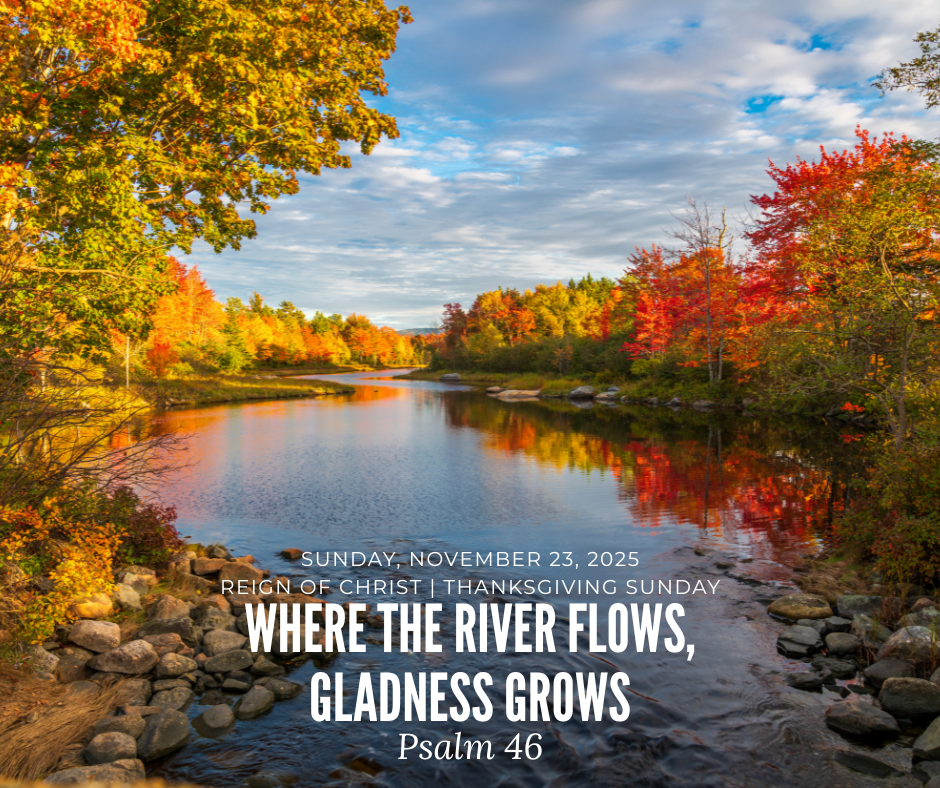
To make sure the audience understands this God-given nature of help, the writer says, “There is a river whose streams make glad the city of God.” If you know the geography of Israel and Jerusalem, there is no river feeding Jerusalem. So, we might think of this as a metaphorical river, the Spirit of God flowing towards us, bringing life and gladness. Many hymns refer to the river of God’s Spirit flowing into our souls. “I’ve got a river of life flowing out of me, makes the blind to walk and the captives free…”
That imagery made me wonder: where did Jerusalem get its water during the siege? So, on Thursday, I went down a rabbit hole and studied Jerusalem’s water system. The findings stunned me, both in engineering and theology. The city’s primary water supply came from the Gihon Spring, just outside the main city walls and vulnerable to attack. As the Assyrian armies threatened Judah’s borders, II Chronicles 32 says that King Hezekiah ordered the construction of an underground trench to bring water directly into the city. The ancient engineers tunneled 1750 feet through solid rock to bring water into the pool of Siloam inside the city. This remarkable work saved the city from dying of thirst, and the mice took care of the rest.
So, when we read, “There is a river that makes glad the city of God,” it could refer to Hezekiah’s tunnel. The river of life can be both a metaphor for God’s grace and the determined human work to save the city by digging through rock. Both God and humans have agency. God’s Spirit inspires our courage to act. Many mystics and poets compare God’s life-giving Spirit to an underground river. Here are a few examples:
“God is a great underground river that no one can dam up and no one can stop.” Meister Eckhart
“Our real work is supported by a quiet, persistent spring deep underground.” Wendell Berry
These quotes emphasize how God’s Spirit flows steadily and sure, even if unseen. When the world is going all kinds of crazy, there is still a stream of sanity flowing beneath. So yes, nations still rage. From Jerusalem to Wittenberg to my Poughkeepsie church on 9/11, the same river flows beneath every trembling city.
Kingdoms still totter. Our world still trembles.
But after all the shaking and roaring,
The Psalm gives us a simple guideline —not a command to strive, not a demand to fix the world, But an invitation:
Be still, and know, that I am God.
Be still — not because life is calm,
But because God is present.
Be still — not because you have the answers,
But because you are held.
Be still — not to escape the world’s pain,
but to remember the river beneath your feet.
And when we are still, we can hear the water flowing.
We will know, even in a trembling world,
There is a river that makes glad the city of God.