
Living Between What Was and What Will Be
Any healthy religion needs to embrace the tension between the need for order and the necessity to adapt and change. Religion is a great force for stability that grounds us in something larger than ourselves. Faith helps us find meaning and moral purpose. We discover wisdom refined over centuries. Rituals, hymns, and sacred objects help center us on a broader horizon. By engaging in these practices of faith, we can become less anxious, more hopeful, kinder, more generous, and more honest. That is why we gather here this morning.
But too much order creates problems. Faith becomes rigid. When religion refuses necessary change, it ends up focusing on power and control. It joins a repressive status quo. Healthy religions need processes of confession, renewal, and grace. Order anchors us, but faith also flows like a river. You can guide a river, but you can’t force it to stay still. Healthy faith honors the banks and the current.
The life of Jesus embodied this tension between order and tradition vs. the dynamism of God’s life-giving Spirit. He was deeply rooted in tradition — teaching Torah, observing the festivals — yet he challenged hypocrisy, questioned hierarchy, and told parables that disrupted preconceived notions. He loved his faith enough to transform it.
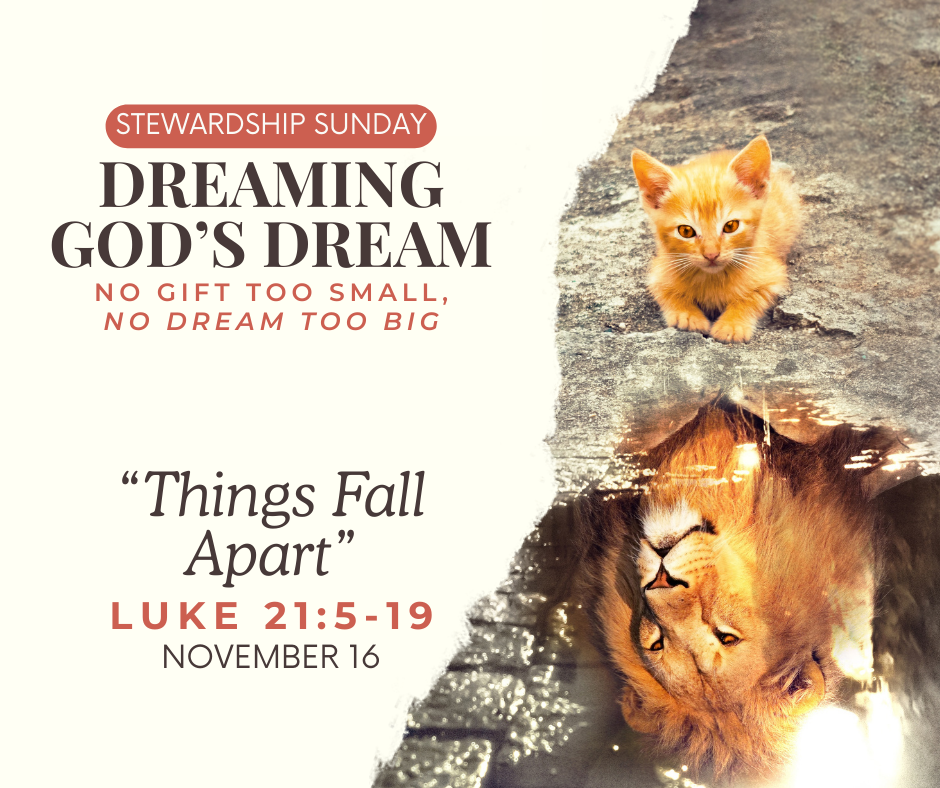
So, how do we walk in the way of Jesus in our own time? How can his life and teaching help us find a center in a world where change feels faster than most of us can adapt? In our scripture for today, Jesus speaks about facing a tumultuous future and urges people to hold firm in times of tragedy and persecution. He envisioned a time when the most stable thing they knew, the Temple in Jerusalem, would be no more. So, let’s explore the text to see what we need to have a grounded, stable, yet adaptable and life-giving faith.
Imagine being one of Jesus’ disciples standing in the Jerusalem Temple. They were from the small fishing villages around Capernaum, where the biggest building was the equivalent of a three-bedroom house, with a half-bath unattached in the backyard (meaning an outhouse). For perspective, if you stood at the Washington Monument on the National Mall and looked to the Capitol Building, the Temple complex would cover a similar distance. Hundreds of thousands of people could fit inside the outdoor walls. The marble and gold Temple stood in the center, visible for miles from the mountain top. It rivaled any of the ancient wonders of the world and was a symbol of spiritual awe and national pride.
For Jesus to say that it would all be knocked down, not a stone left on stone, was unfathomable. The largest remnant stones on the Western Wailing Wall are 44 feet long, weighing 500 tons—more than a Boeing 747. To say he would build it again in three days was beyond hyperbole, since it took over 50 years to construct the Temple Mount fully.
The crowd might hear Jesus as that guy with a sign that says, “The End is Near,” trying to frighten us into turning towards God. By now, we have heard the prophecies of doom so many times that they just roll off us. The Y2K bug was going to lead to the breakdown of civilization. In 2012, a bestseller claimed that the Mayan calendar predicted the end of the world. Reading the signs of the end times is an obsession for some. Hal Lindsey, who popularized Rapture theology, wrote that the 1980s would be the decade of Armageddon.
We have witnessed so much doom come and go; you might think we would move past it and focus on solving our common problems. But just like the crowd around Jesus who wanted to know the signs of the times, dystopian stories are increasingly popular. People are re-reading 1984, The Handmaid’s Tale, and The Parable of the Sower. I’m currently watching “Murder Bot,” a futuristic drama about AI robots. (When I preached the sermon, only one other person has seen this show on HBO. I think they need another title.)
Dystopian fiction is not just entertainment — it’s a collective emotional processing experience. When people feel the world is shaking — politically, environmentally, spiritually — dystopian stories help us imagine our fears. Jesus performs a similar act in Luke. He names our fears honestly, but then calls us to courage, endurance, and hope. Jesus was not saying just hang in there till the end of the world, and God will save you. He was telling people not to lose hope in a God even as the world goes through cataclysm. Even more, watch for opportunities for love, justice and service.
For the first readers of Luke’s Gospel, the destruction of the Temple had already occurred. Jesus died around 33 CE, Roman Legions destroyed the Temple in 70 CE, and Luke wrote between 80 and 85 CE. Luke’s audience held fresh memories of this great trauma. They may have lost family members in the invasion. Or they fled and started a new life in another part of the Empire. For Jews, this was the kind of devastation that divided “before” and “after.” Like the grief America experienced after 9/11, Jews mourned the destruction of their national icon. Their sense of a safe world, where God watched over them, was shattered. The Temple was the literal house of God, the holy dwelling place. A primary religious duty was to travel to offer sacrifices in Jerusalem, but now the sacred place is gone. How does a religion survive when God’s dwelling is destroyed by invasion?
Both early Christians and Jews had to adapt after Roman imperial violence. Both formed smaller communities that met in homes. Rituals focused on eating together. Sharing communion made Christ’s table a pop-up temple that could be anywhere, where two or three are gathered in His name. Without priests and hierarchies, people had the freedom to experiment with forms of community, doctrine, and rituals that reconfigured the shattered faith of the past into new, mosaic-like patterns.
Things fall apart, but they also get reorganized. I think I chose to major in sociology and journalism because I wanted to understand why society falls apart and what holds it together. My early life was filled with conflict and uncertainty. Till kindergarten, I grew up on a college campus as the Vietnam War divided the country. I went to school and was drilled to put my math book over my head in case of nuclear attack. I learned about the branches of government during the time of Nixon’s corruption. When I entered college, the farm crisis was decimating the way of life I grew up with. One in three families lost their land and livelihood.
Experiencing collective tragedy made me search for answers. From sociology, I learned that societies often fail more from within than without — when institutions lose their higher purpose, when they serve hierarchies rather than the common good, and when they scapegoat instead of confessing and repairing.
And faith communities are no different. What holds us together isn’t stone temples, rigid doctrines, or even the traditions we cherish most. What holds us together is the God who chooses to dwell in human hearts, in communities that break bread together,
who welcome the outsider, and refuse to give up on one another when the world feels unsteady.
And that realization brings us full circle to where we began this morning.
Healthy faith has always lived in the creative tension between order and adaptation.
The Temple represented order — a sacred center, a place to anchor life.
But when that center collapsed, God did not vanish. God moved.
Or perhaps more truthfully: our attempts to contain God failed.
The Spirit moved into new forms of community and worship —from the upper room, to the homes where early Christians gathered, to every place where two or three meet in Christ’s name. When our world shakes — when institutions feel fragile, when headlines break our hearts, when our own lives enter seasons of upheaval — the God who carried our ancestors through destruction is the same God who carries us now. The forms of faith may change; the Spirit who fills them does not.
Things fall apart.
But God does not.
And in every season of collapse or confusion, the Spirit is quietly building something new —
a sanctuary not of stone,
but of living hearts;
not of marble,
but of mercy;
not of gold,
but of courage and compassion.
This is the holy tension Jesus invites us into:
to honor what is ancient and wise,
and to welcome what God is making new right now.
That is the Temple the world cannot tear down.
That is the hope Jesus places in our hands.
And that is the life that endures —by trusting God enough to love boldly in the present.