

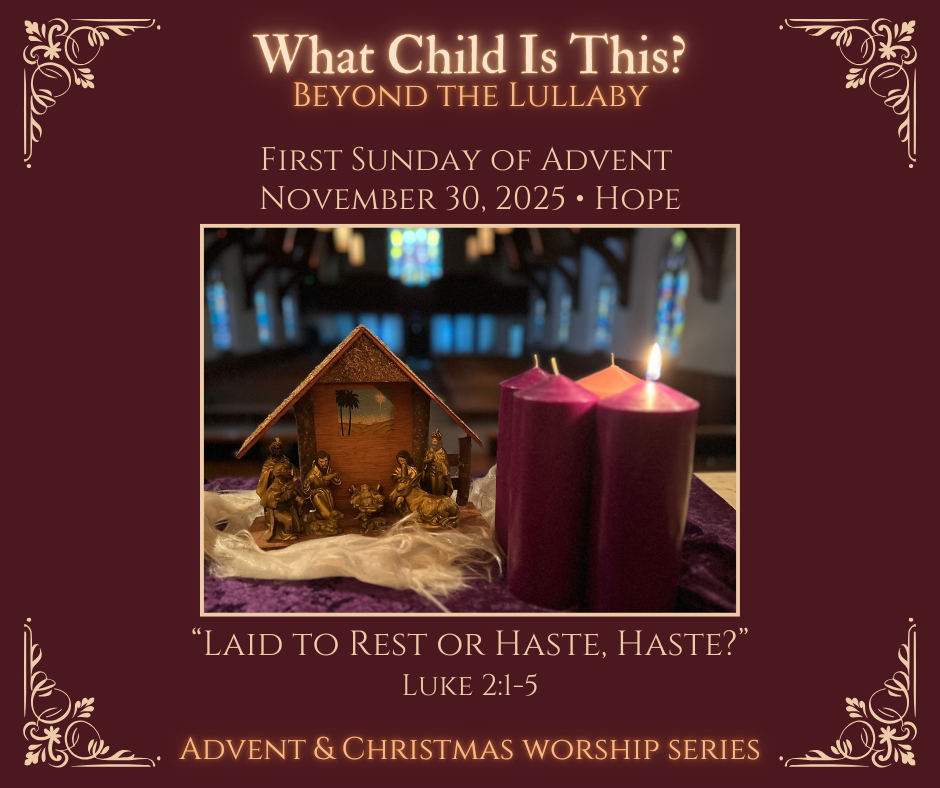
An old carol can help us find Christ in the here and now
Luke 2:1-5
In those days Caesar Augustus issued a decree that a census should be taken of the entire Roman world. 2 (This was the first census that took place while[a] Quirinius was governor of Syria.) 3 And everyone went to their own town to register.
4 So Joseph also went up from the town of Nazareth in Galilee to Judea, to Bethlehem the town of David, because he belonged to the house and line of David. 5 He went there to register with Mary, who was pledged to be married to him and was expecting a child.
You all know the main plot and characters of the Christmas story, including Mary and Joseph, the angel Gabriel, shepherds, and of course, Rudolf the Red-Nosed Reindeer. Without Rudolf, the wisemen might not have arrived. The biblical story and modern fables like “A Miracle on 34th Street” or “The Grinch” all circulate in our consciousness to create a Neuvo cuisine fusion of the meaning of Christmas. While I am a huge fan of fusion cooking (I prefer pineapple poblano salsa instead of cranberry sauce), it’s important to remember our origin stories.
Luke is weaving a story that leads us to an awe-filled, hopeful question asked in the carol, “What Child is this?” Luke grounds the birth of Jesus in a time and place. It occurs during the reign of Caesar Augustus, when Quirinius is appointed governor of Syria and Palestine, dating Jesus’ birth to around 6 CE. But to us, the names Augustus and Quirinius feel distant and academic. But to the first hearers, those names carried tension and turmoil, the way specific political eras do for us. If I said, “Jesus was born in the presidency of Herbert Hoover, just after the Wall Street crash,” you would have a foreshadowing of the world he was born to.
Luke begins with a fateful decree for the Christmas story. If paraphrased, it might sound something like this,
“I, CAESAR AUGUSTUS, SAVIOR OF ROME, BRINGER OF GOOD NEWS, PRINCE OF PEACE; DECREE EVERY CITIZEN RETURN IN GRATITUDE TO THEIR HOMETOWN, AND REGISTER FOR A CENSUS. THANK YOU FOR YOUR ATTENTION TO THIS MATTER.”
Notice how the words parallel familiar biblical themes of peace, a savior, and good news. Luke cleverly uses Roman imperial language throughout the Gospel to make truth claims about Jesus. Caesar does not own these words, and Rome is not the ultimate power.
This census decree was meant to extend Rome’s power, but it went badly. The point of a census was to figure out how much you owe in taxes. It marks the first Roman move to assert direct control of Palestine. The historian Josephus reports that this caused an uprising led by Judas the Galilean. Jesus’ Galilean home was a hotbed of guerrilla warfare and resistance. Quirinius brutally crushed the rebellion, crucifying hundreds. This chaos was the world where Jesus was born, plagued with unrest, taxation, heavy-handed rule.
For Mary and Joseph, the immediate consequence was the fated journey to Bethlehem to register for the census. Luke tells us that the Holy Family is caught in the chaos of the day. Their lives are disrupted by societal forces beyond their control. They are forced to endure the hardship of traveling while Mary is pregnant. There are no tax extensions from Caesar for being pregnant. They travel despite the morning sickness and kicks in the belly. It wasn’t a day trip. Mary endured through a week of rough travel—more like a hike on the Appalachian Trail than a Christmas card. The child jostled with every step of that long journey, feeling his mother’s tension and exhaustion. He is not untouched by the world he’s entering.
Caesar’s decree wasn’t just a plot device to get Jesus to Bethlehem. It disrupted the lives of hundreds of families living on the edge. But Luke shows us that while Rome issues decrees to extend power, God issues decrees to extend hope. Four divine announcements chart God’s purposes:
· First, the angel Gabriel announces to Zacharias that he and Elizabeth will have a son, John, who will prepare the way for the Messiah.
· Next, he tells Mary to be not afraid, for she will give birth to a great man, whose kingdom will have no end.
· Angels visit Simeon and Anna to tell them they will see the Messiah before they die.
· And the big final announcement to the shepherds mirrors the words of royal Roman decrees, “I bring you good news of great joy for all people. To you is born this day a Savior, the Messiah, the Lord.” Plus, a heavenly host singing, “Glory to God in the highest, Peace on earth to those God favors.”
What child is this, entering Caesar’s world? A child whose birth quietly rivals Augustus.
Centuries later, another troubled world listened for the meaning of Christ’s birth: Victorian England. William Dix wrote the only Christmas carol that begins with a question. I love a good question, and this one is essential for us to keep asking. It moves us beyond seeing the nativity story as proof that Jesus is the Messiah to contemplating what Jesus is for us. What is God’s work happening in the story?
Dix’s carol marked a significant shift during the Victorian age in how Christmas was understood and celebrated. We can see this in comparing the popular carols pre-1800. The most famous carols of the 1700s were bold and majestic.
“O come all ye faithful, joyful and triumphant.”
“Hark the herald angels sing, glory to the newborn king.”
“Joy to the World, the Lord is come. Let earth receive her King.”
When we sing carols from this era, they are buoyant and uplifting. I know the bass lines of all these songs by heart, and love joining the four-part harmonies. These three carols reflect a theology that God is transcendent and reigns in heaven. God is a majestic but distant power who controls human destiny from afar, usually through Kings and Lords who rule by divine right. The work of a faithful Christian was to give thanks and obey.
But carols shifted in the 1800s. We get songs more intimate and earthy. In carols like “Away in a manger,” Jesus has no crib for a bed…the little Lord Jesus is asleep on the hay.” “In Bleak Midwinter,” God enters harsh reality. Earth stood hard as iron. Frosty wind made moan. “What Child is This?” Dix says Jesus is born vulnerable and of “mean estate.”
What happened at the turn of the 19th century that reflects such a different tone? Revolutions in America and France overturned monarchies. England was experimenting with a reformed constitutional monarchy. Royal imagery had become too politically charged. Hymn writers began softening or reinterpreting it to focus on Christ’s humanity and nearness. So, when Dix says, “This is Christ the King,” he tones down the grand royalty of Jesus to one more sympathetic to the plight of common people, who experienced hardship.
These 19th-century English hymns were also being written on the shoulders of Charles Dickens. He wrote “A Christmas Carol” in 1836, which contrasted the wealthy, hardhearted Scrooge with the hardships of low-income families and children like Tiny Tim. Dickens’ writings woke people to the sufferings in coal-choked cities, where wealth was built on child labor, where working families were often on the verge of starvation.
The popularity of “A Christmas Carol” influenced a shift in Christmas celebrations. More emphasis was placed on compassion, fostering togetherness in a heartless urban setting. Christmas carols reflected a shift toward focusing on God’s immanence, right here and right now. Mary and Joseph are just like other struggling families, the Christ-child is tender and vulnerable, and the stable and the manger become symbols of God entering ordinary life.
In this context, Dix’s question, “What Child is this?” becomes more profound. It pushes us to reflect on how Christ enters the world in our age.
He enters worlds that feel uncertain—worlds shaped by empire, economic strain, climate extremes, and the weight of decisions made far above our heads. He entered all the places where people were stretched thin and barely holding on.
What child enters our world?
A world where housing is out of reach for many who work here, where neighbors quietly choose between heat or groceries or medical bills, where fishermen watch the warming Gulf of Maine with growing worry, where storms bite harder into our coastline each year. A world where caregivers are exhausted, A world where grief and hope live side by side, even in small towns like ours.
If Christ could be born into Roman Imperialism and into Dickens’ London, then Christ can be born into Boothbay Harbor, Southport, and every Maine community where people still struggle to find room. He comes not to the world as it should be, but to the world as it actually is. And that is good news for us.
Because Christ can surely be born in our time too—
in our neighborhoods and nursing homes,
in the boats heading out before dawn,
in the families juggling winter bills,
in the quiet courage of those caring for one another.
And so this Advent, the question becomes an invitation:
Where is Christ being born now?
In the neighbor who checks on someone alone in a storm.
In the volunteer delivering meals or firewood.
In people working on climate resilience.
In the teacher encouraging a child.
In communities that dare to practice peace; offering hospitality to immigrants being threatened, imprisoned and deported.
Christ is still arriving in all the places we thought were too bleak, too ordinary, or too small.
What child is this?
Love in the flesh.
God with us.
May we have eyes to see him, hearts to receive him,
and lives ready to carry his hope into the world.
Amen.