
Advent 2 on the quiet that restores us
Why lies He in such mean estate,
Where ox and ass are feeding?
Good Christians, fear, for sinners here,
The silent Word is pleading.
What Child is This? v. 2
Luke 1:5-25 (Click for full reading)
18 Zechariah asked the angel, “How can I be sure of this? I am an old man and my wife is well along in years.”
19 The angel said to him, “I am Gabriel. I stand in the presence of God, and I have been sent to speak to you and to tell you this good news. 20 And now you will be silent and not able to speak until the day this happens, because you did not believe my words, which will come true at their appointed time.”
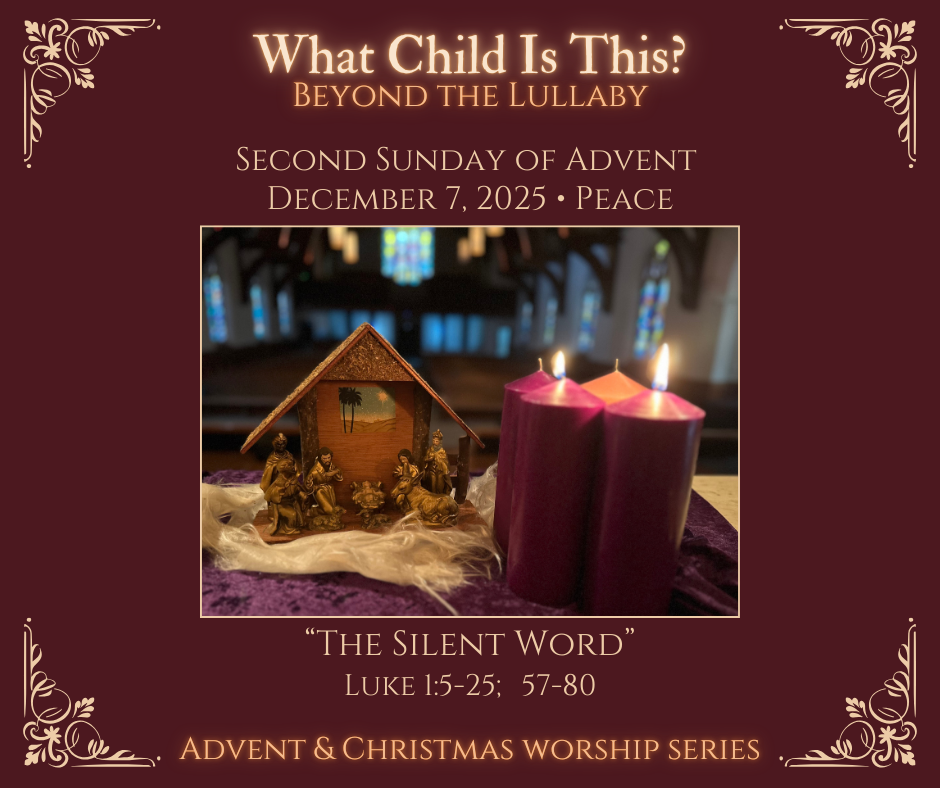
The prevailing mood of this second Sunday of Advent is silence. We have lit the second candle symbolizing peace. Peace and quiet nest together comfortably. Verse two of the carol, “What Child is This?” creates a bucolic scene of ox and ass eating hay in the background, while baby Jesus is nursing or sleeping. We sinners, are asked to hear, “the silent word is pleading.” The silent word. How can a word be silent? And pleading? Isn’t the point of a word to make a sound that corresponds with some kind of meaning so that we can understand each other? Happy, sad, tasty, poison, tiny, ginormous. Words help us navigate life.
I love words and exploring their meaning. The word “word” means utterance or speech. The Greek Logos is the source and structure of all things, as from John’s Gospel, “In the beginning was the logos, and the word was with God and the word was God.” God speaks, and there is light and day. So, what does it mean that the silent word is pleading? It is a poetic shock to us, word-o-philes, that we need silence to draw near to holiness. If we can’t be silent, then all the words are just a jumble.
How are you with being silent? I took a meditation class two years ago and slowly worked my way up from 10 minutes to 30 minutes of quiet. Many days, these moments of solitude were the best minutes all day. But I got out of the habit and recently started again, setting my timer for 15 minutes. That shouldn’t be too hard. But my brain managed to pack so many words and thoughts into those 900 seconds. There were additions for my to-do list, sermon ideas were added and discarded, Netflix shows I watched the night before, things that made me angry from the news, maybe I should eat less. If you commanded me to have as many thoughts as possible in 15 minutes, I could not have achieved as many as my mind did while avoiding being silent. We say we long for peace and quiet, but silence can be deeply uncomfortable. It brings thoughts we would rather avoid. I had not realized how noisy my brain had become. It was so loud that I’m surprised you all could not hear what was going on inside my head. I longed for a word silently pleading.
Advent teaches us to wait, to listen, to soften the noise inside us. And no one embodies this lesson more honestly than Zechariah. He steps into the Temple assigned to offer the holiest of rituals—and instead God offers him a silence so deep it stretches across months. He has been chosen by lottery to light the incense in the inner Temple. This was a once-in-a-lifetime experience. The odds of getting selected for this holy duty were roughly 1 in 600, and most priests never got the opportunity.
During major religious festivals, people gather in the Temple courtyards twice a day. The selected priest entered the holiest place in the Temple to light incense to begin the prayers. The incense symbolized prayers floating up to God. A specific formula of rare elements was combined in the incense, considered pleasing to God. After ritual purification baths, Zachariah entered the holy sanctuary alone. On one side of the altar were twelve loaves of bread, one for each tribe of Israel, symbolizing God as the provider of the people. On the other side was a Golden Minora, host of the perpetual flame.
When the angel Gabriel shows up, Zachariah reacts with fear. It fascinates me that after all that preparation, a lottery drawing, ritual baths, special incense, all done to create a holy moment, the priest is startled when an angel shows up. When Gabriel delivers his good news, Zachariah wonders how this can all be; he still wants a sign that this is true. If you have just heard the most important words of your life, spoken in the holiest place in the Temple, by the highest known angel, what else is there to say? Would a burning bush help, or touching a hot coal to his lips, or seeing the stairway to heaven? The sign he gets is silence, losing his speech. It may sound like a punishment for not fully trusting the words. But it is a powerful gift. The deeper truth and presence of God often require silence to be fully understood. Words can only approximate the awesome presence of God or the meaning of a blessing. When we cannot speak, then we may encounter the silent word’s pleading.
Years ago, I took a three-day silent retreat in a Benedictine monastery. No phones, computers, podcasts, books on tape, or iPods. At orientation, they urged us not to read any books except a few scriptures. Walk the grounds, sit in the chapel, rest in your room, but no talking. This meant mealtimes too, where we ate together in the dining hall. It was so hard not to say “good morning” at breakfast. The sisters and brothers were practiced in the art of warm smiles and moving on. It was a small cafeteria, so we sat close; hearing each spoon clink on china, the loud chewers, the noisy shifters.
Without morning news or conversation, there was nothing else to do but sit and eat. Just eat. I consumed that first meal quickly and began my day of silence. I soon realized there was no reason to hurry breakfast, because eating was something to do on a silent retreat. So, the next meal I lingered and tasted. The vegetable stew was seasoned with herbs from the monastery gardens, and I pondered how rosemary and thyme worked wonders with mushrooms, potatoes, and peas. I looked around at my silent and content companions, who spent part of their day weeding and watering the gardens, and contemplatively chopping onions for the soup. My meal was their labor and gift. I pondered which one was up early making the fresh bread, and who was it so skilled with the flaky apple pie crust.
Over shared meals, I began to notice others who were on retreat. The woman to my left ate with annoyance, huffing and sighing. The man to my right looked so sad, I thought he might try to drown himself in his stew. But the brothers and sisters surrounded us with a silent presence, a blanket of goodness and comfort. Were they praying for us or just savoring the moment? Is there a difference between the two? These men and women were ministering to me, showing me what God was like, just by being present. The quality of their silence said more than words could, and they were putting our hearts right again just with their presence.
By dessert, the huffy woman had noticed she was sitting in a lovely patch of sunlight. The sad man had forgotten his plan of death by stew, finding tender joy in eating apple slices out of his pie, saving the crust for last.
I learned all this about my companions without a word. If we were allowed to speak, I might have known less about them, as we shared what we did for a living or commented on the food we weren’t taking the time to taste properly. It is so easy to hide ourselves in words. We act like we are sharing, but we are really hiding the things that concern us most deeply. When my retreat ended, a new group of people was checking in at the lobby. They seemed so noisy and chatty. Where are you from? Do you come here often? I’ve never been on a silent retreat before! No kidding, I would have never guessed! It was jarring to return to the wordy world.
It didn’t take long to be buried again in words. Emails to read, tapping away at my keyboard, producing sermons and memos, phone calls, headlines, advertisements. I love words, but they can be exhausting. More and more of them do not make me happy or wise. I keep returning to the lessons of that silent retreat. When God seems distant, or I feel spiritually disconnected, I need a return to solitude where I can encounter the word silently pleading.
Advent begins not with noise, nor with certainty, but with a silence that pleads for our attention. Zechariah learned to hear God again, not through more words, but through the absence of them.
The Christ child—the eternal Word—comes to us wordless. His smallness and quiet presence speak the deepest truth of God’s love in a way no spoken sentence ever could.
As we come to the table today, I invite you into a holy quiet.
A pause.
A breath.
Space enough for the silent Word to plead with your heart.
And perhaps this week, each day, you might make room for even a minute or two of stillness.
Let the noise drain away.
Listen for the God who still speaks in a voice of sheer silence.
For in the silence, the Word is pleading.
For you.
For your healing.
For your peace.