

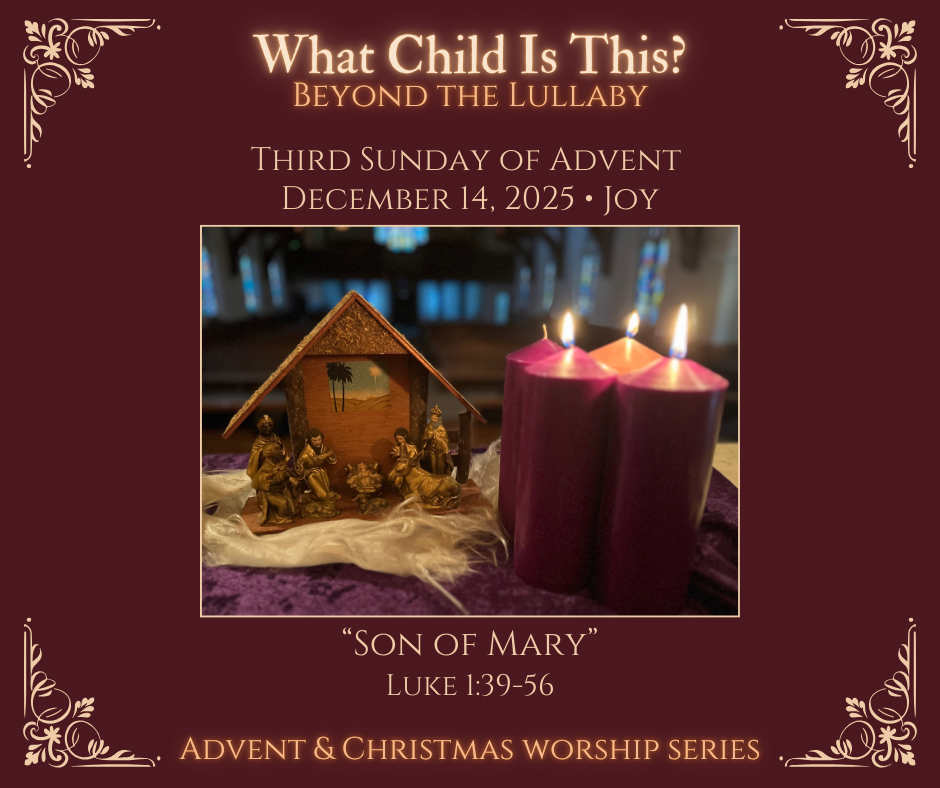
Mary, Elizabeth, and a World Being Made Whole
Luke 1:39-56
39 At that time Mary got ready and hurried to a town in the hill country of Judea, 40 where she entered Zechariah’s home and greeted Elizabeth. 41 When Elizabeth heard Mary’s greeting, the baby leaped in her womb, and Elizabeth was filled with the Holy Spirit. 42 In a loud voice she exclaimed: “Blessed are you among women, and blessed is the child you will bear! 43 But why am I so favored, that the mother of my Lord should come to me? 44 As soon as the sound of your greeting reached my ears, the baby in my womb leaped for joy. 45 Blessed is she who has believed that the Lord would fulfill his promises to her!”
46 And Mary said:
“My soul glorifies the Lord
47 and my spirit rejoices in God my Savior,
48 for he has been mindful
of the humble state of his servant.
From now on all generations will call me blessed,
49 for the Mighty One has done great things for me—
holy is his name.
50 His mercy extends to those who fear him,
from generation to generation.
51 He has performed mighty deeds with his arm;
he has scattered those who are proud in their inmost thoughts.
52 He has brought down rulers from their thrones
but has lifted up the humble.
53 He has filled the hungry with good things
but has sent the rich away empty.
54 He has helped his servant Israel,
remembering to be merciful
55 to Abraham and his descendants forever,
just as he promised our ancestors.”
56 Mary stayed with Elizabeth for about three months and then returned home.
Now that we have lit the candle of joy, we might be eager to rush headlong into joyful Christmas, with the big, bold Christmas songs.
“Joy to the World, the Lord is come.”
“O Come, All ye faithful, joyful and triumphant.”
Angels are spreaders of joy in the Christmas story, telling Zachariah and Elizabeth, “You will have joy and gladness.” Today’s reading Elizabeth and Mary share great elation in their pregnancies, and share tender moments which perhaps only they can fully understand.
Even though this is the Sunday of joy, let me pump the brakes a moment. We are not there yet. Every Christmas story reveals a tension and a villain who much be constrained. Rudolf has his tormentor, Comet, plus the abominable snowman. The Grinch stole Christmas from Whoville. Mr. Potter’s greed nearly drives good George Bailey to suicide.
The biblical story reads like a Dickens’ novel. Caesar Augustus and Ebeneezer Scrooge are partners in greed. The stable and manger are like the Cratchit’s kitchen, sparsely equipped yet overflowing with family love. The biblical angels and Dicken’s Christmas ghosts are cousins—messengers who interrupt the darkness and tell us, “Turn around, there is still time for joy.
The joy in our Christmas story is not a celebration of success represented in expensive gifts, nor the perfect togetherness of our ideal families, the greatness of our country. Joy is announced into fear, even amid hopelessness, not after distress is eliminated. The angel doesn’t say, “Once everything settles down… once Herod is gone… once the census is over…” Joy is announced right in the face of Grinch, Potter, Scrooge and Herod. It bubbles up from the bottom, from hardship, from happy Whos, Cratchets, Bailey’s and Elves.
Theologian Henri Nouwen put it this way: while happiness usually depends on circumstances, joy runs deeper. “Joy is the experience of knowing that you are unconditionally loved and that nothing — sickness, failure, emotional distress, oppression, war, or even death — can take that love away.”
Mary’s joy was complicated and vulnerable, but her effervescent song flows from a wellspring deeper than the surface of things. Our story begins after the Angel Gabriel visits Mary to tell her she has been chosen to give birth to the Messiah. Who would you tell first if you were pregnant for the first time? Notice Mary goes immediately to visit her relative Elizabeth. I wonder why she didn’t go to her mother. Nor does she tell her fiancé, Joseph. Mary needs someone wise to help her sort out her unusual circumstances. Elizabeth is a logical choice because the angel tells Mary that Elizabeth is also pregnant. They have both heard the call to be a part of God’s work in the world.
So, Mary seeks counsel from someone likely to be sympathetic. If angels deliver shocking news, wouldn’t you check it out to ensure you aren’t crazy? Build an ark. Confront Pharoah to let my people go. You will give birth to the Messiah. God can ask much of some people. This type of knowledge is a lot to carry. Most people in the Bible want a second opinion after a divine visitation.
Today, we would give Mary the Minnesota Multiphasic Personality Inventory (MMPI), which helps to diagnose mental health disorders like schizophrenia or anxiety. One of the 567 true or false statements to answer is “God sometimes speaks to me.” When I took this test upon entering seminary, I laughed out loud, because God’s call was why we were all in the room. If I say “true,” do I get a diagnosis. Two minutes later, someone else laughed. A minute later, two people laughed. One perplexed person said “Sssshhh!” When she laughed two minutes later, most of the room erupted. The test supervisor looked like she thought it was a madhouse, and we had to explain to her that God spoke to all of us. I think that bothered her even more than the laughing.
Mary decides not to tell her mother or her fiancé. How will Elizabeth react to her news? When Mary walked in the door, Elizabeth’s baby, who would become John the Baptist, leaped in her womb. Mary says hello, and Elizabeth know. She greets Mary, “Blessed are you among woman, and blessed is the fruit of your womb.” Well, good morning to you, too, Elizabeth! She understands without a word from Mary. Call it intuition or a spiritual gift, she confirms what Mary has experienced. There is excitement in the room that two pregnant women experience the multilayered miracles of body and divine Spirit. They have a pact.
Unfortunately, this scene doesn’t make it into most Christmas pageants. It would tell young women that wise elders are around to guide them, even in complicated families. Luke’s Gospel brings women’s experience front and center. Joseph has little role to play, whereas Matthew’s Gospel is about Joseph and his dreams, and Mary never speaks. If you read Luke and the Magnificat, it’s clear Mary knows exactly what is going on. I wonder if Luke, being a physician, had a little more experience with women and knew how to include that in the Gospels.
A closer look at the words of the Magnificat reveals a bold joy. What are your hopes for your children or grandchildren when they are born? What would you say if you had to write a song about it? If Mary was a different kind of person, a helicopter parent aspiring to a prosperity Gospel, she might have sung:
A Prosperity Magnificat
My soul magnifies the Lord,
for surely my son will go to the Ivy League.
My heart rejoices in the future I imagine for you, my child,
for God has seen your potential and intends success.
Aspire, dear one, to dwell in the grandest estate;
let your home be a palace of luxury,
proof that God has smiled upon you.
May your name be synonymous with wealth and favor,
your résumé impressive,
your riches counted with many zeros.
Heed the call of the luxury car, my child;
may valet parking be your birthright
and inconvenience far from you.
For the Lord helps those who help themselves
and rewards those who plan well.
Blessed are the successful,
for their success shall be called blessing—
now and for generations to come.
Mary magnifies a God who rejoices in justice and celebrates a world being made whole.
He has shown strength with his arm;
He has scattered the proud in the imagination of their hearts.
52 She has brought down the powerful from their thrones
and lifted up the lowly;
53 She has filled the hungry with good things
and sent the rich away empty.
The Magnificat echoes throughout Jesus’s ministry in Luke’s Gospel. His first sermon says, “God has anointed me to bring good news to the poor. When he said it is harder for a camel through the eye of a needle than a rich man to enter heaven-sounds like the Magnificat. Jesus saw with different eyes, noticing the poor widow giving her last coin, Blind Bartimaeus shouting for mercy, showing mercy on a woman caught in adultery. Is this perspective from Mary? Mary did more than change his diapers and nursed him from her breast. She was also his teacher, and she likely taught him the values of the Magnificat. Wasn’t God working through her, guiding his whole life?
Maybe God chose someone like Mary because she wasn’t docile, and she didn’t teach her son Jesus to go along to get along or curry favor with the rich and powerful.
Do you know who understands the power of the Magnificat? The super rich and powerful get it. During British colonial rule of India, the Magnificat was banned. The British East India Company prohibited the recitation during evensong in Advent in Anglican churches. On the final day of British rule over India, as English flags were lowered in unison, Gandhi asked that the Magnificat be recited at each site as the flags came down.
This third Sunday of Advent, we are called to be present with joy. Mary’s story celebrates joys large and small. There is the tender joy of new life, a baby’s leap in the womb, a wise elder to guide, and a safe haven. But there is also the joy that the world can truly be better than it is. There is joy when all are fed, all are made whole, and all are welcome. Mary carried this joy pregnant on a donkey, to birth in a manger, flight to Egypt, and beyond. This joy is ours to carry, too. If we are present to notice joy, it is right here and right now.