
Joseph and a faith that makes room for God
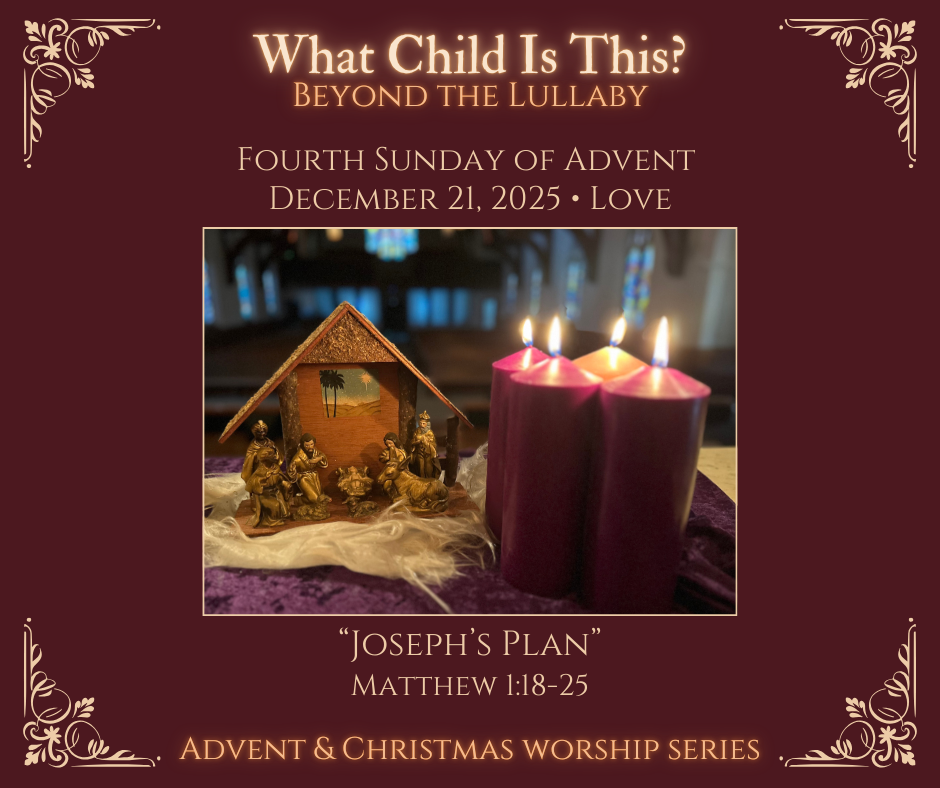
Matthew 1:18-25
18 This is how the birth of Jesus the Messiah came about[a]: His mother Mary was pledged to be married to Joseph, but before they came together, she was found to be pregnant through the Holy Spirit. 19 Because Joseph her husband was faithful to the law, and yet[b] did not want to expose her to public disgrace, he had in mind to divorce her quietly.
20 But after he had considered this, an angel of the Lord appeared to him in a dream and said, “Joseph son of David, do not be afraid to take Mary home as your wife, because what is conceived in her is from the Holy Spirit.21 She will give birth to a son, and you are to give him the name Jesus,[c]because he will save his people from their sins.”
22 All this took place to fulfill what the Lord had said through the prophet:23 “The virgin will conceive and give birth to a son, and they will call him Immanuel”[d] (which means “God with us”).
24 When Joseph woke up, he did what the angel of the Lord had commanded him and took Mary home as his wife. 25 But he did not consummate their marriage until she gave birth to a son. And he gave him the name Jesus.
I’m sure Joseph had plans. Business was good. He had renovated a few kitchens, and his work on the Goldburgs’ new sunroom had generated lots of business. His nest egg was just enough to start a family. Joseph’s family had negotiated a betrothal to a younger woman named Mary. He heard she could be fiery and a little opinionated, but he was OK with that. There are only so many options in Nazareth. So, wedding plans moved forward.
But then Joseph got some troubling news. Mary was pregnant, and he knew he was not the father. I wonder how he heard. Did Mary’s family pass along the news, or did he listen to it by chance at the pub? We don’t know the extent of his disappointment, but we do know he quickly moved to plan B. Joseph was a decent guy, probably realizing that Mary faced more serious consequences than he did. Matthew tells us that Joseph was righteous, which can mean legalistic and unyielding, but I think it just means he was good. If he were legalistic, he could have asked for compensation from the bride’s family, had her charged with adultery, maybe even stoned to death. The keyword about Joseph is that he would quietly divorce Mary so she would not be publicly disgraced. No vengeance, it was just time to move on.
Maybe Joseph was a procrastinator and put the complicated conversation off for a couple of days. Then, at night, an angel visits Joseph in a dream.
Joseph, son of David, do not be afraid to take Mary home as your wife, because what is conceived in her is from the Holy Spirit. 21 She will give birth to a son, and you are to give him the name Jesus,[c] because he will save his people from their sins.”
We are familiar with the story, but it needs some unpacking. The angel is asking Joseph to swallow three humongous leaps in logic. First, Mary is still good wife material. “Your fiancé is pregnant, but don’t be afraid. She really is a good woman.” I wonder if Joseph had a best friend who pulled him aside and said, “Are you sure about her, Joe? Do you want your firstborn to be someone else’s child?”
The next hurdle is the whole “conceived from the Holy Spirit” item. How would Joseph and Jewish culture have understood this Immaculate Conception? They wouldn’t be thinking about the biology. If you said the word “biology” to Joseph, he wouldn’t have understood. It would be 1800 years before biology became a thing, and scientists discovered sperm, eggs, chromosomes, and so on. Joseph certainly knew sex could lead to pregnancy, but the whole process was one big mystery.
There is no mythology of gods having sex with humans in Jewish mythology. The Greek gods were promiscuous, quite often appearing as something else, tricking, seducing, or overpowering women against their will. The offspring possessed divine powers, enabling them to rule. They were called “Sons of God,” which meant they had divine authority to rule over others. These are stories meant to justify power, authority, and domination. But the Gospels give Mary agency. She says, “Let this happen according to your word.” That is what we call consent. To Romans and Greeks, that would be a crazy story. They would say, “When you are a god, you can do what you want. You don’t even have to ask. You just grab them…”
First-century Jews would more likely have focused on the Holy Spirit part than the act of conception. In the Hebrew scriptures, the Holy Spirit is the ruah of God, the breath, the divine wind blowing, which was the active power of God in the world. The ruah blows and separates land from water in Genesis 1. In Genesis 2, ruah is the divine breath breathed into the first human. God’s Spirit enters prophets to speak the truth. What Joseph and the first-century reader heard is that the Spirit was breathing, blowing, working in Mary and this child.
So, quietly—and without spectacle—Joseph chooses Plan C. Unlike Isaiah and Jeremiah, he does not fall down and say he is unworthy. Unlike Moses, he does not say his brother would be better at this kind of thing. He does not wrestle with the angel, as Jacob did. He just acts faithfully.
We know that Joseph has more changes of plans ahead. Plan D involves Caesar’s decree of a census, and he has to travel with pregnant Mary to Bethlehem. Another dream warns Joseph of Herod’s murderous intent. He flees and takes on Plan E. E is for Egypt, where he became a migrant laborer building homes. Through this story, we never hear Joseph speak. We don’t know if he complained, got angry, or felt like giving up. It leaves the impression that Joseph was quietly faithful, acting on divine dreams and faithfully doing his part.
But all of those plans—Plan C, Plan D, Plan E—turn on one decisive moment.
When Joseph takes Mary as his wife and names the child Jesus, he is doing more than accepting a strange explanation or trusting a dream. He is adopting a child who is not biologically his as entirely his own.
Joseph probably loved Mary, but did not simply choose love.
He chooses risky faithfulness. He attaches his name, his reputation, his livelihood, and his future to a child whose story will never quite make sense to others.
That choice almost certainly costs him something—standing in the community, whispered suspicion, maybe even work. This path is neither safe nor sensible. It is the hard one.
And yet, we should not imagine Joseph as grim or joyless. Over time, there must have been moments of pride—teaching Jesus a trade, watching him grow, seeing Jesus grow into a man of faith and courage. The costly path does not erase joy; it deepens it. Last week, I noted that Jesus likely received many of his values from his mother. He also learned something from Joseph: steadfast courage—the willingness to do what is right even in the face of opposition.
This story is how God enters the world: not through certainty or control, but through someone willing to take responsibility for a life they did not plan.
Most of us don’t meet God in our Plan A.
We meet God when something breaks, when the future shifts, when we are asked to carry a responsibility we did not choose and cannot control.
And Advent asks us a quiet but serious question:
When the moment comes, will we walk away—or will we stake our lives on what God is doing, where the ruah Spirit of God blows, even if it costs us something?
Joseph does. And in that moment, his courage quietly becomes the doorway through which God enters the world.
This Advent, God does not ask us to understand everything.
God asks us to pay attention.
To do the next right thing.
To choose the faithful step that makes room for love to take flesh.
That is how God still comes near.
Immanuel—God with us.
Not just then, but now.