
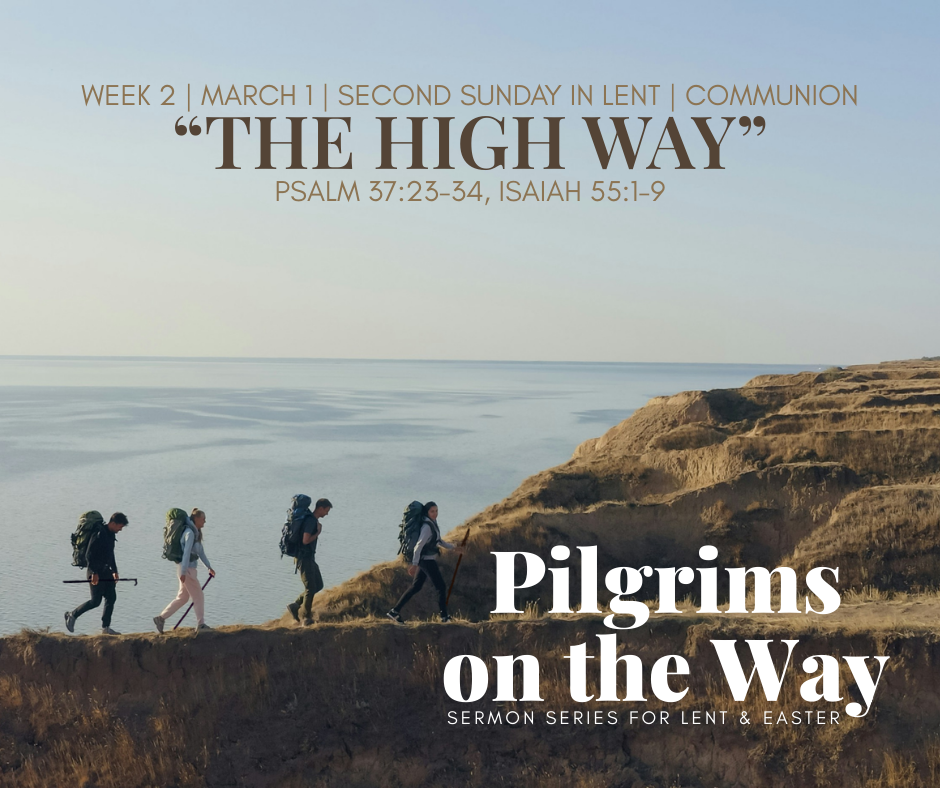
The High Way
What is home after exile?
Ho! Everyone who thirsts;
come to the waters;
and you who have no money,
come, buy and eat!
Come, buy wine and milk
without money and without price.
2 Why do you spend your money for that which is not bread
and your earnings for that which does not satisfy?
Listen carefully to me, and eat what is good,
and delight yourselves in rich food.
3 Incline your ear, and come to me;
listen, so that you may live.
I will make with you an everlasting covenant,
my steadfast, sure love for David.
Isaiah 55: 1-5
Growing up in a small farming town, we rarely shouted to get everyone’s attention. When I moved to Boston for seminary, getting off the Green Line at Park Street Station felt like everyone was shouting for my attention:
Sign this petition to save baby seals.
Can you spare some change?
Hey, Ice Cream!
The Hare Krishnas were chanting. A man in a burnt orange robe pressed a tract into my hand. So many people wanted my attention, I did not know where to focus. As a polite Midwesterner, I wanted to acknowledge everyone, at least with a smile. I soon learned to walk as if I was paying no attention, even as I noticed it all in my peripheral vision. Within weeks I seldom noticed them.
I tell you this moment to explain the first word of Isaiah 55, which is translated “Hear!” but in Hebrew it is “Hoy!” It may be a most ancient expression, meaning listen up, pay attention, miss this at your own risk. Isaiah, the most poetic of the prophets, turns to street vendor language, “Hoy, are you thirsty? Come and drink.” He later comes back to the more lyrical, “Incline your ear to me,” and the more polite “listen to me carefully.” But the first word needs to cut through the cacophony of petitioners, panhandlers and vendors. “Hoy, are you thirsty for something that truly quenches your need? Come here!”
What could be so important that Isaiah, the most poetic of the prophets, abandons his poetry entirely — shouting like a Manchester footballer from Ted Lasso — and then comes back for attention two more times in the next two verses? What is so urgent it requires three attempts to cut through the noise?
This middle section of the Book of Isaiah is known as the Book of Consolation, written to Jews taken captive after the brutal Babylonian conquest. Chapter 40 opens this section, meeting people in exile with the familiar words from our Advent hymn, “Comfort, Comfort, O My People.” It contains the hopeful images of streams in the wilderness, and encourages people to prepare the way, make a highway for God to travel. When people first reach Babylon we hear their despair in the book of Lamentations….In Psalm 137 they sing, “By the waters of Babylon, we lay down and wept for thee Zion.” They felt taunts from the conquerors who shouted, “Where is your God now?” It made them so angry that the song ends with a curse, “May your babies heads be dashed against the rocks.”
The center section of the Book of Consolation assures people that God has not forgotten them. The suffering servant poems tell them that as their wounds heal, they will find new strength and wholeness. These words became essential to the Christian understanding of Jesus’ crucifixion, and remind us that despair and suffering can be faced, endured, and we come out the other side.
Isaiah 55 is the last word to the exiles, and much has changed in the generation since they were forced from their homes. Many of them were born in Babylon, and don’t remember what their parents call home. They have learned to speak Aramaic and Akkadian, and maybe only knew a few words of Hebrew from the Sabbath prayers of their grandparents. They built businesses and homes, some even prospering, marrying Babylonians. Just as they are assimilating, Babylon is collapsing. Like most empires built on conquest and violence, their economy is focused on plunder and corruption. As Cyrus of Persia ascends, Babylon is fighting itself, and collapses without a battle. Cyrus generously offers a chance for exiles to return to Jerusalem.
The prophet’s last words, “Hoy, listen up people,” land at a moment of choice. As the Clash song went, “Should I stay or should I go? If I go it will be trouble. If I stay it could be double.”
Isaiah’s words invite people to come and buy wine and milk, even if they have no money. Think about what that would mean to people who had spent a generation wondering if God was done with them. No Temple. No sacrifice. No way to earn back what was lost. And now this: Come anyway. The table is set. You don’t have to deserve it.
This is not the language of a transaction. It is the language of a homecoming. Exile seems to be over — not because they earned their way back, but because the door is simply open.
After the invite, a question lands: “Why do you spend your money for that which is not bread and your earnings for that which does not satisfy?” That question lands today with the same force. This consumer society promises you things it can’t deliver. No amount of Coach bags, all you can eat buffets, cars turned into living rooms will make you fulfilled. You will just make Jeff Bezos rich. He doesn’t want you to be happy, he hopes you won’t realize that less is more.
Many scholars have interpreted the Book of Consolation as the call to come back to Jerusalem and start again. It is a big ask to encourage people to leave the only home they knew. So how many people actually heard Isaiah’s message and returned to Judah? The best historical accounts estimate about 5 percent. So what do we make of the 95% who stayed? Were they faithless, settling for Babylon’s broken promises when the door home was open?
History suggests otherwise. The greatest flowering of Jewish thought happened not in Jerusalem but in Babylon. The Talmud — the vast ocean of rabbinic wisdom that became the foundation of Jewish life for two thousand years — was compiled there. Judaism was as profoundly shaped in Babylon as anything happening in the land of Israel.
By the time Jesus arrived in Jerusalem 500 years later, he was not a big fan of the Temple priesthood. The people who had made the 900-mile journey home, who had rebuilt the altar and the walls, had slowly accommodated themselves to a new empire — Rome this time instead of Babylon. The Temple had become magnificent and compromised in equal measure. The prophets had warned about exactly this. Micah said it plainly: do justice, love kindness, walk humbly with God. You can do that in Babylon. You can fail to do it in Jerusalem. The city was never the point.
The exiles understood this without knowing it. Jews who stayed near the Tigris in Babylon created a faith adaptable to any river you lived by. Jews who crossed the Jordan back into Israel preserved the relationship to a specific holy place of their ancestors. The real question was never about the final destination. It was whether the walking brought you closer to God.
The Camino de Santiago itself was an adaptation. For centuries, Christians walked to Jerusalem. But when war and politics made that road too dangerous, they did not stop walking. They adapted. They found another way west. They walked to Santiago. The geography changed. The pilgrimage did not. The point was the walking.
And here is where Isaiah presses us. Some went back to Jerusalem. Some stayed in Babylon. But this was not passive. It was not drifting. It was not staying because it was easier or going because it sounded noble. It was a decision.
“Why do you spend your money for that which is not bread?” That is not a gentle question. It is a confrontation. Should I stay or should I go?
Sometimes faith means leaving what is comfortable. Sometimes faith means staying and refusing to assimilate. Sometimes faith means rebuilding something ancient. Sometimes faith means creating something entirely new.
But here is the real danger: Not choosing at all. Drifting. Spending our lives on what does not satisfy. Calling Babylon “home” because it is familiar. The exile does not end just because Cyrus opens the gates. The exile ends when someone decides to walk toward God again.
Lent is not about geography. It is about direction. Where are you headed?
What is forming you? What are you spending your life on? The Camino is not simply a place. It is the next faithful step that costs you something.
And that is the question Isaiah shouts over the noise: Hoy. Not because God is far away and has to strain to reach you. But because Babylon is loud. Empires are designed that way — keep the noise up, keep people consuming, keep them too distracted to hear what their souls are asking for.
We know something about that. It doesn’t take a trip on the Green Line to find the cacophony. It finds us.Lent is the practice of inclining your ear again. Of turning down the noise long enough to hear the voice that has been calling all along. And then — once you hear it — taking the next faithful step toward it.
That is the whole Camino. Listen. Then walk.
Buen Camino.