
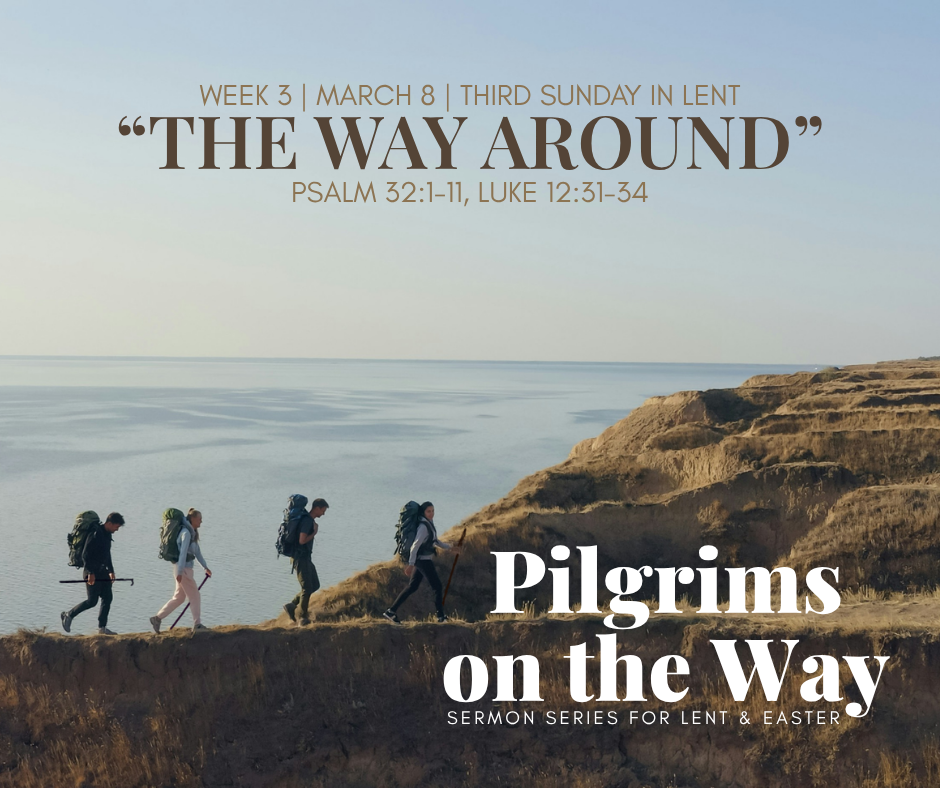
The Way Around
Neglecting the sole ends the journey. Same with the soul.
Blessed is the one whose transgressions are forgiven,
whose sins are covered.
2 Blessed is the one whose sin the Lord does not count against them
and in whose spirit is no deceit.
3 When I kept silent, my bones wasted away through my groaning all day long.
4 For day and night your hand was heavy on me;
my strength was sapped as in the heat of summer.[b]
5 Then I acknowledged my sin to you and did not cover up my iniquity.
I said, “I will confess my transgressions to the Lord.”
And you forgave the guilt of my sin.
6 Therefore let all the faithful pray to you while you may be found;
surely the rising of the mighty waters will not reach them.
7 You are my hiding place; you will protect me from trouble
and surround me with songs of deliverance.
8 I will instruct you and teach you in the way you should go; I will counsel you with my loving eye on you.
9 Do not be like the horse or the mule, which have no understanding
but must be controlled by bit and bridle or they will not come to you.
10 Many are the woes of the wicked, but the Lord’s unfailing love
surrounds the one who trusts in him.
11 Rejoice in the Lord and be glad, you righteous;
sing, all you who are upright in heart!
Psalm 32:1-11
To be a pilgrim on the Camino de Santiago takes a great deal of planning. You might need airline tickets, time off from work, and the right backpack and equipment. You might brush up on your Spanish, think about rainy days, hot days, what you will eat and drink. But one thing matters more than anything else for a safe journey-your feet! Depending on how many detours you take, the Camino is about 700,000 steps. Every step rubs the skin of your soles, and each of the 26 bones in your foot absorbs the shock. You need sturdy hiking boots to clamber over rocks, yet still light enough to not weigh you down. Thick socks help too, but blisters, infections, planter fasciitis, and sore heels bedevil many pilgrims. One trail veteran writes,
Every day, just as soon as I had claimed my bunk, I tended to my feet. I removed my socks, bathed my feet and then applied moisturizer with 4 drops of lavender to guard against infection. I gave my feet a Jin Shin Jiyistu energy point message. I would not have survived without wide medical tape and Compeed to treat the blisters.1
Your feet are where the rubber meet the road. The sole of the foot is the soul of the journey. Walking is the point, after all, the essence of this pilgrimage. Ignore your feet to your peril.
Psalm 32 says the same thing about the soul that Camino pilgrims say about their feet: if you neglect it, the journey eventually stops. If we do not tend the honesty of our soul, it begins to fail us. When we do not fill our souls with goodness, the skin wears thin and blisters form. Each time we look away from suffering and injustice, callouses build on the heart and we lose our sensitivity.
Little compromises make it harder to recognize the larger ones. And one day we wake up and realize we have drifted from the path toward justice and goodness. Not because we took one terrible turn. But because we neglected the soul.
Notice how the Psalm talks about how it feels when we neglect our soul.
When I kept silent,
my bones wasted away
through my groaning all day long.
Here silence means we are failing to communicate. We are holding things in, not truly being honest with ourselves or God. What does it mean for bones to waste away? Without honesty we lose structure. Our bones hold us up. If you can’t stand up for what is just, we say you are spineless. “When I keep silent, my bones waste away.”
We say we feel things in our bones. An elbow aches and we know rain is coming. A book titled “Your Body Keeps the Score” describes how we store our emotional pain in our physical bodies. Our trauma or our shame lodges in places in our bodies, our aching back, or stiff neck. We try to ignore it, but it only gets worse. At some point our body and our soul require our attention.
Imagine taking the same daily care of our soul as the pilgrim takes of their feet. St. Ignatius suggested a daily examine to look back at the previous day. He did not begin with self-criticism. Begin with gratitude. What were the gifts of the day, the moments of beauty and kindness? Soul care begins with love and grace. Then we ask the harder questions. Where did we treat someone unfairly, speak a harsh word? When were we not completely honest? What hard thing needs to be done but we are avoiding it? The final stage is committing to make things right. Who needs an apology? Where am I called to act for justice? What do we need from God to carry this forward?
I do a version of this writing in my journal when I wake in the morning. Putting pen to paper forces honesty. I write in cursive, illegible enough that it could be a secret code, so I can tell it as it is. When I don’t write, I tell myself I’m just busy. But that is a lie. I’m really hiding something from myself and therefore, hiding from God. When I return to my journal, I slowly find my soul again, word by word, like each step of the Camino. Many mornings I realize more good happened that I noticed. The weight of ink makes the gratitude more tangible. I write myself out of the holes my ego dug for me. Often by page two, clarity emerges for the next day. At the end I often feel filled, released, content.
This state is the meaning of opening words of the Psalm:
Happiness comes from having your rebellion taken away, from having your failure completely covered. Happiness comes from YHWH not counting your mistakes, from having nothing to hide.
The Hebrew word gets translated happy or blessed, but it is closer to a feeling of well-being. It is well with my soul. The psychologist Carl Rogers would have called it congruency. What we are showing on the outside is exactly who we are on the inside. The bones of my soul are aligned, as if a chiropractor as set them straight.
The Psalm goes on to warn against letting things slide from well-being. Don’t be like a horse or a mule. (Don’t be an ass!) They are directed by bridal and bit in their mouths. They are guided by external pressures, rather than inward clarity. If we are guided by ego, by fear, by social pressure, we are begin pulled around like a bridle guides the horse.
This psalm sounds great. Who doesn’t want well-being, walking the right path, feet on the ground and well protected on your Camino. But in practice, real honesty is challenging. Integrity and doing the right thing seems simple at the bottom of the mountain, but it gets harder the higher we climb. If we don’t protect our soul daily, it can fail us when we need it most.
We are watching one of the most important morality tales in my lifetime play out with the Epstein files. Most of the focus is on the obvious evil of sex trafficking and taking advantage of young women and girls. Many people started digging for dirt on their political opponents, but what is uncovered is a more comprehensive moral crisis that is far beyond politics. The participants include Republicans, Democrats, businesspeople, diplomats, philanthropists, healers, professors, scientists, even royals.
I listened to an interview of journalist Anand Giridharadas, who wrote the NYT op-ed “How the Elite Behave When No One Is Watching: Inside the Epstein Emails.” The emails reveal a vast network of people trading favors and using each other. Epstein’s network offered access to elite jobs, large scale financing, recognition that could get you published. This scandal isn’t limited to the morally compromised or the politically corrupt. It reaches into places we would never have expected.
A startling name in the files is Noam Chomsky — the philosopher who spent fifty years as America’s most relentless critic of elite power, of the ways the powerful protect their own at the expense of everyone else. He knew. Epstein had already been convicted. And Chomsky kept emailing — not for money or status, but for but to be in the room the intellectual elite. The man who wrote the book on elite moral failure found it irresistible to join them.
What held the network together, Giridharadas says, was solidarity and favor trading that made it too expensive for people to consult their own moralities. When principles conflict with staying in the network, the network wins.
Giridharadas says something I cannot get out of my mind. When Epstein needed to rebuild his reputation after his conviction, he chose people with a particular superpower. He chose people who were good at looking away. This was not their first time. They had looked away from economic inequality, environmental destruction, scapegoating LGBTQ people and immigrants, and from the financial crisis that gutted ordinary families while they collected bonuses. Each time a little easier.
The network wins. The bones go on wasting away. The tragedy Giridharadas describes did not begin with monsters. It began with people who learned to look away. Little compromise by little compromise. Callous by callous, until looking away was simply what you did to stay in the room.
The Psalm invites another path.
I acknowledged my sin to you. I did not hide.
And when we stop hiding from God, we discover what verse 7 has been waiting to tell us all along: You are my hiding place. Not the power network. Not the connection too expensive to lose. God. The one who knows everything about you and calls you beloved anyway. God is the hiding place where our souls are cared for.
Pilgrims know you must tend your feet every day if you want to finish the Camino. The same is true of the soul. Tell the truth. Soften the callouses. And keep walking.
Buen Camino.
Notes
1. From “Walking from Here to There” by Christy Day, p. 25.