
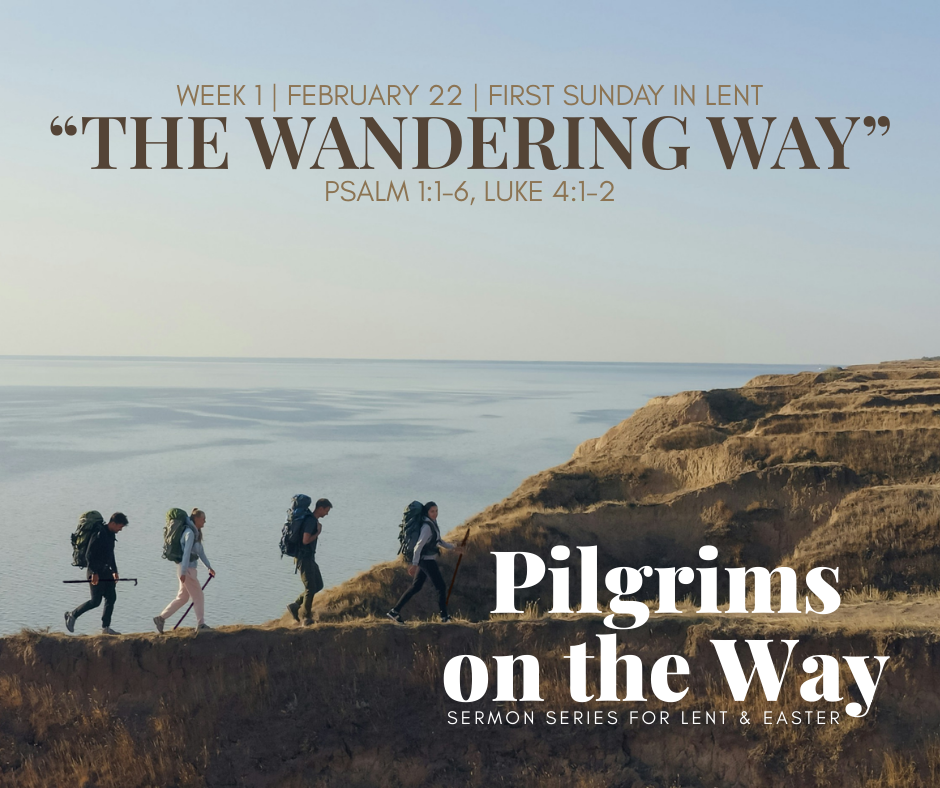
The Wandering Way
Don't be a tourist in your own life.
There is a big difference between being a pilgrim and a tourist. A tourist stands in front of Botticelli’s “Birth of Venus,” and as the goddess of love springs from the sea, they take a selfie while sticking their tongue out sideways. Perhaps it was meant as a critique of the modern eclipse of eros replaced by casual hookups, but more likely it says, “Look where I am!” The world is just a backdrop for curating and promoting the self.Pilgrimage comes from the Latin peregrinus — meaning “one who travels through foreign fields.” The Peregrin Falcon gets its name from this word because it has a vast migration, breeding in the Arctic tundra and wintering as far south as Argentina. A pilgrim travels the unfamiliar and is changed by the experience. This journey can be exciting and terrifying all at the same time. Many in this congregation are “from away.” We moved here as pilgrims to the sea, not because we love lobster rolls, but because we seek something our souls need in this beauty.
What would happen if you made Lent a pilgrimage? What would that look like for you?
Pilgrimage as a spiritual act is as old as organized religion. Evidence shows that people came from all over Britain to Stonehenge. Holy sites were often not just in beautiful places, but thin spaces where geographies collide: mountaintops where rock meets sky, coastlines where water meets earth, islands and places where elements meet. Often, the space was not easy to reach, and getting there was part of the spiritual process. You must climb to Jerusalem, sail to Iona, and walk for 30 days to take the full Camino. In the challenging parts of the journey across Spain, there is little shade, and blisters are nearly universal.
Medieval Christianity had a strong culture of pilgrimage. People traveled to Jerusalem and to sites associated with martyrs and saints. People hoped that if they could walk in the steps of Jesus or Paul, they would discover a deeper faith. Perhaps they could see as the saints see, if they could see what the saints saw.
In the Hebrew tradition, the three great pilgrimage festivals — Passover, Shavuot, and Sukkot — required the journey to Jerusalem. The Psalms of Ascent (120-134) were sung on the road going up to the Temple. Pilgrimage was built into the liturgical calendar as an embodied practice.
When Jesus goes into the wilderness for 40 days, he is embarking on a pilgrimage rooted in Jewish tradition. A thousand years before him, Hebrew slaves escaped into the Sinai wilderness. Jesus 40 days re-enact the 40 years of wanderings, and a journey from captivity to new freedom. We always begin our 40 days of Lent with this text, inviting us to adopt a pilgrim’s mindset, even though we are not leaving the Boothbay Peninsula. We are invited out of our routines into a time of reflection and discernment.
Jesus’ pilgrimage begins with a revelation at his baptism. He emerges from the River Jordan, the heavens open, and he hears a divine blessing, “You are my beloved in whom I am well-pleased.” You might think this great spiritual moment would lead him to begin preaching and gathering disciples for this megachurch. After all, he is the beloved! Instead, Jesus is going off the grid for 40 days, no Instagram or DoorDash. Luke says the Spirit led him in the wilderness, but Mark says the Spirit drove him, forced him to Sinai. Some pilgrimages are chosen and planned because of our longings. But we can be driven into pilgrimage because of illness, cancer, grief, or facing a grave injustice in the world. A collapsing democracy can force a pilgrimage that requires us to reorient our mindset.
If you are going to do something as important as being a messiah, you’d better have your head on straight. Power brings great temptations. You don’t have to believe in a real devil to know that it is true. Jesus faces three great challenges that all leaders must deal with.
Turn stone into bread, focus on material betterment, and physical well-being. Feed 5000 and then set up soup kitchens and food pantries everywhere. But Jesus says, “We don’t live by bread alone, but by every word from God.” We need purpose, hope, and empowerment, not just food.
Prove you are God’s chosen one, and God will protect you if you leap from the Temple. Leaders can get caught up in their own glory. Any of us can get caught up in our ego, our rightness. Then we stop listening and growing.
The third temptation is the most seductive because it wears the face of effectiveness. All the kingdoms of the world — just bow once, just make this one accommodation, just look the other way this time. History is littered with leaders who began with genuine vision and slowly traded it away — a piece at a time, each compromise feeling necessary — until they couldn’t remember what they had originally stood for. The wilderness is where Jesus decides: the kingdom of God cannot be built with the devil’s tools. In the wilderness, Jesus discovered that being the beloved was sufficient. He needed nothing the devil was offering.
Not all of us are driven into the wilderness to face our demons, but we still feel the restless pull to go deeper. My pilgrimage was the chosen kind — no illness, no crisis, no Spirit driving me anywhere: just a sabbatical, a bicycle, and Jeanne. We cycled 275 miles in Assisi and Umbria to visit sites associated with St. Francis. You may think we were taking it easy by cycling, but every Italian town is on a mountain top, so every day ended with crawling up a slope, legs burning to keep the wheels in motion. I recited the Prayer of St. Francis to get through the rough spots. “Lord, make me an instrument of thy peace. Where there is hatred let me sow love…” I had to say the full prayer 23 times to get up to Orvieto.
I chose the Via Francescana because Francis changed the church by renouncing the traditional path to the priesthood. At the height of Vatican wealth and Papal power, he chose simplicity. He literally sought to imitate Christ by selling all he had from a substantial inheritance and giving it to the poor. He crossed social boundaries by tending to lepers, befriending Muslims, and encouraging women like Claire to form her own monastery. Francis was an inspiration to many social justice leaders, including liberation theologians.
I’m not sure what I was looking for in this trip, but the Camino travelers have a saying, “The journey gives you what you need, not what you want.” I thought I needed more courage and boldness as I trained to complete the miles up and down steep hills. But what I discovered is that I needed beauty and joy. Something shifted in me as I pedaled through the vineyards and stood in ancient cathedrals. I learned that dinner was an artistic experience. I became obsessed with different paintings of the Annunciation. Outside of Bevagnia, I understood why Francis preached to the birds and blessed the animals, brother sun and sister moon.
I discovered my spiritual life was impoverished by being too duty-bound, and that I needed more room for wonder and connection with nature. That Sabbatical played an important role in coming to Maine, and a shift to creation spirituality. I went looking for Francis’s boldness and came home with something quieter and more sustaining. I discovered that wonder is itself a form of prayer — a way of loving God through the world God made. On this path, I came to know myself as part of the beloved creation.
Lent is more than giving something up or reflecting on sins and shortcomings. It is about going somewhere — even if you never leave wherever you live. These forty days are an invitation to become a pilgrim rather than a tourist in your own life. To stop curating a life for others to see and start wondering. To let something look back at you and ask the question you’ve been avoiding. The journey will show you what you need, something you may not have known you wanted. And what you may discover — as Jesus discovered in the wilderness, as Francis discovered in the ruins of San Damiano, as I discovered somewhere between Assisi and Orvieto — is that you are already the beloved. You need nothing the world is offering to prove it. The road is open.
Buen Camino. Good journey.