
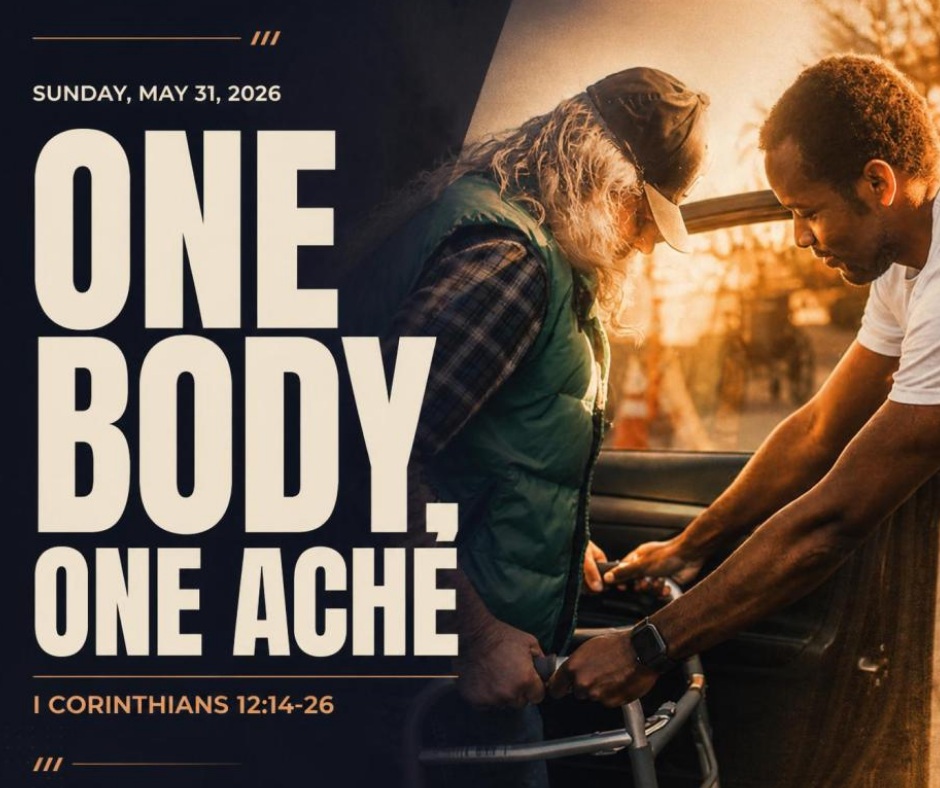
One Body, One Ache
Why We Need the Whole Flock
I Corinthians 12:14-26
14 Even so the body is not made up of one part but of many.
15 Now if the foot should say, “Because I am not a hand, I do not belong to the body,” it would not for that reason stop being part of the body. 16 And if the ear should say, “Because I am not an eye, I do not belong to the body,” it would not for that reason stop being part of the body. 17 If the whole body were an eye, where would the sense of hearing be? If the whole body were an ear, where would the sense of smell be? 18 But in fact God has placedthe parts in the body, every one of them, just as he wanted them to be. 19 If they were all one part, where would the body be? 20 As it is, there are many parts, but one body.
21 The eye cannot say to the hand, “I don’t need you!” And the head cannot say to the feet, “I don’t need you!” 22 On the contrary, those parts of the body that seem to be weaker are indispensable, 23 and the parts that we think are less honorable we treat with special honor. And the parts that are unpresentable are treated with special modesty, 24 while our presentable parts need no special treatment. But God has put the body together, giving greater honor to the parts that lacked it, 25 so that there should be no division in the body, but that its parts should have equal concern for each other. 26 If one part suffers, every part suffers with it; if one part is honored, every part rejoices with it.
Paul was distressed about the news from Corinth. The church he founded with so much promise was breaking into factions, fighting ego battles and having bitter theological arguments. Can you eat meat sacrificed to idols? (You know, normal church parking lot conversation!)
I imagine him twirling his stylus, splashing ink on his tunic. “What am I going to tell the Corinthians? I must calm down the hotheads and bring people together again. What I need is a good metaphor for how they should act, something everyone can understand. How about the church is like a loaf of bread. You must let it rise or it comes out flat like a falafel. No, that’s not right. Or it’s like herding cats.” None of the metaphors are working until Paul is rudely interrupted by a sharp pain in his stomach that doubles him over, breathless.
“There is my thorn in the flesh again. Anxiety gets me every time.” And then the idea hits him. The church is like a pain. No, like a body. If the stomach suffers, everyone suffers. When the stomach says “Ouch!” the whole body has a problem. Each part needs the other in the body of Christ.
The body is a brilliant illustration, because we all have one. There are parts of my body I like. I especially like my fingers and hands. I enjoy feeling textures, writing with a pen, gesturing to make a point. However, my digestive tract has tried to kill me at least three times. As I age, I’m much more aware of the complex interactions of my body. I take a daily pill to regulate my blood pressure. I need monthly B-12 injections because I don’t absorb it well. My nerve endings don’t like the needle stabbing my stomach and shout “no” each time. But I tell them it’s good for me, so just relax.
The worst thing I can do with my body is to ignore the cranky part, the small ache. I might ignore that rumble in my stomach, the first sign of physical stress. I don’t want to slow down. But the stomach will continue until it has my full attention as I lie in bed with a heating bad for relief. Paul is telling us the church it is like the body. If you ignore the ache, the grief, the steady person who is burning out, the simmering conflict; it rarely dissipates on its own. The grows until it has everyone’s attention. You must respect what each part is telling you. It’s all a delicate, shifting balance of each learning to live together.
Paul’s first major point to the Corinthians is they are all interconnected, whether they like it or not. Church is a place where we honor the importance of all the parts, all the people. In modern language, Paul was explaining systems theory. All living things are part of a system, interconnected and affecting each other. Our bodies survive by the complexity of eleven different systems. We are not just brain, bone and muscle. We have a cardio system to transport oxygen to cells. It needs the respiratory system to breath. Which needs the muscular system, supported by the skeletal system. You are all very complicated! And so is church. We exist in a wonderous yet delicate balance.
Next Paul addresses the importance of our differences. Unity is not based on sameness. Don’t fall too much in love with orthodoxy. Paul said the whole body can’t be the eye. That would be a bizarre existence, to perceive everything but not be able to touch, or move or act. Paul’s choice of the eye wasn’t random. Greek philosophy of the day ranked sight as the highest sense because it was associated with the intellect. We need people with great insight, but what happens when everyone thinks they are the ones who see truly? If you have sat through a faculty meeting, you may know how things can bog down with a room full of intellects. The eyes need some hands and feet.
Or perhaps everyone being an eye was more about over-observation, as in “I’ve got my eye on you.” Was Paul urging people to stop watching what everyone else is doing? Social science has noted the observer effect. When we know someone is watching, we change our behavior and are more likely to conform to other peoples’ expectations. In The Lord of the Rings, evil is embodied by the Eye of Sauron atop Mount Doom, watching what everyone is doing to make sure they are all obedient.
Paul warns of imposing sameness through prying eyes, of wanting everyone in church to be just like us. Too much sameness isn’t healthy. In nature, a monoculture is vulnerable. A forest with only one species of tree is not a forest — it is a crop waiting for the wrong virus. But a forest with oak and pine and birch and alder, with understory ferns and mosses, with fungi threading through the soil connecting root to root — that forest can withstand drought, disease, and storm in ways no monoculture ever could. The diversity is not decorative. It is the source of the resilience.
Church becomes monoculture if questions and new ideas are discouraged. If a church only allows one view of God, one theology, one political point of view, one generation’s experience, it’s like trying to form a body out of just one part. It will lose all balance, stagnate and eventually die.
Paul is making a profound argument about diversity. He isn’t simply saying everyone belongs, so welcome everyone because it is the right thing to do, the nice thing to do. Paul is stating that interconnected diversity is the way God intended the world to be. It is not a concession. It is not a problem to be managed. Multiplicity is designed to make the structure of existence strong, flexible and beautiful. We are better off together than we are alone, despite all the challenges of being in community.
Research published in Science Magazine found that a flock of 25 birds flying in V formation can travel 70% farther on the same energy than a bird flying alone. Together they can reach somewhere none of them could reach solo. In 2001 researchers fitted pelicans with heart rate monitors (now there is an interesting job!) and found birds flying in formation had measurably lower heart rates. They were less stressed, less strained, carrying less of the journey alone.
I imagine some of those pelicans didn’t like each other. They don’t fly in the V because they have perfect harmony and no conflicts. Pelicans are territorial about their nesting grounds. They joust at each other with their beaks. Some pelicans steal fish right out of their neighbor’s pouch. But somehow, they find a way to deal with their conflict because they are stronger together than they are alone. They need each other. Paul was trying to tell the Corinthians: flying together is better than flying solo.
Paul pushes this one step further, noting that the parts that seem weakest are most necessary. The English translation says they are indispensable, but the Greek word is anankaia, it means the load bearing, essential thing. He is making a systems claim. The members the Corinthians had been overlooking are the ones you cannot survive without.
In my first church, a man named Scott was that kind of person. Scott had been a medical student when he had a serious motorcycle accident and brain injury. It took him years to retrain his brain and body to walk with a stagger and speak in a halting way. He insisted on being an usher, and every offering was an adventure. He might spill coins on the floor or look like he was about to fall. It took longer when Scott was ushering. But he was infallibly positive and determined. Scott taught the congregation more about grace, perseverance and service than any sermon I could possibly write. In his weakness, he was a load bearing wall.
At our recent retreat I asked everyone what part of the body of Christ they were? We had some hands and feet who like to get things done, some Befrienders who are ears, vocal chords for the choir. What part do you think you are? I have given this some thought. I played with being the listening ear but settled with the thyroid. I regulate the church’s metabolic rate, managing where energy needs to flow. Noticing where energy gets stuck, and where it is overflowing to exhaustion.
What part of the body are you? If you are not sure, what part would you like to be? We are one body, part of the V. What one member carries, all of us carry whether we know it or not. The ache travels. So does the joy. So does the healing.
You came in here today carrying something. Maybe an ache you have not named yet. You did not bring it into an empty room. You brought it into a body. And this body — complicated, conflicted, irreplaceable in every part — is made to carry it with you.