
Part I: Summer Sermon Series
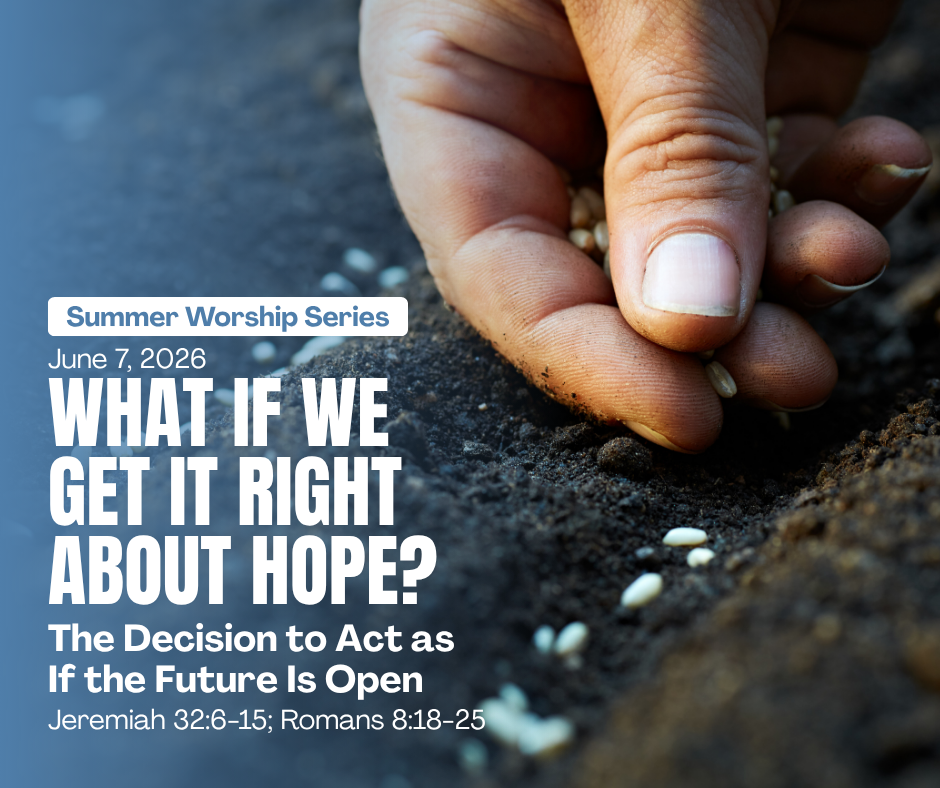
What If We Get It Right About Hope?
The Decision to Act as if the Future is Open
Houses, fields and vineyards will again be bought in this land.
Jeremiah 32 :15
22 We know that the whole creation has been groaning as in the pains of childbirth right up to the present time. 23 Not only so, but we ourselves, who have the firstfruits of the Spirit, groan inwardly as we wait eagerly for our adoption to sonship, the redemption of our bodies. 24 For in this hope we were saved. But hope that is seen is no hope at all. Who hopes for what they already have? 25 But if we hope for what we do not yet have, we wait for it patiently.
Romans 8:22-25
Are you a glass half-full or half-empty person?
My outlook is generally hopeful. Ask me whether the glass is half empty or half full, and I’ll tell you I don’t care how much water is in it — half full or bone dry, there must be some way to fill it to the top. Jeanne will confirm that my go-to phrase whenever we face a challenge is, “We’ll figure it out.” Early in our marriage she thought it might be a stalling tactic, a way of saying “everything is going to be OK.” Clearly, everything is not going to be OK. But by now she knows that “figuring it out” is just my nature. I got a pencil in third-grade Sunday School that read, “I can do all things through Christ who strengthens me” (Philippians 4:13), and it stuck.
That outlook carried me through 9/11 in New York, through COVID, and through living with a chronic illness. No matter how low the water gets, there must be a way to fill it back up. But lately I’ve begun to question my own hopefulness. It isn’t one thing: it’s the pile-up. I count the new dead trees on my hikes and watch the slow destruction of climate change. I look at my checking account and feel like I got mugged at the grocery store. Posts show up on my feed that aren’t just false, but cruel. It’s that rising justification of cruelty toward one another that troubles me most. For the first time, I can’t simply say, “We’ll figure it out.” I’m no longer sure.
I recently read a book that names the mood I’ve been feeling in a single word. Don’t be distracted that the word isn’t PG-13. Cory Doctorow calls it “enshittification.” You might say it isn’t a real word, but it was the American Dialect Society’s word of the year for 2023. Doctorow focuses on how our digital platforms; Facebook, Twitter, shopping on Amazon; slowly degrade as they squeeze more money and data out of us. Facebook once offered connection to family and friends and a window onto the world. I used to love it. Now it’s mostly scam ads and inflammatory politics. And it’s harder to find your friends, unless your friends happen to be rude internet trolls.
Even if you’ve quit these platforms, we’re all living with algorithms that reward the extremes. Disinformation makes it harder to tell what’s true, and it has shattered our common life into vitriol. It’s a close cousin of a KGB technique called “flooding the zone.” Pour so much disinformation and conspiracy into the public square that no one can tell what’s true anymore. And that leads, finally, to apathy. People get used to evil and injustice and stop acting, because the good gets so covered in muck that it can no longer be seen or believed.
Let me pause before you reach for your blood-pressure medication. I promise this is a sermon about hope. But hope must be more than blind trust that everything will be fine. Hope is not “Don’t worry, be happy.” Real hope passes through a crucible; it looks into the abyss and still reaches for something better. As James Baldwin said, “Not everything that is faced can be changed, but nothing can be changed until it is faced.” These past months have tested my natural optimism, and now it’s work to hope. I’ll tell you how I found my way back — but first, we need the prophet, Jeremiah.
Jeremiah was the original prophet of doom. For forty years he was a thorn in the side of Israel’s rulers, calling out idolatry, corruption, and the oppression of poor people. His name even gave us the English word “jeremiad,” a prolonged denunciation and lament. If you asked him about the glass, he’d say the water is so polluted you can’t drink it, so it doesn’t matter how full it is. Jeremiah is my personality opposite, but I took a class on him anyway, from Dr. Bill Holladay, who wrote the twenty-pound Jeremiah commentary and seemed depressed about it. He often wandered into the mailroom where I worked and delivered jeremiads while we listened to the Iran-Contra hearings.
Near the end of Jeremiah’s career, the Babylonian superpower was overrunning Israel. He told Jerusalem to surrender and beg for mercy, because the city was doomed. By chapter 32, that truth-telling has landed him in prison for disturbing the peace and treason. And that is where something astonishing happens. God gives him a strange instruction: buy your cousin Hanamel’s field. It’s a redemption purchase. When a relative had to sell land in hard times, the next of kin had first right to keep it in the family. But here’s the kicker: the field is already behind enemy lines, and Jerusalem is under its final siege. The land will be worthless to Jeremiah the moment Babylon takes the city.
This is not Warren Buffett buying at the bottom of the market. It is a prophetic act of consolation. It’s a stunning development when the doomsday prophet offers a sign of hope at the very worst moment. Jeremiah knew what was coming — the sacking of the city, the exile, the whole catastrophe. You’d expect him to say, “I told you so.” Instead, he says, “Houses and fields and vineyards will yet again be bought in this land.” He can’t spare them the reckoning, but he promises that beyond it there will be restoration. God’s Spirit is still at work to bring life even after we have failed.
Jeremiah’s story grips me because I fear our own world is edging towards doom. I don’t know how close we are. But we’ve spent years denying the evidence of climate change even as the forests burn and the Gulf of Mexico reaches 100 degrees. Jeremiah told the truth as best he could, and they would not listen — yet he refused to leave them to their despair. That is the move I keep coming back to.
I’m noticing a shift in how climate activists talk about the future. For years they used the Jeremiah strategy — pronounce doom, show the floods and the famine, scare people into changing. It hasn’t worked fast enough. Doom drives many people into denial. So, they’re changing tactics and turning to hope. Not optimistic hope, not “technology will save us,” not even “God will save us.” It’s the last-ditch hope of a band of rebels holding out against an Empire that outguns them — but you never know. It’s what Paul meant when he wrote that we hope for what we cannot see: hope grounded not in the evidence, but in a conviction of what is right to do. And here’s what turned me around: hope is what lets you see what isn’t being seen. The good is still there. It’s just buried under the muck.
That’s where Ayana Johnson’s question lands, “What if we get it right? As a marine biologist, she knows all the grim data, just as Jeremiah knew his. But she also knows hundreds of creative people who still believe we can make it and want to give it their best shot. Hope is how you gather the people and the energy you need.
So, I started looking. I now read three blogs that tell the climate story the mainstream misses. My favorite is, “Your Daily Dose of Climate Hope.” Here’s something you probably haven’t heard, because good news doesn’t trend. With oil supplies choked off at the Strait of Hormuz, the world sees how fragile it is to depend on fuel from a handful of volatile places. Countries that don’t want to be held hostage are rapidly transforming their energy structure. South Korea now requires every parking lot larger than a thousand square meters to put solar panels over the top. It has chosen 500 rural communities, places like ours here in Maine, to go fully renewable in two years. What if we did that in the Boothbay region, and made all our own power right here? What if we get it right?
Jeremiah didn’t just feel hopeful. He bought a field. He weighed out the silver, signed the deed, and sealed it in a jar for a day he’d never live to see — because he could see what no one else could: that houses and fields and vineyards would be bought in the land again. That’s not optimism. That’s hope.
I still say, “We’ll figure it out,” but it means something harder now. I mean the future is still open, and what we do still matters, even when we can’t see how it ends. There’s a field to buy. Maybe ours has biodiversity-friendly solar panels on it. Hope is not believing that everything will be OK. Hope is believing that God is not finished.
So, when the world says, “It’s over,” buy the field.
When cynicism says, “Why bother?” buy the field.
When fear says, “Nothing can change,” buy the field.
Because houses and fields and vineyards will yet again be bought in this land. So, let’s figure it out. And one day, long after we’re gone, someone will gather a harvest from seeds we never saw bloom.