
Part II: Summer Sermon Series
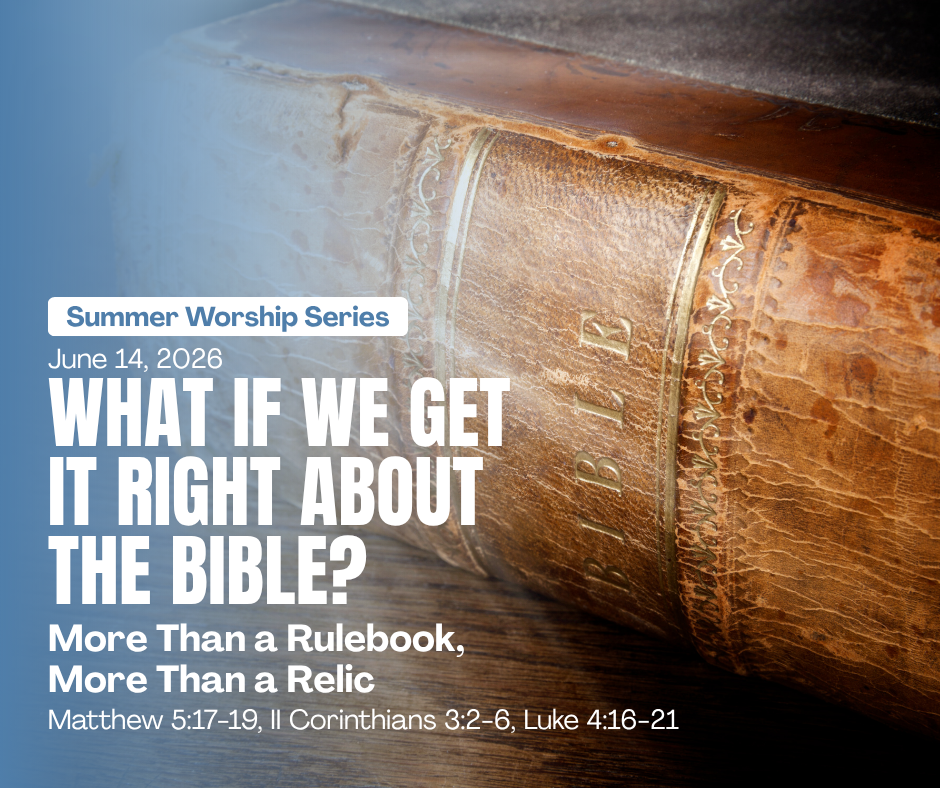
What If We Get It Right About the Bible?
More Than a Rulebook, More Than a Relic
17 “Do not think that I have come to abolish the Law or the Prophets; I have come not to abolish but to fulfill. 18 For truly I tell you, until heaven and earth pass away, not one letter,[a] not one stroke of a letter, will pass from the law until all is accomplished. 19 Therefore, whoever breaks[b] one of the least of these commandments and teaches others to do the same will be called least in the kingdom of heaven, but whoever does them and teaches them will be called great in the kingdom of heaven.
Matthew 5:17-19
15 He began to teach in their synagogues and was praised by everyone. 16 When he came to Nazareth, where he had been brought up, he went to the synagogue on the Sabbath day, as was his custom. He stood up to read, 17 and the scroll of the prophet Isaiah was given to him. He unrolled the scroll and found the place where it was written:
18
“The Spirit of the Lord is upon me,
because he has anointed me
to bring good news to the poor.
He has sent me to proclaim release to the captives
and recovery of sight to the blind,
to set free those who are oppressed,
19
to proclaim the year of the Lord’s favor.”
20 And he rolled up the scroll, gave it back to the attendant, and sat down. The eyes of all in the synagogue were fixed on him. 21 Then he began to say to them, “Today this scripture has been fulfilled in your hearing.”
Luke 4:15-21
I grew up in a Bible culture. We had a Bible Recognition Sunday, when everyone who read one of the Testaments got a pin. Miss Mitchell, my second-grade teacher, to whom I credit all my academic success, read the whole Bible every year-even Leviticus, the begats, and the beasts of Revelation. In 4th grade Sunday School, we received prizes for memorizing scripture. I loved prizes, so I got my bookmark and went to work.
After doing the standard 10 Commandments, 23rd Psalm and Beatitudes, I branched out. They were expecting us to recite the Apostle Paul’s greatest hits, and I would recite Solomon telling his lover she had a lovely neck, white teeth, and breasts like gazelles. I found Psalm 137 fascinating, as Jews lamented being captives, weeping by the waters of Babylon. They lashed out at their conquerors with the curse, “May your babies heads be dashed against the rocks!” My teachers thought I was mischievous, maybe even demon possessed. But Pastor Roy had the wisdom to see a budding theologian and encouraged me forward. But he struggled when I told my Baptism class, I was a conscientious objector to war after reading the Sermon on the Mount and love your enemies.
Some of my motives were the juvenile joy of poking the grown-up bear to watch it growl. But I was also asking them to help me understand this profound and strange book. I wanted to get it right. This book that taught me the nine fruits of the Spirit – love, joy, peace, kindness, gentleness, faithfulness and self-control (oh, and I always forget patience). But the Bible also valorized Jeal seducing and killing a rival general by driving a tent-peg through his head. This book is truly explosive. It can turn you into Gandhi or a mass murdering dictator for Jesus, depending on how you read it.
I am deeply concerned that people see what they want to see in the Bible, using it more like a weapon than a source for wisdom. I left the Baptists in seminary because they used the Bible too much like a literal rule book. All you had to do is find the right quote for the right moment. If you were discouraged, you read Isaiah 40:31 about eagle’s wings. Leviticus and Paul told you everything you need to know about homosexuality. Paul also had a lot to say about how women should act (and they clearly should not bring tent pegs to church!) The approach works until it doesn’t, because you can justify anything; slavery, sexism, or locking up immigrants in inhumane detention camps; with a cherry-picked quote. (I always wonder why people want to put the 10 Commandment up in schools, but not the Great Commandment to love one another.)
I still carry three life lessons from these formative early years. First, scripture is my foundation and central to my values. Second, what I gain from scripture isn’t just about knowing the truth, it is being in relationship with the living God. Third, like Jacob wrestling with the angel, we often must grapple with the text to find the blessing.
That third point led me to seminary. I loved the freedom to ask questions and propose alternative interpretations. I found people much more critical than I was, challenging the cultural and social bias of some biblical texts. We should not be throwing Hagar and her son out into the wilderness when it suits us, like Abraham and Sarah did. Paul was culturally biased to bar women from speaking in church. We have moved on from biblical justifications for slavery (haven’t we?!)
But then I met the opposite problem. If the Bible has parts that are biased, sexist, racist or homophobic, then what good is it? Some think it is a relic unworthy of building a religion. I received a solid paragraph of red ink on a paper I wrote for having a pre-critical understanding of the scripture because I believed that the Holy Spirit spoke in and through the text. I was flabbergasted since I was the one who wasn’t afraid to recite the baby’s heads being dashed against the rocks in 4thgrade.
Too often in Mainline Protestantism, we use the Bible like Goodreads. We look for the good parts, just what we want to read. But we don’t spend the time devotionally to search for the God, even as we hang banners that say, “God is still speaking.” I love the United Church of Christ, and the freedom and values we have, but at the end of the day, Jesus is my path, and I learn about him in the Bible. I’ve learned much about the inward life from mindful meditation and Buddhism, and nature and science open new wonders to explore, but I’m still a disciple of Jesus, and if we lose that grounding, are we still church?
So, how do I handle the violent, bloody passages in the Bible? My answer is that I see the blind spots in the Bible, because the Bible itself has taught me to notice them. I see the calls to battle in the Old Testament through the eyes of Jesus who said to love even your enemies. I note Paul’s sexist bias, but that he also said in Christ there is neither male nor female. He also acknowledged women played prominent roles in the New Testament, which was unprecedented in ancient Middle Eastern literature. I read it all through the eyes of the Greatest Commandment to love my neighbor. Anything that contradicts that needs wrestling and challenge. Indeed, the Bible wrestles with itself, and therefore we can too. And I would much rather believe in a truth full of wrestling than one that has all the answers and then oppresses anyone who disagree.
I picked two texts that each help me understand how we approach scripture, so I will make brief comments about each. In the first reading from Matthew 5, Jesus says, “Do not think that I have come to abolish the Law or the Prophets; I have not come to abolish them but to fulfill them.” There is a subtly subversive idea in what Jesus is saying. By naming law andprophets, Jesus is including those who critiqued the status quo interpretations of the faith. The Sadducees who controlled the Sanhedrin Council at the Jerusalem Temple only counted the first five books, Genesis through Deuteronomy, as scripture. For them it is all about the law. Jesus is putting Isaiah, Jeremiah and Amos, those who provoked kings and priests, on the same standing as the laws of Moses.
In the final text, Jesus is reading scripture in his hometown. He reads the inspiring section from Isaiah about the Jubilee, where all are set free from what limits and oppresses them. Then he rolls up the scroll and says, “Today this is fulfilled in your hearing.” The key word here is today. When Luke wants to make it clear that God is present and active, he begins with “today:”
· To the shepherds on Christmas day-Today, is born to you a savior.
· To Zacchaeus when he renounces his wealth-Today, salvation has come to this house.
· When a thief on a cross asks to be with Jesus in his kingdom-Today you will be with me in paradise.
To his hometown, Jesus tells them the words of the ancient scripture are happening right now, bringing justice, healing, shalom and joy. Every time we hear the scriptures read and preached, we need to put a today in front of it. These words are not coming from the past but still speaking in our presence. When we read and hear the texts, our work is to invite it to live within us. As Paul told the Corinthians, you are the living text of Christ in the world.
I often find this to be true in my own devotions and sermon preparations. When I hear Moses’s complaints that he is not a good enough speaker, who is he to go to Pharoah, or that even his own people don’t listen to him; I hear my own complaints to God and ask for courage.
I see my rash decisions in the prodigal son, and my envy in the older brother. I hope I can rise to occasion of the father’s generous spirit towards both.
When I am overwhelmed by terrible events in the world, I turn to Psalm 46, and the words “Be still and know that I am God.”
And when death is near, I take comfort in that I will fear no evil, even in the valley of the shadow of death.
These are living words. And they are not only mine — they are yours. The same Spirit that lifted Isaiah off the scroll in Nazareth is loose in this room, ready to make the old words speak today, in your hearing. So don’t shelve this book, and don’t swing it like a weapon. Open it. Wrestle it. Let it live. What if we got that right?