
God Is Still Speaking
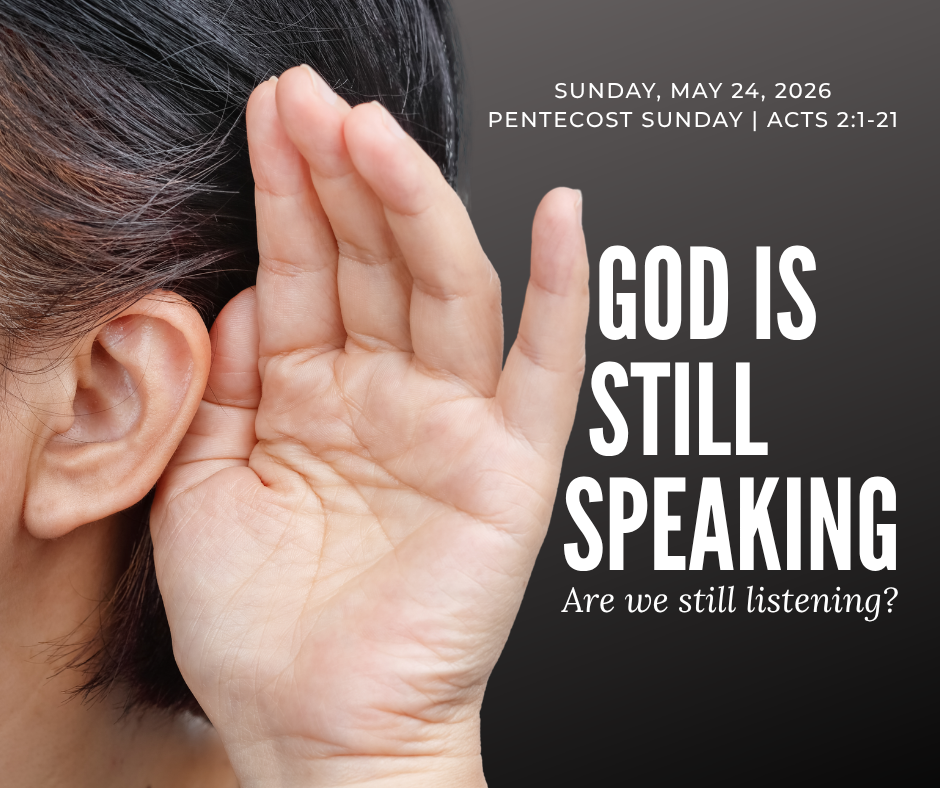
Are we still listening?
Acts 2:1-13
When the day of Pentecost came, they were all together in one place.2 Suddenly a sound like the blowing of a violent wind came from heaven and filled the whole house where they were sitting. 3 They saw what seemed to be tongues of fire that separated and came to rest on each of them. 4 All of them were filled with the Holy Spirit and began to speak in other tongues[a] as the Spirit enabled them.
5 Now there were staying in Jerusalem God-fearing Jews from every nation under heaven. 6 When they heard this sound, a crowd came together in bewilderment, because each one heard their own language being spoken.7 Utterly amazed, they asked: “Aren’t all these who are speaking Galileans?8 Then how is it that each of us hears them in our native language?9 Parthians, Medes and Elamites; residents of Mesopotamia, Judea and Cappadocia, Pontus and Asia,[b] 10 Phrygia and Pamphylia, Egypt and the parts of Libya near Cyrene; visitors from Rome 11 (both Jews and converts to Judaism); Cretans and Arabs—we hear them declaring the wonders of God in our own tongues!” 12 Amazed and perplexed, they asked one another, “What does this mean?”
13 Some, however, made fun of them and said, “They have had too much wine.”
God is still speaking. For over a decade this has been our “branding” statement for the United Church of Christ. It is more than marketing; it is a core theological conviction. It means we do not believe that God said everything that needed to be said in the first century, put it all in one book and then decided to focus on the Dagoba star system. We can’t just memorize the 10 Commandments and think we have wrapped up all we need to know. As William Sloan Coffin put it, too many people use the Bible like a drunk uses a light post – more for support than for illumination. God is still speaking means there are still burning bushes to see, still small voices to hear, somewhere there is another Isaiah whose lips have been touched by a burning coal, who is ready to say, “Here I am, send me.” The Spirit of Moses lives on in the spirit of Martin, and someone new will go to the mountain top.
The early Puritans who set out on the Mayflower could not have imagined our issues – like global climate change, privacy issues on the internet, inclusion of various sexual identities into the church. But their pastor, John Robinson said to them as they boarded that ship from one world to another, “There is yet more light and truth to break forth from God’s Holy Word.” Those words are a theological vessel that allows us to travel across time, blown by the winds of the spirit. We can adapt and change and love as God intends.
God is still speaking is a very Pentecostal statement. When you think about the word Pentecostal, what comes to mind? Speaking in tongues, rock bands and lots of hands in the air. I worshiped with charismatics in college, and it was fun, but my path to God runs a little more like Quakers. Quakers have put more emphasis on listening for God than speaking about God. If we truly believe in a still speaking God, paying attention and listening must be a spiritual practice.
Listening is a part of the Pentecost story where we don’t focus. While the disciples were busy speaking, the crowd was just as surprised that they could hear in their own language. The original Greek says they heard in their own dialects. (The Spirit could speak English in Boston, Minnesota or Texas!) Verses 7-8 tell us:
Amazed and astonished, they asked, “Are not all these who are speaking Galileans? 8 And how is it that we hear, each of us, in our own native language?
Great question! How do we hear each other? Galileans communicating and Medes, Parthians, Libyans and Cappadocians can all hear. Google these places and you will see it is the expanse of the ancient Roman world. We might ask -How can Christians, Muslims and Jews hear each other? How can Democrats and Republicans, no wait, how can Democrats and Democrats, or Republicans and Republicans hear each other? How can parents and children hear each other, spouses hear what the other really means? We are speaking the same language, but that doesn’t mean we can hear each other.
I was taught to listen all wrong. As a white male with many privileges and a graduate education, I learned to listen for information so I could come up with good ideas, my ideas, for better ways to live and do things. That is not so terrible, though it did condition me to fix people. I was not taught to ask if people wanted to be fixed. It turns out many people don’t! I was certainly not taught to help people find their own answers. Now I know, though I am still a recovering fixer. Any other “recovering fixers” out there? We need our own support group. Let’s look more deeply at the Pentecost crowd and see what we can learn. Verses 12-13 ask the question again:
12 All were amazed and perplexed, saying to one another, “What does this mean?” 13 But others sneered and said, “They are filled with new wine.”
Beware of the first person who answers a question. Occasionally the first answer is the best answer, but often it is an anxious extrovert who says the first thing that pops into their heads. At Pentecost, someone quickly decide everyone is drunk. We all think we understand each other when we are intoxicated. It’s good to step back and breathe a little before answering. A good guideline is the acronym WAIT, W-A-I-T, Why Am I Talking? Think how the world would change if we all asked “Why am I talking?” before we spoke. Fewer apologies are necessary. Boring meetings can move more fluidly. The quiet but creative thinkers can emerge.
In the confusion of the Pentecost moment, Peter jumps in and quotes from the prophet Joel:
God declares,
that I will pour out my Spirit upon all flesh,
and your sons and your daughters shall prophesy,
and your young men shall see visions,
and your old men shall dream dreams.
Even upon my slaves, both men and women,
in those days I will pour out my Spirit;
and they shall prophesy.
To whom does God speak? It doesn’t say God only speaks to experts, clergy, theologians, or only people who have been church members for at least 20 years. All gender identities, all generations, all socio-economic levels. If this is true, then the church must be a place where all voices are given a seat at the table. Who knew that the Bible was postmodern even before the modern world was invented? Postmodernism holds that all voices have validity and equal privilege, not just white male or wealthy voices. What postmodernism hasn’t figured out is the listening side of things. This is where the church can find new relevance. What if we define ourselves as a people who can listen intently, a place that is a container for many voices to speak, that we are a people who know how to listen and discern, a people that don’t always say, “Thus sayeth the Lord” but a people who listen to understand how God might be speaking through another, even someone whom we struggle with. A church where everyone agrees isn’t very interesting. (It might be a cult!) A church that deeply listens will be a place of transformation.
My coaching training has been a laboratory for learning to listen. The first assumption we were taught is that every person is whole and complete, and has the possibility of transformation within them. Using biblical language, everyone is created in the image of God, and therefore emits God in some way. Here is the second thing I learned. A good coach almost never, never ever gives advice. Even good advice can be a bad thing when it short-circuits someone’s process. Do you know how hard it is to have someone seek your help and then not give them advice? All you can do is mirror what you are hearing or ask questions. Be honest, could you do it? At first, I felt like I was failing people. But I am coming to realize that real change happens more from listening, and it is a relief to not feel like I must have all the answers.
My first coaching client opened a session with a story about a great sermon she preached to a clergy gathering. Afterwards, a man said to her, “That was a great sermon, but you need to learn to modulate your voice. It’s too high pitched. Then people will take you seriously.” She asked me what I thought of the advice. I was tempted to jump in, but held back, instead saying, “Tell me how this landed in your gut.” She debated whether this advice was pragmatic to be relevant in a male dominated world or condescending and sexist. Then she blurted out, “My mother would have given me the same advice. Be pragmatic like Hillary Clinton, and look where that got us. I am a fiery 5’2” redhead with a high-pitched voice, I am not going to freaking modulate my voice!”
That moment — her anger, her clarity, her refusal — that was the Holy Spirit. Not a gentle dove descending, but a fiery 5’2” woman who knew her own voice. Joel said daughters would prophesy, not modulate. I just witnessed it. She didn’t need my advice. She needed someone to get out of the way and listen.
And that is what sacred listening looks like — one person, fully present, getting out of the way so another can find what God has already placed within them. Try it this week. Before diving into your opinion (which I’m sure is profound), try asking a question first.
That is the church I want us to be. Not the place with all the answers, but the place where people discover they already carry something holy. God is still speaking. The challenge is whether we are still enough, humble enough, present enough to hear.