
Stop looking up for the Kingdom of Heaven
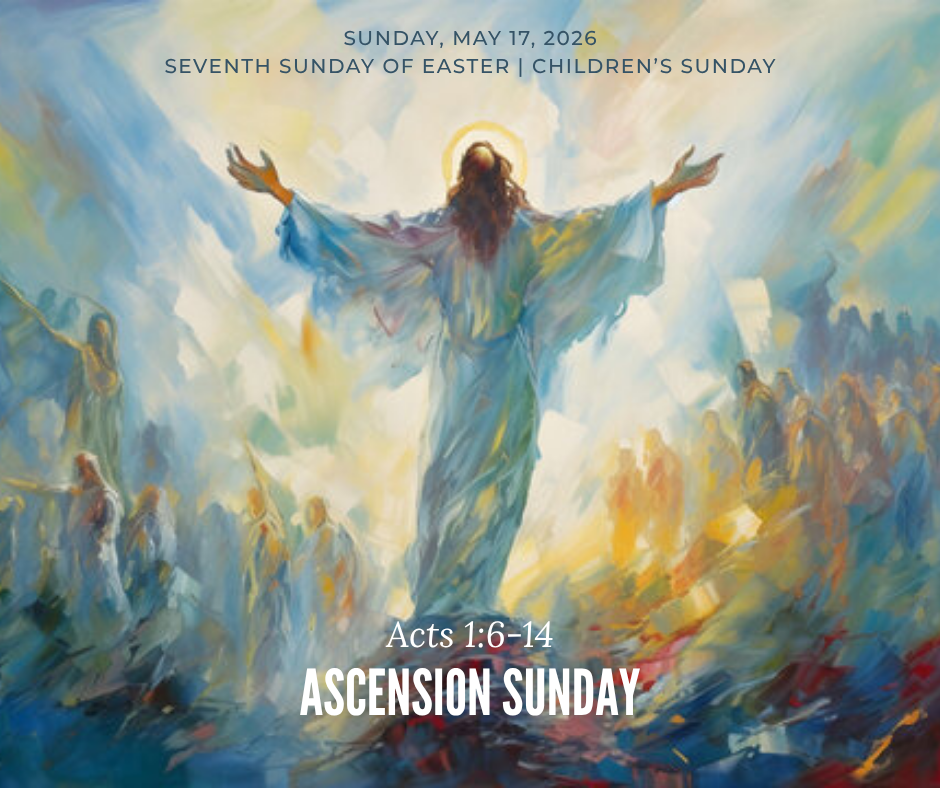
Acts 1:6-11
So when they had come together, they asked him, “Lord, is this the time when you will restore the kingdom to Israel?” 7 He replied, “It is not for you to know the times or periods that the Father has set by his own authority.8 But you will receive power when the Holy Spirit has come upon you, and you will be my witnesses in Jerusalem, in all Judea and Samaria, and to the ends of the earth.” 9 When he had said this, as they were watching, he was lifted up, and a cloud took him out of their sight. 10 While he was going and they were gazing up toward heaven, suddenly two men in white robes stood by them. 11 They said, “Men of Galilee, why do you stand looking up toward heaven? This Jesus, who has been taken up from you into heaven, will come in the same way as you saw him go into heaven.”
Most important things in the Bible happen in blocks of 40. Noah steers his floating zoo for 40 days of rain. The slaves from Egypt wander in the wilderness for 40 years. Jesus fasts in the wilderness for 40 days. If you hear the number 40, think “This is a great inflection point, with a transformation at the end.” At the end of each, there is a promised land, a new stage of the journey. So, we are 40 days after Easter morning. What is the transformation that will happen next?
The disciples came to Jesus and asked him, “Lord, is this the time when you will restore the Kingdom of Israel?” What is in this question? First, it shows the hope and excitement the disciples had after Easter. Change is coming. For three years Jesus taught “The Kingdom of Heaven is near.” He taught them to pray, “Thy Kingdom come, thy will be done, on earth as it is in heaven.” In Matthew, right after the Lord’s Prayer he tells eight parables to say what the Kingdom of Heaven is like. Its like a tiny Mustard seed, it is like yeast, it is a Great Banquet where the poor are invited, it is sowing seeds, a pearl of great price.
How significant is this Heaven talk? In the Old Testament the word heaven is used 380 times, and every time it refers to a place beyond the earth. Jesus says the Kingdom of Heaven is near you, right now on earth, 75 times in Matthew Gospel alone. Notice in the disciples question in Eastertide is not about the Kingdom of God. Instead, they ask, “Is this the time you will restore the Kingdom of Israel?” Jesus never even once said he would restore the Kingdom of Israel. That belongs to Herod and Rome.
Old paradigms die hard. The disciples are still thinking the old narrative-the Messiah will come, throw out Rome, bring down Herod and restore the righteous line of King David. In fact, just a few years before Luke writes these words, the people of Israel tried to do exactly that. A revolt lasted about three years before the Roman legions came and crushed them. You have heard it said that those who forget history are doomed to repeat it. True enough. I love history. But those who try to hold on to history in the present are doomed to lose what they have. There is no way to recreate a moment in time, or a bygone Golden Age. But here are the disciples asking for the restoration of the good old days. And their Golden Age must be sometime before 586 BCE, when Babylon conquered Jerusalem. There has been no Kingdom of Israel for 600 years.
The old ways die hard. We aren’t that different as humans. Every church I have known had a Golden time it wished to return too. It is a natural tendency in times of great change. But it is a trap, even anti-evolutionary. It is important to know when to let go of an old paradigm and embrace a new one. The nature of change is about death and resurrection. We must let the old die, then the new can be reborn. Rebirth means it resembles the past; it contains some of the DNA, but it is something new.
Jesus does not chastise his disciples for asking this question. There is no eye rolling, condemnation or shouting insults about their thick-headed question. He simply replies, “It is not for you to know the times or periods that God has set by.” Jesus does not kill their genuine, if misguided, enthusiasm. He instead is going to try to attach their desire for change not to the past, but to something to come. There is still a kingdom coming, just not quite the one you thought. There is an important lesson here. When we decide to move into the future, we don’t get to know the outcome ahead of time.
That’s a challenge. We would all love a guarantee. I would love it if Jesus said to me, ‘Preach this sermon and here is exactly what will happen.’ In my first church, we followed a book called “The 12 Keys to an Effective Church.” I still have it on my shelf. But following it to the letter wouldn’t solve the modern spiritual crisis — because the Spirit doesn’t follow a blueprint. Following the Spirit means listening for where it moves. What is on offer is not certainty about outcomes, but presence for the journey. The future is always a leap of faith. But don’t leap alone.
Jesus next words are, “But you will receive power when the Holy Spirit has come upon you; and you will be my witnesses in Jerusalem, in all Judea and Samaria, and to the ends of the earth.” Kingdoms have a power and a geography. In the disciples mind the location of the kingdom is the land of Israel, and the power is the king, the Temple and the Law, most likely backed by an army. Those are the features of an earthly Kingdom. Jesus says the power in the Kingdom of Heaven is going to come through the Holy Spirit who moves in you. This Kingdom will not come from the power of kings, laws and armies; it will come through preaching the good news to the poor, healing to the brokenhearted, forgiveness, doing justice, loving mercy.
The Kingdom of Heaven also has a different geography. It is Judea, Samaria and the ends of the earth. Imagine, not just Israel, but the ends of the earth. They didn’t even know the ends of the earth yet. They thought it was flat, and it would be 15 centuries before humanity would know differently. Even Rome did not know the geography of the ends of the earth. By the way, the ends of the earth includes Samaria. In the disciples’ minds, they worshiped on the wrong mountain, in the wrong way, and only knew one hypothetical good Samaritan who would actually help a person in distress.
The spiritual geography of the Kingdom of Heaven is not about mileage or drawing lines on a map between us and them. It is about crossing the emotional and cultural maps to embrace the people we don’t understand and don’t trust, reconciling with those whom we have fought wars, healing the divisions of disagreement and opening ourselves to those who worship and think differently than us. That is what Samaria represents. And if you can cross those boundaries, then you can possibly go to the ends of the earth. The question it brings to my mind is this: What if the church stopped mourning what it used to be — and asked what it is being called to become?
So, here is how Jesus answers the disciples’ question about the restoration of the Kingdom of Israel. “You don’t get to know how it all turns out. The power you want will come from the Holy Spirit and not from worldly power. And your geography is too cramped.” And then without apparent warning or even a “Good luck,” he ascends straight up into heaven. Now that is how you end a sermon! Leave them with their mouths hanging open in wonder!
But here’s what Luke wants us to notice: that cloud is not a weather report. Clouds descend at the key moments when God shows up — on Sinai when Moses receives the law, at the Transfiguration when the disciples catch a glimpse of who Jesus really is. Now the cloud receives Jesus into it. He hasn’t left. He’s gone all the way into the presence of God. He goes into God so God can receive all his human experience.
Then come the men in white robes. “Why are you standing there looking up?” I wonder if they stood there in silence for several minutes, not knowing whether to grieve, rejoice, or move.
Don’t miss how gently disruptive that question is. Stop waiting for the kingdom to arrive from somewhere else. Stop searching for a return to what once was.
The Spirit is coming. And when it comes, it will push them outward —
beyond Jerusalem, beyond familiar borders, beyond old certainties,
even beyond Samaria. Ten days later they will become something the world has never seen before.
Maybe that is the question before the church now. Not how to recreate what once was. But whether we are willing to let the Spirit expand our geography too. Because the kingdom of heaven is always larger than we imagined. And the Spirit is always leading farther than we intended to go.
I wonder where you will go next?