
The Other Way
What pilgrims know about Palm Sunday
(Click for full reading)
37As he was now approaching the path down from the Mount of Olives, the whole multitude of the disciples began to praise God joyfully with a loud voice for all the deeds of power that they had seen, 38saying, “Blessed is the king who comes in the name of the Lord! Peace in heaven, and glory in the highest heaven!” 39Some of the Pharisees in the crowd said to him, “Teacher, order your disciples to stop.” 40He answered, “I tell you, if these were silent, the stones would shout out.”
Just imagine, here on the sixth Sunday of Lent, that you had been walking the entire time on the Camino de Compostela. You’ve been walking for weeks. Your boots are worn in now — or worn out — and your body has reorganized itself around the road’s rhythm-early mornings, the heavy pack, following yellow arrows, the blisters that became calluses, the strangers who became companions.
And then one morning, you crest a low hill; Monte de Gozo, the Hill of Joy. And there you see the cathedral towers of Santiago de Compostela, rising above the distant city.
Pilgrims have been stopped on that hill for a thousand years. In the Middle Ages, they made their wills before leaving home, in case they didn’t survive the journey. Even today 10 to 30 pilgrims die on the Camino. Seeing the towers meant you were going to live to the end.
Here is how pilgrims describe the moments of nearing the gates. They don’t say triumph. They don’t say pure joy. They say: “I had a good cry and then curled up on my backpack….We clutched each other with joy and loss and loneliness and the relief of human connection, all at once.” One pilgrim who has walked it four times says, “I enter a bittersweet state, because I know I am close to the end.
Arrival is not what you thought it would be. It is more wonderful and harder and stranger than you imagined. The destination is real — you can see it — but you’re not there yet. You might feel the thrill of accomplishing the journey, anticipating home and your own bed. Perhaps you learned a great deal about yourself and made remarkable friendships. But now you will part. What happens when the pilgrimage ends and you realize you don’t know the answer to life, the universe and everything. Returning to the real world is bittersweet.
In Jesus’ day, pilgrims went to Jerusalem for high holy days to fulfill religious aspirations. In Luke’s Gospel, Jesus and his disciples begin the journey from Galilee in chapter 9, and we are now in chapter 19. He goes through Samaria and tells the parable of the Good Samaritan, he encounters 10 lepers, Blind Bartimaeus, the rich young ruler. He just passed through Jericho and met Zacchaeus up in the tree. 40 percent of Luke occurs while Jesus is on this Camino to Jerusalem, and now he arrives at the Mount of Olives.
From there pilgrims see the first stunning view of Jerusalem and the Great Temple. It is a similar distance as Mount de Gozo is from Santiago de Compostela. Pilgrims didn’t just take a picture here and stop at the souvenir shop. They went through ritual purifications and sacrificed a red heifer (yes, it had to be red.) This tradition may explain why Luke spent so much time on procuring a donkey for Jesus. I mean, why do we need four verses about what to say to the owner of the donkey and that it must never be ridden? Because the donkey must be ritually pure for this sacred trip to enter Jerusalem after the long pilgrimage.
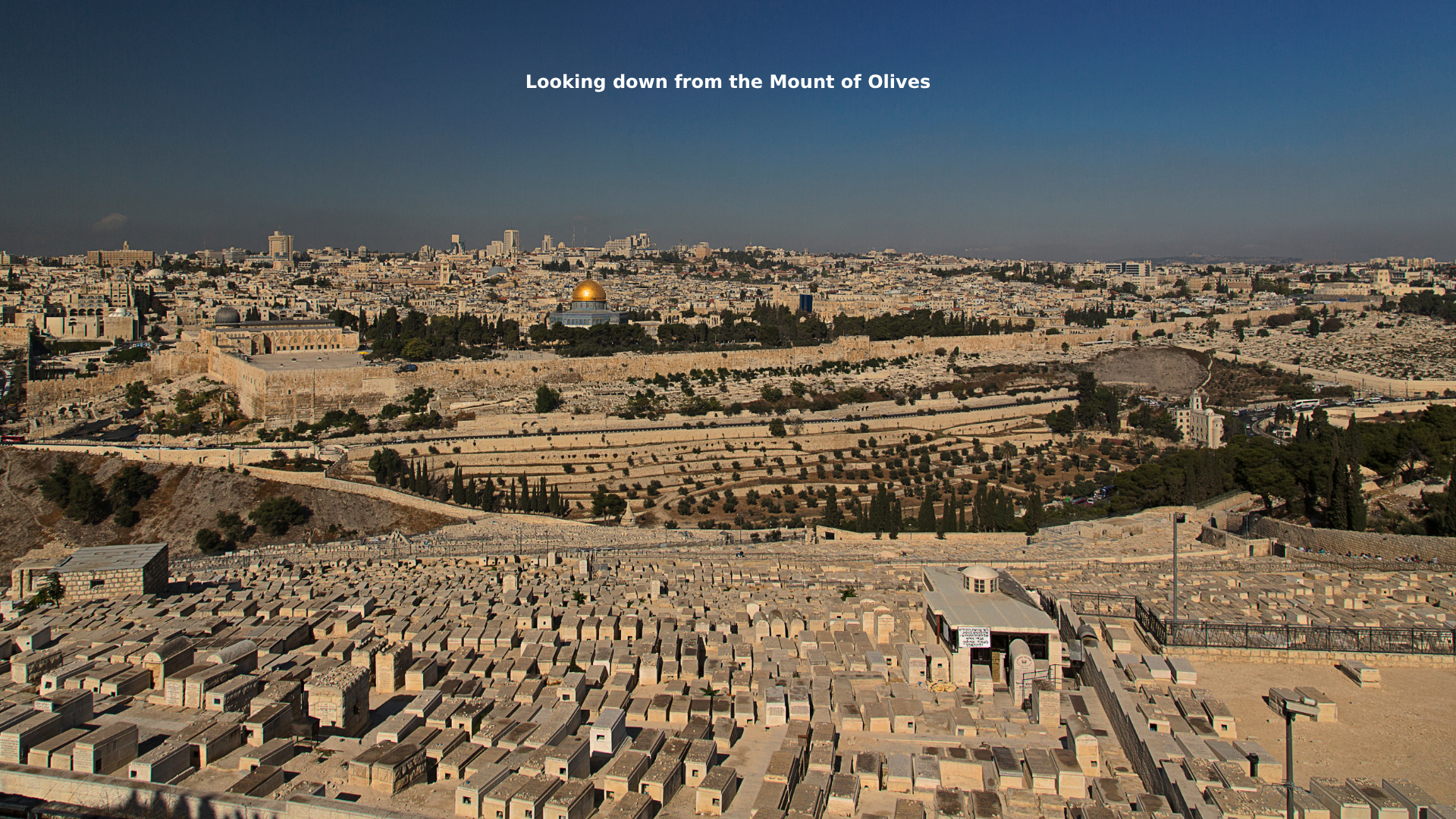
It’s helpful to see the view from where Jesus and the disciples were. The picture shows not only the grandeur of the Temple, but a lot of stones in the valley. These are graves, some as old as 2500 years. The tradition from Zachariah 4:14 is that the messiah would come to the Mount of Olives and the resurrection of the dead would begin there. An earthquake would shake the mountain and split it in two. Numerous people spent a small fortune so their grave would have a front row seat. If you have the money, why not spend it on some end times entertainment?!
Luke 19:35 locates the beginning of Jesus’s Palm Sunday processional leading up to this location. Notice there are no palms in this story. In truth, only John’s Gospel has the palm waving. Matthew and Mark mention people cutting leafy branches from the fields — but Luke strips the scene down even further. No palms, no branches at all. Just a donkey and people’s cloaks.
These symbols work together. A donkey is an ordinary beast of burden — not fast and impressive like galloping stallion, not as load bearing like a caravan camel. If you saw a man riding a donkey through first-century Jerusalem, you would not mistake him for a conqueror. But the sure-footed donkey was the practical mount of common people in the rugged Judean hills.
But there is more to the donkey than practicality. Five hundred years before, the prophet Zechariah wrote: “Rejoice greatly, O daughter Zion! Your king comes to you — triumphant and victorious, yet humble, riding on a donkey.” Notice what comes next. “He will cut off the chariot from Ephraim and the war horse from Jerusalem. He shall command peace to the nations.” (Zechariah 9:9-10)
This is not simply a humble king. Zechariah’s king arrives having disarmed. The chariot is cut off. The war horse is gone. The weapons of empire are surrendered before he ever enters the gate. In the ancient world, the horse meant war — bred for battle, the instrument of conquest. The donkey meant the end of war. Jesus doesn’t just come in peace. He comes as the deliberate undoing of everything military power represents.
Which makes his entry into Jerusalem not a soft gesture of humility, but something far more provocative. He is staging a counter-coronation. He is saying with his body, on this borrowed animal, descending toward the graves on the Mount of Olives with Galilean pilgrims spreading their cloaks beneath him: this is what a king looks like when God is doing the crowning. Not armor. Not a warhorse. Not the thunder of an imperial procession. A donkey.
While Luke spent many words on Jesus’ commands about getting the donkey, he says nothing about a command to spread their cloaks before him. This gesture seems more spontaneous and unforced. It’s an act of vulnerability, giving honor, almost surrender. A cloak was a person’s essential garment. It was a large rectangular, woolen cloth wrapped around your body, over a thinner tunic. If it rained or the sun was too bright, you covered your head. At night you would wrap yourself to stay warm. Most people only had one, not a closet full for all occasions. In Mosaic law, a creditor could not take your cloak. No matter how poor, everyone needed its dignity and protection. To remove your cloak in public was considered to be naked and exposed. All these disciples disrobing and places their cloaks before Jesus’ donkey might look a little scandalous.
Let this sink in. You are going to take off your cloak and be exposed. And spread it on the ground not for Jesus’ feet, but to be trod by donkey hooves. (And they couldn’t drop it off at the dry cleaners afterwards.) The power of the gesture is that Jesus did not ask for it. It is freely given. Why did they do it? Were they among the hungry fed? Or they had been healed? Fisherman who left their shores to follow him for three years. Women like Mary, Martha, Mary Magdalene were given respect their culture did not recognize. Matthew the tax collector, who gave up his lucrative position to follow. People who experienced grace, whose lives were made purposeful were all there, throwing their cloak to the ground.
The gesture might be gratitude or respect, or also the recognition that he was about to ride into some serious trouble down the road past the tombs. It’s near the end of the Camino, and there is joyful expectation, and relief, and uncertainty about what comes next. But they believe in this man who rides the donkey.
And maybe it feels a little like standing on that hill—Monte de Gozo—the Hill of Joy. You can see it. You know something real is ahead. But you are not there yet. There is still a road to walk. And not everyone will welcome the way this king comes.
In Luke’s telling, the Pharisees say, “Teacher, order your disciples to stop.” Quiet this.
Tone it down. Don’t make a scene.
And if we follow him long enough, we will hear those voices too.mBe reasonable. Don’t make waves. Keep your faith to yourself.
But Jesus says, “I tell you, if these were silent, the stones would cry out.” And we have already seen those stones, the grave stones. This kingdom — this way of peace, this laying down, this strange and vulnerable love — cannot be silenced. It is already alive.
And it is still calling. Calling us to trust this kind of king. Calling us to lay down what we carry. Calling us to keep walking, even when the road turns hard.
So here we are, on the hill. We can see it. And now the only question is: will we join the song, or will the stones have to sing it without us?