
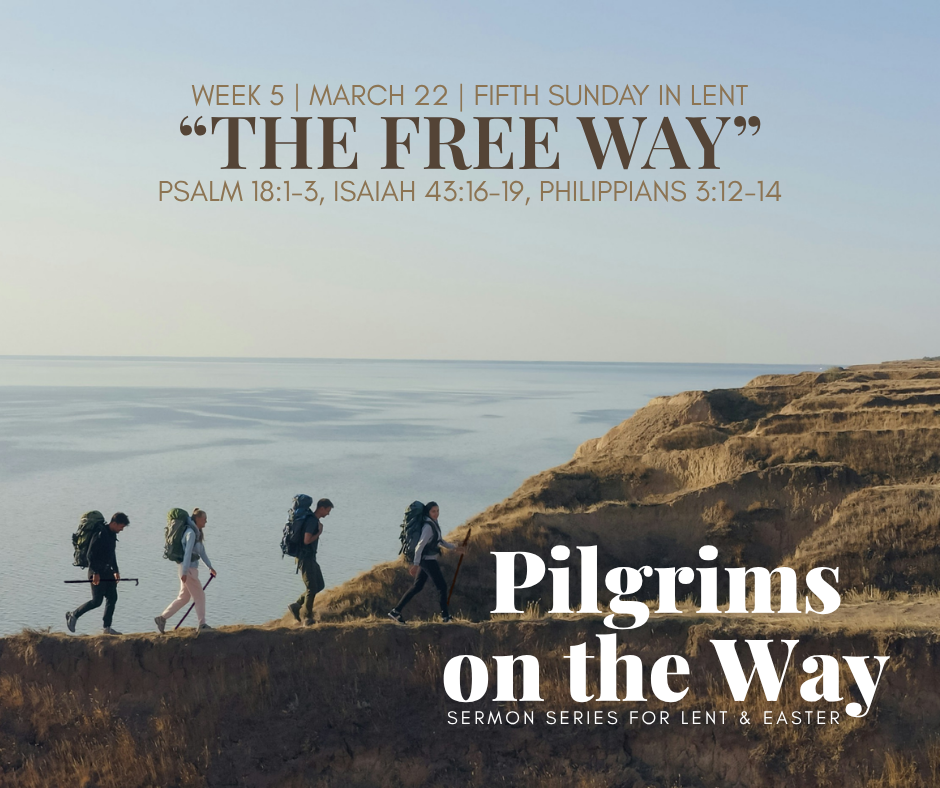
The Free Way
God's New Thing in an Old World includes jackals and ostriches.
Thus says the Lord,
who makes a way in the sea,
a path in the mighty waters,
17 who brings out chariot and horse,
army and warrior;
they lie down; they cannot rise;
they are extinguished, quenched like a wick:
18 Do not remember the former things
or consider the things of old.
19 I am about to do a new thing;
now it springs forth; do you not perceive it?
I will make a way in the wilderness
and rivers in the desert.
20 The wild animals will honor me,
the jackals and the ostriches,
for I give water in the wilderness,
rivers in the desert,
to give drink to my chosen people,
21 the people whom I formed for myself
so that they might declare my praise.
Isaiah 43: 16-21
We can’t see a way forward. You feel like calling it quits, wave the white flag, throw in the towel. All pilgrimages have moments where we don’t want to walk anymore. Pilgrims on the Camino de Santiago travel roughly 10 days through the Meseta, a long plateau of open fields and space. It is scorching in the summer and freezing in winter, but the real challenge is boredom. There are no scenic vistas of river valleys or coastlines. So, the only thing to do is walk. The buzzing brain needs to think something, so all the feelings usually avoided emerge. Regret. Guilt. Sorrow. Shame. These become companions on the Meseta. Boredom and thoughts become more burdensome than rough terrain.
But if the pilgrim persists, they ascend the to the highest point of the journey. The Cruz de Ferro, Iron Cross in English. The tradition is to carry a stone that represents the inward burdens you carry. At this ¾ marker, you lay down the stone. You carry it the whole way — through the Pyrenees, across the Meseta, through rain and blisters — and only then, when you have earned the right to let go, does the tradition ask you to release it. The stone has become part of you by the time you release it. That’s not accidental. You cannot release what you have not truly carried.
Two thousand years before pilgrims walked to Santiago, Isaiah understood this moment. Isaiah 43 says, “Forget the former things; do not dwell on the past.” These words come to people who have carried much into exile. They may have seen their city burned, lost family, and force marched on their own Camino to Babylon. Isaiah’s words of release are written at their Cruz de Ferro moment, having carried the burdens of exile for a generation. While the prophet is announcing a way forward, the new thing from God is not yet clear. First, they must let go, forget, not dwell on the past. You cannot reach for a new way if your fist is closed around the old way.
What did they need to let go? The anger at being conquered. The grief of all they lost. The romanticized golden age. When our world is shattered, it is not something we simply get over. We need to feel safe again. We need an invitation from outside ourselves — a moment where something opens and we say: it is enough. I am ready for something different. Isaiah’s words deliver a great reassurance that God is making a way where we felt there was no way. We are not alone, we don’t have to do it all ourselves.
Listen to how Isaiah describes this new way. It is not a memo from the divine planning committee. God speaks in poetry, “I will make a way in the wilderness, and rivers in the desert.” This is creation language. The same God who called light from darkness at the beginning, who parted the sea so a people could walk through on dry ground — that God is at work again. Not tweaking the old system. Not issuing a revised edition. Making a way where the map shows nothing but empty space. Making rivers where the ground is cracked and dry. This is not a new program. This is new creation.
But here is the harder word inside the reassurance. Isaiah doesn’t just say I am doing a new thing. He asks: do you not perceive it? That question has a gentle edge to it. The new thing is already sprouting like a seed already breaking ground beneath your feet, and you may be missing it entirely. Not because God isn’t acting, but because you are still dwelling on the road that led to exile, still looking backward at what was lost. The invitation is not merely to hope for something new. It is to train your eyes to see what is already beginning. Which turns out to be harder than it sounds.
Beware of the tyranny of the “new and improved.” Consider IHOP and Applebee’s. Two struggling restaurant chains, both owned by the same parent company. Their solution to decline? Merge them into one building, one entrance — but two dining rooms, one red and one blue, with separate brand identities intact. They even created special “menu mashups” — a Loaded Buffalo Chicken Omelette, a breakfast burger with hash browns and hollandaise. Behold, we are doing a new thing. Except it is the same pancakes and the same hot wings under one roof, with a fresh coat of paint.
For a time, Isaiah 43 was a rallying cry for change in the United Church of Christ. At state and national meetings, we had banners and new songs proclaiming, “Behold, I am doing a new thing.” We got brightly colored T-shirts. I went to seminars on how to be more welcoming, we were encouraged to tweet our responses for everyone to read. A younger generation would come back into our churches if we allowed them tweet their thoughts during church. (That aged badly.) But behind the scenes, we were simply downsizing and restructuring our staff, thinking that new branding and technology was going to save us.
Don’t get me wrong, I like new things. I am an early adopter by nature. I had a Mac computer in 1991, designed a church website back in the 20th century, performed gay weddings in 2000. I am competitive about continuing education, and I want to know the best practices and new ideas. But I’ve also watched so many ideas come and go, and few were truly transformative. Many were just a better chair to sit on the deck of the Titanic, with a new flavor of seltzer.
What is the real difference between the transformative and the glitzy branding? The transformative is organic — it sprouts from below, breaks ground in unexpected moments, cannot be manufactured or scheduled. The glitzy arrives in a box with instructions, looks impressive for a season, but develops no roots. Rivers in the desert are not a marketing campaign. They are what happens when the God of creation moves through our terrain in places and people we ignore. You don’t produce that. You perceive it. You follow it.
Just past where our text ends, the prophet names who will drink from the rivers in the desert. Not the righteous. Not the faithful remnant. Not the ones who got it right. The wild animals will honor me — the jackals and the ostriches — for I give water in the wilderness.
Jackals and ostriches are creatures of the wasteland. In ancient Near Eastern zoology, these are not the noble creatures. Jackals are scavengers — creatures of desolation, the ones who show up after everything has already fallen apart. And the ostrich? Job tells us the ostrich abandons her eggs in the sand, forgets that a foot may crush them, and is flatly described as lacking wisdom. She buries here head and cannot see what is right in front of her.
Isaiah says the rivers flow for them too. This is not a curated restoration. God is not waiting for the right congregation, the right politics, the right moment of institutional readiness. The new creation is wild and indiscriminate in its generosity. The water flows and even the scavengers drink. Even the ones who buried their heads lift them. Even the naysayers, the resisters, the ones who couldn’t perceive what was already sprouting beneath their feet — they are included in what God is doing. Grace is not means-tested. Which means we are not the gatekeepers.
Here in coastal Maine, we know something about this crossroad. We have watched the ocean change in ways that unsettle us. The familiar markers are shifting — the lobster are migrating to Canada, the tides surge higher, I count more dead and fallen trees nearly every walk after a storm. While we are getting snowfall, it is a record 87 degrees in Iowa. If we aren’t unsettled by the changing climate fallout, we might be more like ostriches than we wish to admit. What are we called to perceive amid the changes? We are being asked whether we trust that the God who makes rivers in the desert is also at work in the warming waters, in the uncertain harvest, in the ecosystem groaning toward something we cannot yet name. Creation is not the backdrop for our salvation story. Creation is where God has always been most legible. The answers we need will not come primarily from our institutions. They will come from loving the wonderful creation around us.
That is the invitation. Not to manufacture the new thing, but to lay down what you’ve been carrying long enough to see what is already breaking through. Isaiah asks: “Do you not perceive it? It is already sprouting.” We may not yet see it. But Easter is coming, and our eyes will be opened.
Until then, Buen Camino.