
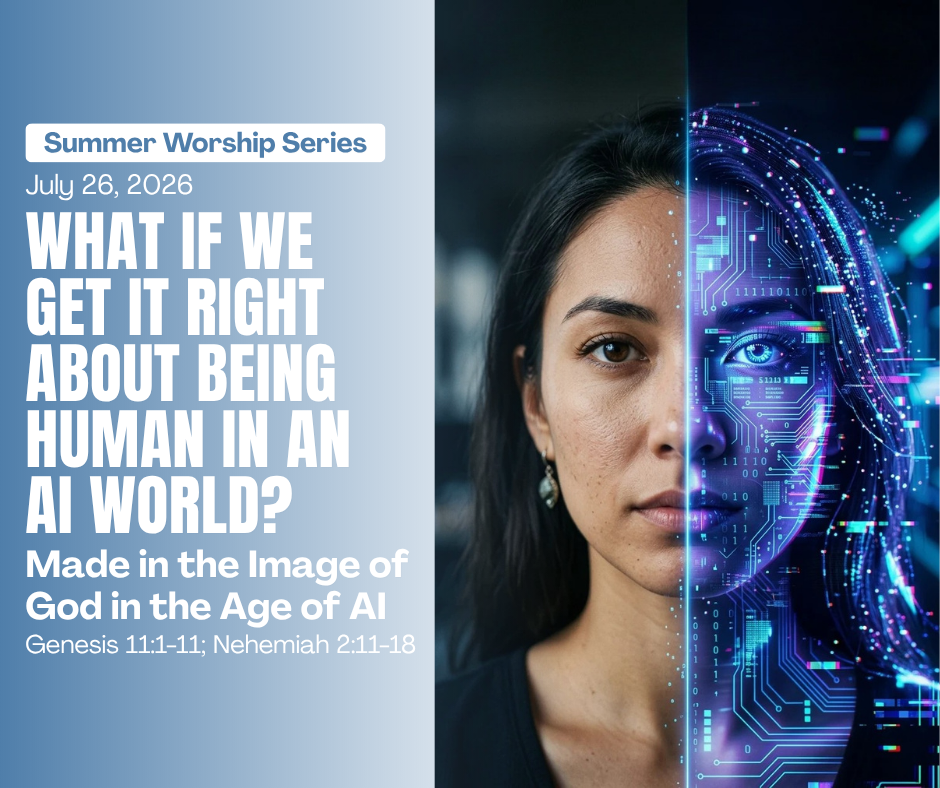
Part VIII: What If We Get It Right About Being Human in an AI World?
Made in the Image of God in the Age of AI
Genesis 11:1-9
11 Now the whole earth had one language and the same words. 2 And as they migrated from the east,[a] they came upon a plain in the land of Shinar and settled there. 3 And they said to one another, “Come, let us make bricks and fire them thoroughly.” And they had brick for stone and bitumen for mortar. 4 Then they said, “Come, let us build ourselves a city and a tower with its top in the heavens, and let us make a name for ourselves; otherwise we shall be scattered abroad upon the face of the whole earth.” 5 The Lordcame down to see the city and the tower, which mortals had built. 6 And the Lord said, “Look, they are one people, and they have all one language, and this is only the beginning of what they will do; nothing that they propose to do will now be impossible for them. 7 Come, let us go down and confuse their language there, so that they will not understand one another’s speech.” 8 So the Lord scattered them abroad from there over the face of all the earth, and they left off building the city. 9 Therefore it was called Babel,[b] because there the Lord confused the language of all the earth, and from there the Lord scattered them abroad over the face of all the earth.
I tried an AI experiment two years ago to satisfy my curiosity. I uploaded 10 sermons and asked for feedback. ChatGPT noted that I really like word studies and dry humor. Chat said, “You don’t preach to win arguments, but to help people see the world differently. Even when you’re addressing contentious issues you rarely sound combative. Instead, you invite people into a different imagination.” Chat is clearly insightful, but designed to keep you coming back. No one will use a tool that says, “You are mediocre and should stop writing.” Then came the critique. I preach too many ideas per sermon. Simplify and go deeper. My transitions leave the audience wondering about the connections. I’m not sure I wanted all that feedback. But I took negative feedback from Chat better than I might from a human, so I made the changes.
I tried a second experiment to gauge my AI competition. Write a sermon in my style and theology. I was relieved to read a sermon not up to my Sunday standards. But it was well constructed and theologically in tune. It was a solid B. I felt a little twinge of dread that AI will soon be chasing all of us whose vocation is to think, write and communicate effectively. It is already rivaling many beginning preachers and wordsmiths, and what is to stop someone from writing a sermon with AI, and adding a personal story to pass it off as their own?
What an AI preacher cannot do is read the room, add a little humor, be in the moment, and get the feel for the audience on Sunday. But then many preachers struggle to do this well. There is still room for a discerning Spirit, hearing a still small voice no algorithm can replicate. But our content environment is being flooded with AI-generated prose. I recently read that 62% of pastor’s are using AI in some way at work. It raises all kinds of ethical questions. Some churches have AI prayer bots on their website that will pray with you. More people are turning to AI for moral and theological guidance rather than revealing their spiritual challenges to a pastor.
Writers are asking similar questions. Some editors and teachers say AI should be avoided at all costs because it will kill our creativity and originality. Others say it is fine to use AI as an editor after the first draft to help with structure, clarity and fact checking, but don’t let AI write generatively for you. A third camp says fully embrace AI as a collaborative partner in a new revolution in writing. I just saw that Substack is including an AI-checker, so the reader can now get a score on how much of the article is human or computer generated. I checked two sermons. Both came out 100 percent human, so I’m glad to find out I’m not a covert cyborg.
Beneath the ethical issues, there is the underlying existential challenge. As machines do more of our thinking and work, what is still valuable about being human? What does it mean to be created in the image of God as our human-created AI can now think faster, with more logic, sometimes more kindness, and at least do a B imitation of human work? What happens to truth in a world where pictures and video are generated with such quality that you can’t tell the difference? 40 percent of social media is already AI-generated, and some news is now written by AI “reporters.”
Pope Leo’s recent encyclical offers a theological framework for discussion. Vatican theologians met with computer engineers, philosophers and AI CEOs to assess the dangers and opportunities for human flourishing. The final document isn’t anti-artificial intelligence, but is sharply prophetic about the risks. The very first sentence gives a provocative challenge:
“Humanity, created by God in all its grandeur, is today facing a pivotal choice: either to construct a new Tower of Babel or to build the city in which God and humanity dwell together.”
To understand this choice, I first want to explore the theological significance of the tower and Babylon.
Babylon was the most important city of the ancient world by 2000 BCE. Its inhabitants amassed great power and wealth. The hanging gardens were a wonder of the world. They gave us the 60-second minute, the 60-minute hour, the first legal code, and lawyers.
But Israel lived in the moral shadow of the Babylonian Empire. The prophets saw conquests, cruelty, destruction of local cultures, and extraction of resources from others. The Genesis 11 Tower of Babel story is satire designed to challenge hubris. The ancient Akkadian name for Babylon, means “the gate of god.” How important is our city? We are the gate of God! They believed Marduk and the gods had blessed them, and built Ziggurats, great stepped towers where the gods could descend and dwell among them.
Genesis gives the two motives, to make a name for themselves and to not be scattered. Scattering people is what Babylon does to conquered nations. They exterminated, deported and colonized Israel. The temple was razed and sacred objects were taken back to Babylon. Even though they are an empire, they are afraid of scattering. The Hebrew verb translated “scattered” implies anxiety, a dread of the future. Deep insecurity leads to a massive building campaign of towers, hanging gardens, maybe even ballrooms.
The Message translation captures God’s response perfectly. God steps down to see the towers reaching for the heavens:
God took one look and said, “One people, one language; why, this is only a first step. No telling what they’ll come up with next—they’ll stop at nothing!
The text captures the drive to uniformity and conformity. Everyone must speak our language and follow our religion. God does not merely observe religious hubris, but an empire smashing cultural diversity. Genesis has a final word on the matter. The Babylonians called their city Bab-ili — gate of god. The Hebrew narrator renames it Babel, from the verb balal: to muddle, to confuse. The gate of god turns out to be the place of the muddle. Their anxious drive for uniformity and grandeur was the true confusion.
The Babel syndrome, as Pope Leo calls it, has a modern look: a single platform, a single algorithm, a universal language of data that promises to translate everything — including human personhood — into information and output. The anxiety driving it isn’t so different from the Babylonian tower builders. We are afraid of being left behind, of irrelevance, of losing our footing in a world moving faster than we can think.
We are not in the early stages of deciding whether to use AI. I believe we are four years past the Hiroshima-moment; when Open AI launched ChatGPT to the public. Comparing artificial intelligence to nuclear fission is a useful analogy. Both technologies can do equal harm to civilization as we know it. We need to be just as serious about AI as the past generation was about nuclear arms agreements. The nuclear analogy gives us the balance of fear and hope. We have prevented nuclear war for over 75 years, so AI enslaving humans in The Matrix is not inevitable. Also, nuclear fission helps us with every x-ray, with every tumor destroyed, and may be less threatening than continuing to burn fossil fuels.
Likewise, AI can accelerate medical advances, help us with modeling the impact of climate change and many other uses. AI will amplify many of the problems we already face—inequality, environmental strain, misinformation, even warfare. Those public questions deserve urgent civic attention. But we must act with moral, spiritual and civic vigor while we can.
Pope Leo gives the theological counterweight to a world where everything is reduced to data and algorithms that predict what should happen next. In the beginning, we were created in the imago Dei, the image of God. If God is the unfathomable mystery of life and all creation, then each of us carries a spark of that divine life. Technology is one of the expressions of our creativity, but it must always remain accountable to human dignity, never replacing it.
Which brings us to the deeper question. The question is not whether artificial intelligence will become more intelligent. It almost certainly will. The real question is whether we will become more fully alive.
AI can analyze astonishing amounts of information. It can imitate conversation. It can even write respectable prose. But it cannot stand in awe. It cannot fall in love, forgive, hold the hand of someone who is dying, or feel gratitude on a summer evening as the sun slips below the horizon. Those are not failures of intelligence. They are the gifts of being human.
Irenaeus of Lyon put it this way: The glory of God is a human being fully alive. What makes you fully alive?
Becoming fully alive is wonderfully ordinary. Paint something. Write a real letter. Sing loudly. Dance, even if you’re not very good at it. Invite friends around the table and linger over the conversation. Spend an afternoon without a screen. Sit beside the ocean. Pray. Tell the truth. Love generously. Every one of those moments tends the divine spark God has placed within you.
Our tools—from computers to cell phones to artificial intelligence—can become remarkable servants. But beware the logic of Babel. The answer to our anxiety has never been to surrender our humanity to our own creation, but to accept the steadfast love of God.
Remember, ChatGPT doesn’t really love you. Claude can’t dance. Grok can be more like your crazy uncle than a trusted spiritual director. But you were made for more than any of them can offer.
God did not create you to compete with your machines. God created you to become fully alive. So, tend that spark. Share that light. And let your life give glory to the One in whose image you were made.