
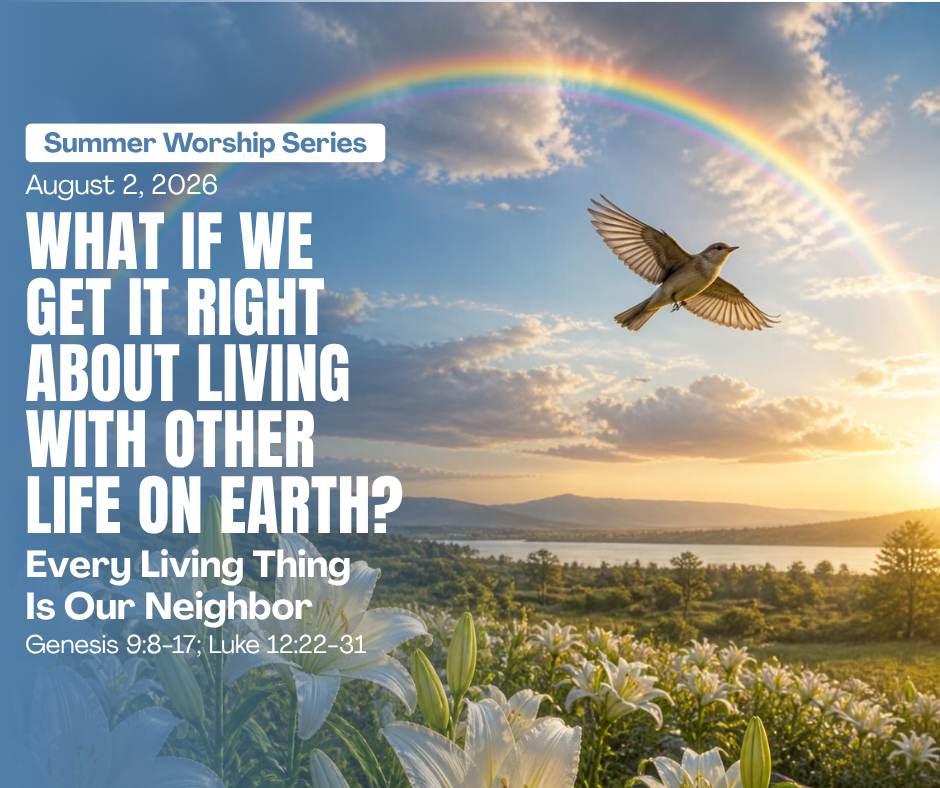
Part IX: What If We Get It Right About Living with Other Life on Earth?
Every Living Thing Is Our Neighbor
Genesis 9:8-17
8 Then God said to Noah and to his sons with him, 9 “As for me, I am establishing my covenant with you and your descendants after you 10 and with every living creature that is with you, the birds, the domestic animals, and every animal of the earth with you, as many as came out of the ark.[a]11 I establish my covenant with you, that never again shall all flesh be cut off by the waters of a flood, and never again shall there be a flood to destroy the earth.” 12 God said, “This is the sign of the covenant that I make between me and you and every living creature that is with you, for all future generations: 13 I have set my bow in the clouds, and it shall be a sign of the covenant between me and the earth. 14 When I bring clouds over the earth and the bow is seen in the clouds, 15 I will remember my covenant that is between me and you and every living creature of all flesh, and the waters shall never again become a flood to destroy all flesh. 16 When the bow is in the clouds, I will see it and remember the everlasting covenant between God and every living creature of all flesh that is on the earth.” 17 God said to Noah, “This is the sign of the covenant that I have established between me and all flesh that is on the earth.”
My relationship with nature has shifted dramatically since moving to Maine. I thought I was ecologically aware growing up on an Iowa farm. Plus, Jeanne and I cycled through the foothills of Western Massachusetts nearly every warm weekend. I tilled an organic garden full of garlic, tomatoes and basil. Doesn’t all that make me a nature guy? But Maine is different. Nearly every inch of the Iowa plains was human contoured tidy squares of corn and soybean fields. Growth is fostered by tons of nitrogen fertilizer, protected by pesticides and herbicides. It may be the breadbasket of the world, but it is certainly not wild or natural.
The human imprint is diminished here in Maine. Land is formed by great ice sheets gouging the rocks thousands of years ago. Forests, tides, winds and snow swallow human contouring. We live at the edge of the uncontrolled sea and disregard its force to our peril. Here the forests are not in neat rows, but trees grow even in the cracks between the rocks. I have never spent as much time noticing how trees sway and rustle, nor felt the sadness seeing so many dead trees from moth infestations. Here nature is not the backdrop for agricultural production or recreation. You are in it and it has you more than you have it.
Nature certainly had me this week. I noticed a big red bullseye from a tick bite on my shoulder blade, which spread to two other places. A warmer climate favors longer tick seasons and a spread of Lyme in Maine. Then Friday, while hosing off the porch, I was stung four times by wasps, on the ear, neck and eyebrow. I located their nest under the eave, and promptly took it out with a broom stick, before they could turn our steps into the strait of Hormuz. I then declared a ceasefire, but they had another next under the railing and broke the ceasefire with a second attack. I hit them harder than they had ever seen before, and re-opened the stairway, but I imagine this will be an annual battle. Like the human family, relating to nature is full of conflicting purposes, different goals and needs, and deep misunderstandings. The less we understand the more than human world, the greater the destruction.
I’m making some progress in relating to the more than human world. I love sitting on our porch and listening to birds in the morning. I can now at least tell the difference between the calls of seagulls, geese and osprey. I love all the varieties of bird song, but I don’t know what they mean. Are they saying, “I’m a happy bird. Or “Stay away,” or “Mate with me!”?
In Maine, I’m recovering from what the writer Richard Louv named “Nature Deficit Disorder”—not a medical diagnosis, he said, but a name for the human costs of cutting ourselves off from the natural world. It is a spiritual problem with tangible symptoms. It feeds an alienation from the places we live, which makes us more rootless, less aware, less compassionate. And the disease spreads to other living things as human action triggers climate change and a massive die-off of species. Human life could now fit the definition of an invasive species.
Maine has taught me that we don’t simply have environmental problems to solve, that if we just had better legislation, it will all be fine. Our relatedness to nature is off kilter and needs to be restored and healed. We need scientific research, an evaluation of our lifestyles and economics, but also a spiritual orientation of our true place in the world. Christianity has not created this nature deficit disorder, but we have participated through ignoring the rich spirituality that pervades the Bible, if we learn to see it. I believe recovering this neglected stream of Christian faith may become one of the great spiritual renewals our generation needs.
The driving force of the Reformation was to return to the original sources of scripture as foundational for faith. But Calvin and Luther read scripture in a way that made God distant from earth, all-knowing, and transcendent. Today’s scripture readings emphasize a God closer to nature and a spiritually that finds God right within the ordinary wonder all around us.
You probably learned the Noah story as a child, as he improbably gathered a male and female of every species into his small biosphere of an ark. It’s not a history lesson, it’s telling us something about God. Genesis reveals a God who struggles with human injustice and evil. We are hard to reform, and as we learned in Genesis 2 recently, we don’t respect the limits of the earth. God is trying to be just, by saving Noah’s family and a remnant of animals, from an injustice-cleansing flood.
But the resolution is more complicated. Flooding the world every time human wickedness hits a level of intolerance isn’t sustainable or satisfying. Genesis reveals a new strategy where God loves the world as it is. Despite human imperfection, God still implores humanity to live into the full goodness of being created in the Divine image and likeness. God makes the first covenant, an agreement designed to hold together a relationship in a world where we don’t always do the right thing. This covenant is one-sided with God pledging to limit wrath by not destroy the world again, and commits to the world’s flourishing.
In our human-centric focus, we miss that the covenant is with “every living creature that is with you, the birds, the domestic animals, and every animal of the earth with you.” It should be obvious since God says “every living creature” five times. Humans are not separate from nature, but within it, and subject to a divine covenant. Nature is not merely the staging in Christian story, nor is it a storehouse for our needs, or just a beautiful backdrop for vacation. We are in covenant. If God disavows destroying the world, aren’t we bound to the same commitment?
Jesus’ parable in Luke 12 adds depth. Humans worry a lot. What will we eat, what will we wear, what is going to happen next? Jesus tells the disciples they could learn a lot from ravens and lilies about trust and living the life that is right in front of them. These examples are more than object lessons. They demonstrate the inter-relationship and posture we have with all of creation.
Consider the raven. Luke uses a Greek verb for “consider” that invites to study and ponder deeply. It’s not just a generic bird, it’s a raven. What will it teach us? Ravens are highly intelligent. Evidence says they can plan ahead to preserve their food supply. They point at things with their beaks to show other birds. They recognize human faces and remember who has been good or harmful towards them. Noah sent a raven first out of the ark, so he may have known its capabilities. But here is the shock. Ravens are listed in Leviticus as an unclean animal because they are scavengers who eat dead things. God doesn’t just provide for the beautiful bluebird, but the unclean raven. There is a small rebuke here urging us to trust God at least as much as an unclean animal. But also, it’s a note of grace. All are provided for.
The lily extends the metaphor. Lilies in Jesus’ day were more of a wildflower than a flower shop plant for Easter. It’s like saying, study and learn from the lupins beside the road. Wildflowers spend no time grooming or shopping, but naturally portray more beauty than Solomon. Again comes the small rebuke of human pretension. Solomon was the richest of Israel’s kings, but his glory shined less than a sunflower, nor is as intricate as a lady slipper.
Jesus diagnoses our anxiety to be self-inflation and pretense. We will be less anxious when we see ourselves as within the created order of all things. The same bounty that feeds and cares for raven and lily will be generous with us as well.
Getting it right with the more than human world isn’t only finding answers to climate change or environmental problems. It begins when we recover a way of seeing we’ve forgotten. Scripture shows us that our spiritual relationship with nature was there in the beginning. God’s covenant is with every living creature, and each one has something to teach us about the Divine. The rainbow reminds us that we are not owners of creation, but members of it.
But membership asks something of us. Baba Dioum, a forester from Senegal, said it plainly: “In the end we will conserve only what we love, we will love only what we understand, and we will understand only what we are taught.” Tomorrow morning I’ll probably sit on my porch again. I’ll listen to the birds. I’ll keep one eye open for wasps. But perhaps I’ll remember that this little corner of Maine is not mine alone. It is a place where God has made covenant with every living thing—including me. Our task is not to save the world. Our task is to learn to love it well enough that we can live justly with every living thing.