
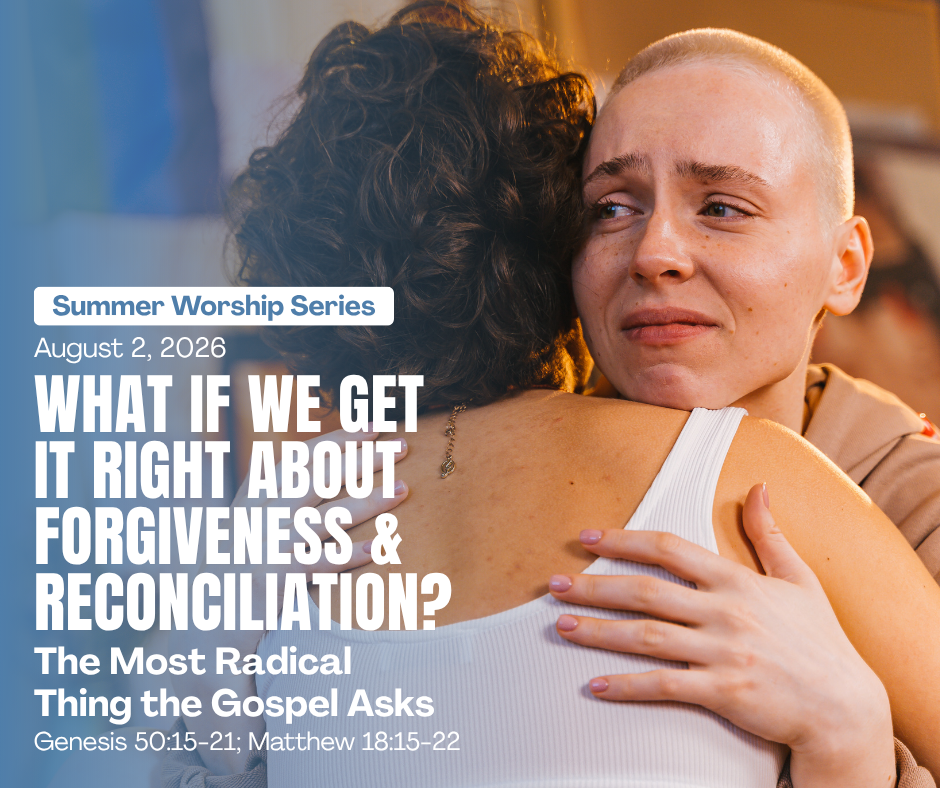
Part X: What If We Get It Right About Forgiveness and Reconciliation?
The Most Radical Thing the Gospel Asks
Genesis 50:15–21
15 When Joseph’s brothers saw that their father was dead, they said, “What if Joseph holds a grudge against us and pays us back for all the wrongs we did to him?” 16 So they sent word to Joseph, saying, “Your father left these instructions before he died: 17 ‘This is what you are to say to Joseph: I ask you to forgive your brothers the sins and the wrongs they committed in treating you so badly.’ Now please forgive the sins of the servants of the God of your father.” When their message came to him, Joseph wept.
18 His brothers then came and threw themselves down before him. “We are your slaves,” they said.
19 But Joseph said to them, “Don’t be afraid. Am I in the place of God?20 You intended to harm me, but God intended it for good to accomplish what is now being done, the saving of many lives. 21 So then, don’t be afraid. I will provide for you and your children.” And he reassured them and spoke kindly to them.
Matthew 18:15-22
15 “If your brother or sister sins against you,[a] go and point out the fault when the two of you are alone. If you are listened to, you have regained that one. 16 But if you are not listened to, take one or two others along with you, so that every word may be confirmed by the evidence of two or three witnesses. 17 If that person refuses to listen to them, tell it to the church, and if the offender refuses to listen even to the church, let such a one be to you as a gentile and a tax collector. 18 Truly I tell you, whatever you bind on earth will be bound in heaven, and whatever you loose on earth will be loosed in heaven. 19 Again, truly I tell you, if two of you agree on earth about anything you ask, it will be done for you by my Father in heaven. 20 For where two or three are gathered in my name, I am there among them.”
21 Then Peter came and said to him, “Lord, if my brother or sister sins against me, how often should I forgive? As many as seven times?” 22 Jesus said to him, “Not seven times, but, I tell you, seventy-seven[b] times.
Forgiveness may be the most identifiable of all of Jesus’ teachings, but also the least followed and most controversial. Jesus gets in trouble not only for forgiving people, but for simply hanging out with sinners. Everyone wants forgiveness for themselves, but less sure when it gets offered to others. Too often the church takes the role of the grudgeful older brother of the Prodigal Son, who would like more accountability, perhaps more suffering, just to make sure it sticks. The bottom line is we are unsure if we can trust forgiveness is real. How do we know if someone is taking advantage? How can we, mere mortals, be so broad-minded? Does justice fall apart if we run around forgiving people, especially if we don’t think they are truly repentant?
I have complicated emotions about forgiveness and reconciliation. I strongly believe in the power of forgiveness, both from experience and as a principal of faith. Many of the wounds from my divorce have healed through therapy, learning to love again, and to let go of hard feelings. Honest communication with willing family members who wanted a better future led to reconciliation. It isn’t always perfect. Old wounds can still hurt, but it is good. But some relationships remain raw after 20 years. The wounds don’t distort my daily life anymore, but my anger can flare quickly when the pain is touched. Some attempts failed. I think I did my best, but both sides need self-awareness. I decided being cordial in public was as good as it was going to get, and that’s OK. We can live with a forgiving heart that never closes the ultimate possibilities, but sometimes reconciliation doesn’t come. We don’t control outcomes.
My working definition is this:
Forgiveness is a challenging path toward wholeness after moral or relational injury.
This healing may or may not include reconciliation, which brings two or more people together. The word “path” carries a lot of weight. Forgiveness is more journey than legal transaction. Like a wound, healing may take time, and may leave scars, or even a limp. The first hope is for the wholeness and well-being of the wounded, and then I hope for the possibility of reconciliation. But reconciliation isn’t always possible or even desirable. In situations of physical abuse, pushing reconciliation can be harmful.
Self-help formulations like “Forgiveness in Three Easy Steps” can do more harm than good. Healing the soul is as complex as healing the beating human heart. Just as cardiac medicine requires cardiologists, surgeons, dieticians and physical rehab; healing the human soul requires love, wonder, kind support, and the perspective of time.
Jesus’ teaching in Matthew shows the challenge of trying to get it right about forgiveness. He gives some sound teaching about what to do when a relationship falters. First, you go to the person directly and try to work it out. Great advice. Solve it as early as possible, don’t triangulate by involving more people than necessary. And if that doesn’t work, then you may need help from a wise friend to mediate. If the problem gets worse, it starts to affect the whole group. If one person refuses to reconcile, Jesus says to treat them like sinners and tax collectors. Of course, Jesus ate with sinners and tax collectors, so we aren’t easily done with people.
Peter thinks he gets it. He says, “Jesus, how many times should we forgive? As much as seven times?” He thinks he is being high-minded, because the law only requires three times. But then Jesus says, “No Peter, forgive seventy times seven.” You must be kidding me Jesus! Have you meant my neighbor? Can’t you just say, “Good enough, Peter?”
Jesus could be saying, “Throw away the calculator. It isn’t about obligation or keeping score.” So, what is this seemingly impossible command? Jesus didn’t pull the number out of the air. Early in Genesis, Lamech killed a man for wounding him. He boasted that anyone who harmed him would suffer vengeance seventy times seven. Jesus is overturning the vengeance and all the calculating of who deserves what punishment. I would rephrase it as, “Work as hard at reconciliation as others do at violence.”
I like preaching from the Old Testament because it gives us a nuanced story rather than a simplistic principle. In Genesis, Joseph and his brothers are what we would call a dysfunctional family. The brothers dislike young Joseph, the 11th of 12, and sell him to a passing caravan. (We all have our fantasies.) Years later the family migrates to Egypt to escape famine, and Joseph has become Pharoah’s right-hand man. After all the years, they don’t recognize him, so Joseph puts them through a series of tests. He isn’t going to forgive easily, until he has a sense of their character. Joseph accuses them of being spies, strikes fear in their hearts, and holds the youngest hostage. But another brother offers himself instead. This touches Joseph’s heart, that there might be some good in his brother’s. So, he tearfully reveals himself, and kisses each one of them. Joseph says to the brothers, “You sold me for evil, but God used it for good.” He gives them refuge in Egypt. He names the wrong but also sees a higher purpose than vengeance.
It sounds like a remarkable story of forgiveness and reconciliation. But things shift. When Joseph’s father dies, the brothers fear Joseph has only been good to them out of respect for the father. They act believing that Joseph is vengeful and will retaliate, despite much evidence to the contrary. They have not dealt with their guilt and still act out of fear and shame. So, they construct a lie and go through a messenger. “Your father told us before he died that he wanted you to forgive us.” They played the Dad Card.
When Joseph receives their message, he weeps. The Old Testament isn’t big on telling us the actual feelings of characters, but if I were him, I would wonder, “Didn’t I do enough the first time? Don’t they see me, and know that I intend good for them?” He realizes that his brothers fear him more than love him, and it breaks his heart. Again, forgiveness is not merely transactional; not a simple one and done thing.
The brothers don’t help the situation by coming and offering themselves as slaves. A spiteful man would relish the moment. But Joseph stays philosophical, “Don’t be afraid. Am I in the place of God?” He repeats, “You intended to harm me, but God intended it for good.” I am tempted to say that all is well that ends well. But the ending is messy. Joseph has done his best to step back from anger, to not take the judgement seat that belongs to God. He demonstrates his good intentions more than once. But the brothers never reach full reconciliation. Why? Perhaps because they never got to the truth — never admitted or apologized for what they had done. Joseph does all the work, and no one can accomplish reconciliation alone.
Getting it right about forgiveness embraces it as a path we travel. The deeper the wound, the steeper the climb, the more courage it takes to offer. We can learn from those who have made the steepest climbs. Bishop Desmond Tutu is one of the most important voices for forgiveness and reconciliation. The wounds people carried at the end of Apartheid in South Africa were both deeply personal and systemic. Tutu chaired the Truth and Reconciliation Commission, a bold attempt to bring some healing and justice. The Commission offered the possibility of amnesty to the perpetrators of violence if they told the truth.
After years of harrowing testimony, Tutu wrote a book titled, “No Future Without Forgiveness.” His argument was that forgiveness isn’t noble, high-minded spirituality, it is pragmatic. Without this moral and spiritual struggle for healing, the outcome is always the continuing cycle of violence and retribution. Tutu understood there could be no reconciling without full truth-telling. People victimized by violence needed to hear it. But perpetrators also needed the opportunity to reclaim their broken humanity.
The process did not create perfect justice nor heal every broken soul. Many people criticized amnesty as letting murderers off the hook. South Africa still carries the burdens nearly three decades later. But some people took the opportunity to repent directly to their victims and others forgave. Thousands of people healed enough to move forward with their lives and build a better nation. Where would South Africa be without this risky initiative to towards forgiveness and reconciliation? History suggests that they would be sinking much deeper into violence and failure.
The people climbed the mountain, supported by the strength of leaders like Tutu. Whether our burdens are great or one difficult relationship, we need a power greater than ourselves to guide us. I think of Jesus nearing the cross, looking at the crowd shouting at him, and praying, “Father, forgive them, for they know not what they do.” Even Jesus, facing a wound, reached beyond himself for the strength to forgive.
No one can be rushed or coerced into forgiving. It is risky, vulnerable, and requires courage and support. But forgiveness can interrupt the cycle of harm. It can loosen the grip of the past. And it can leave open something the past cannot give us: a future.