
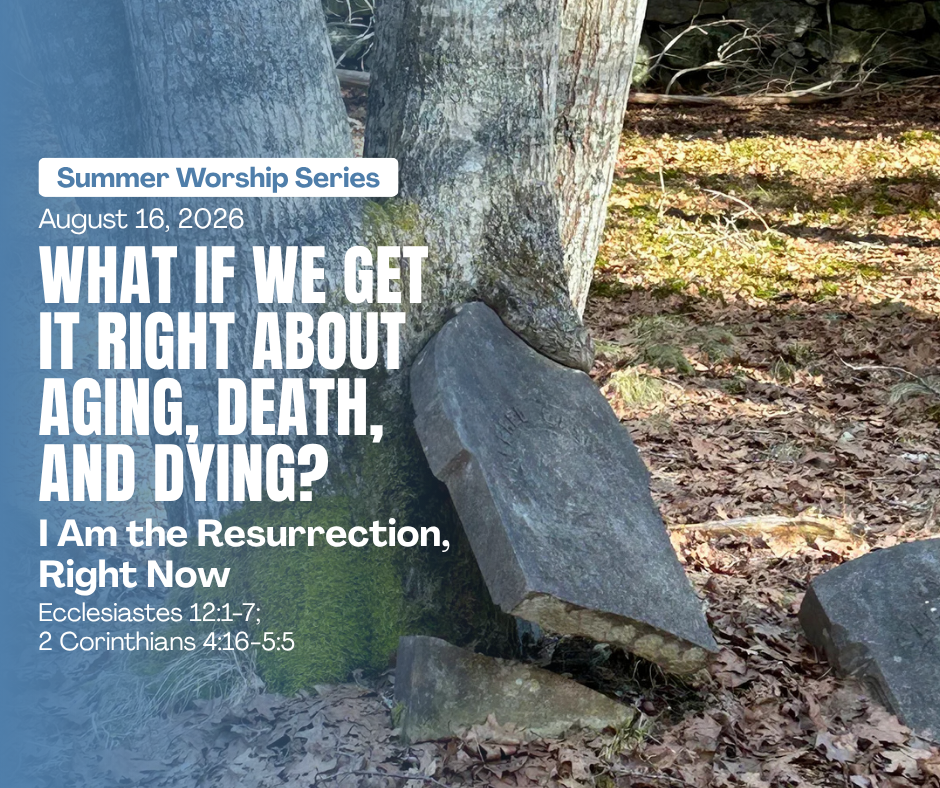
Part XII: What If We Get It Right About Aging, Death, and Dying?
I Am the Resurrection, Right Now
Ecclesiastes 12:1–7
Remember your Creator in the days of your youth,
before the days of trouble come and the years approach when you will say,
“I find no pleasure in them”—2
before the sun and the light
and the moon and the stars grow dark, and the clouds return after the rain;
3
when the keepers of the house tremble, and the strong men stoop,
when the grinders cease because they are few, and those looking through the windows grow dim;
4
when the doors to the street are closed and the sound of grinding fades;
when people rise up at the sound of birds,nbut all their songs grow faint;
5
when people are afraid of heights and of dangers in the streets;
when the almond tree blossoms and the grasshopper drags itself along
and desire no longer is stirred. Then people go to their eternal home
and mourners go about the streets.
6
Remember him—before the silver cord is severed, and the golden bowl is broken;
before the pitcher is shattered at the spring, and the wheel broken at the well,
7
and the dust returns to the ground it came from, and the spirit returns to God who gave it.
Thinking about death is an occupational hazard for clergy. A pastor who doesn’t deal with death should think about switching to accounting. Memorial services determine the success of a pastorate. Death is where it all gets real. It is when families quarrel or come together, when faith is deepened or sometimes lost. It is one thing to celebrate a long life, well-lived. But then there are the other funerals: a child killed in an accident, an overdose, a car crash, cancer taking someone in their prime. Nothing I can say can meet the moment when death is unfair, shocking, and cruel.
As a teenager I was no stranger to death; not just older relatives, but five classmates during my high school years. Two died by suicide, two while driving drunk, one in a tree-cutting accident. I attended the funerals where people shared tearful memories. There were assurances of going to heaven to be with God. But this did not answer my questions or fears. Life could end with a careless mistake. Someone I knew was so tormented and I had no idea. How is any of this fair? I wondered if heaven was just a story to make us feel better.
As a hymn droned along, I thought, “Life is short, and I had better get to it.” I had the chance my friends had lost. I don’t know if that was the best answer, but it drove me. How could I not be a serious person after that? I threw myself into doing something to leave a mark on the world. The writer Ernest Becker might have called this an immortality project — using human achievement to defend us against the reality that we all die. We take on great projects — art, wealth, running for office, heroic deeds, monuments to ourselves — to outrun the fact that we too will die. Like the pharaohs raising stone tombs as eternal memorials, we want something of us to last. Or we just buy a really fast car when the crisis hits.
My first year in ministry was a trial by fire. With the Senior Pastor on vacation, four people died in ten days, and I was the one standing in front of everyone, searching for something to say. “Live a meaningful life” felt cheesy; “your loved one is in a better place” felt like a Hallmark movie. Licensed but not yet ordained, I felt fraudulent. I needed something larger than anything I could create to say.
I was ordained that October, and the day after, a family in our church was murdered. The Brendells and their eight-year-old daughter were killed in a bizarre murder that made national headlines. We were all undone. Our Conference Minister, Rev. Daehler Hayes, led the Memorial Service. A family member spoke and angrily called for the death penalty, while reporters took furious notes. Daehler stood before us in that tense moment and closed his eyes and recited Psalm 46 from memory.
“God is our refuge and strength,
an ever-present help in trouble.
2
Therefore we will not fear, though the earth give way
and the mountains fall into the heart of the sea,
3
though its waters roar and foam
and the mountains quake with their surging.
He recited it all the way through, to “Be still, and know that I am God.”
Daehler did not tell us what the meaning of life was, or what we should do in response, or whether the death penalty was warranted. He never once mentioned heaven. He put us all in God’s hands. He named what was precious in each life lost, named the sorrow that consumed us, and assured us that God was present in all of it. And something inside me simply answered, “Yes.”
I think I have been learning ever since that Christian faith asks us to hold two truths together. Death is real. And so is resurrection. Resurrection does not make death unreal or erase our grief. It tells us that death is not the last word.
The poetry of Ecclesiastes holds two things at once: we are all fading toward death, and life is beautiful. It begins, “Remember your Creator.” The Hebrew zakhor is not simple recall; it means to orient your life toward someone, to order your days around them. As at the Last Supper, Jesus says to eat and drink in remembrance of him; not “don’t forget me,” but “remember how I lived.” Ecclesiastes says, savor the sweet things while you can. Enjoy the starlight and the birdsong, the strength and desire of the body, because someday you will fall apart. Your eyes will dim, and instead of leaping like a grasshopper you will drag yourself along. The poet is laughing a little at the indignities of age — the almond tree in blossom is your hair gone white. This is not meant to depress us but to counsel us: the words of a wise old person about how to live as we come apart. It will happen, so enjoy what you can. You came from dust and will return to dust; the breath of life from God returns to God. Don’t fight it, and don’t waste it.
Atul Gawande describes a similar outlook in his book Being Mortal. As a physician, he names the blind spot in our medical system: it treats death as a failure. But the length of a life is not more important than its quality. We say that someone fought cancer, or lost the battle with cancer. We want to honor the courage it takes to face illness and suffering with grace, and more power to them. But not everyone has to be inspiring to the very last minute. Staying alive a few extra weeks to suffer through chemo is not necessarily a victory. And saying, “I’m done; I want to spend my time with the people I love,” is not a loss. They are all choices.
Over thirty-five years of ministry I have had many talks about handing over the car keys, moving out of the house, what hymns people want at their funerals. At first these felt hard to face; now I know they are a gift. Telling our children what we want spares them the decision while we lie unconscious in a hospital. Keep your independence, but don’t be too stubborn about it. And if you are the grown child, invite the honest conversation: make peace that your parents will die, step up when you must, and respect their independence.
I officiated at a funeral for a woman named Agnes. She was eighty-three, and she died shoveling her own sidewalk. Her children were horrified to find her in the snow drift, and blamed themselves. I had visited Agnes a few months before, and she had told me her life story. Divorced in the 1940s, she raised five children on her own. She clerked in a store, cleaned houses, and learned to fix her own car — an independent woman in a time when that was frowned upon. I told her children that we might wish for a gentler death, but Agnes died on her own terms. She lived independent and she died independent, loving her family and still making herself useful. So be it.
Over the years I have wrestled with the hard questions. Why does a good and loving God permit death at all? Why do some suffer, why do the good die young? Is a better existence in heaven the answer? Will we really see our lost loved ones again? The truth is, I do not need those answers to live a faithful life. I need only to know that my life matters right now, today. I trust that I am in God’s hands for whatever comes.
Psychologist Irving Yalom believed that the limits death puts upon us are a gift for our lives. We tend to be procrastinators and put off many important things, thinking there will be time later. Yalom said that being in touch with our mortality can spur us to live more fully in the present. He set time limits of two years for individual therapy, because he believes limits made us do our work. We treat our lives with greater richness when we know our days are limited. Life is short, so get at it. Love it. Be present to it. And trust God with the rest.
Paul presses the same insight further when he writes about resurrection in Second Corinthians. Resurrection is not only what happens to us when we die; it is already under way. Day by day, Paul says, God is at work within us, making new life even as our bodies decline and fall apart. The point is not to wait for a reward in the afterlife, but to participate in the resurrection now.
We don’t have to defeat death to live well. We don’t have to know everything that comes after. We are invited to receive this life, to love it fiercely, to let it go when the time comes, and to trust the rest to God.
Because death is real. But so is resurrection—and it is already happening.