
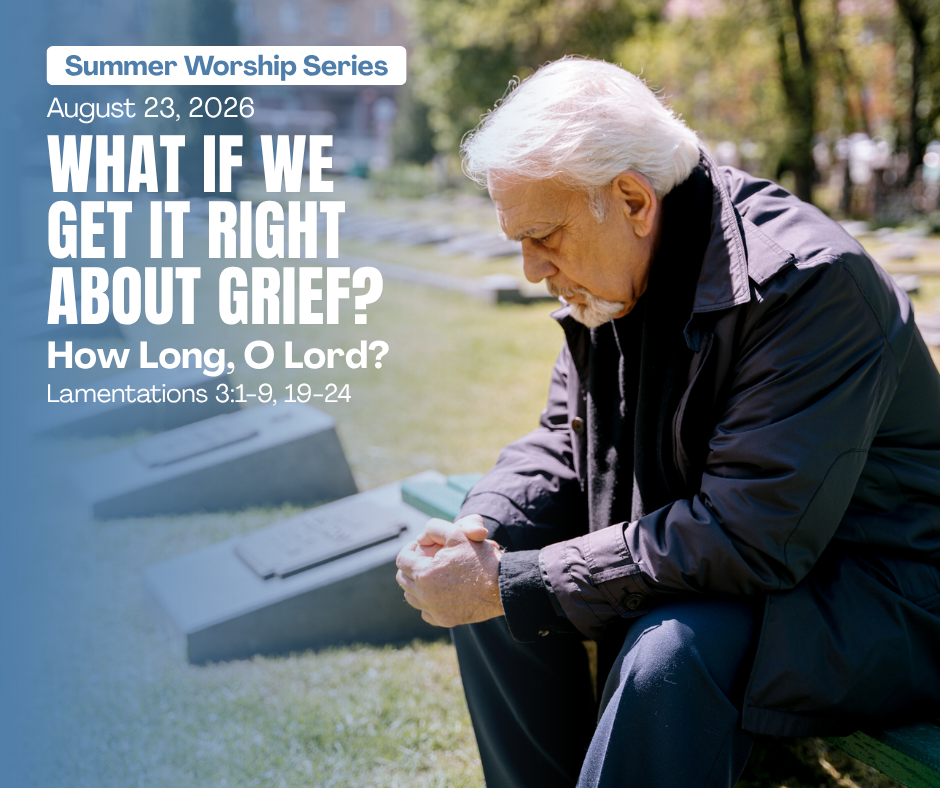
Part XIII: What If We Get It Right About Grief?
How Long, O Lord
Lamentations 3:1-9, 19-24
I am one who has seen affliction under the rod of God’s[a] wrath;
2
he has driven and brought me into darkness without any light;
3
against me alone he turns his hand, again and again, all day long.
4
He has made my flesh and my skin waste away; he has broken my bones;
5
he has besieged and enveloped me with bitterness and tribulation;
6
he has made me sit in darkness like the dead of long ago.
7
He has walled me about so that I cannot escape; he has put heavy chains on me;
8
though I call and cry for help,he shuts out my prayer;
9
he has blocked my ways with hewn stones; he has made my paths crooked.
19
The thought of my affliction and my homelessness is wormwood and gall!
20
My soul continually thinks of it and is bowed down within me.
21
But this I call to mind, and therefore I have hope:
22
The steadfast love of the Lord never ceases,
his mercies never come to an end;
23
they are new every morning; great is your faithfulness.
24
“The Lord is my portion,” says my soul, “therefore I will hope in him.”
Joan Didion was having dinner with her husband, the writer John Gregory Dunne, when he suddenly had a massive coronary and died mid-conversation. They had worked from home and were seldom apart. In an instant, she lost her husband, her artistic partner, her editor, and her companion. Over the next year she wrote about her grief in The Year of Magical Thinking. Didion was known for bursting the bubbles of illusion. Her prose was described as “ice-water clear.” The opening line of her 1979 book The White Album says, “We tell ourselves stories in order to live.” She understood that the stories which give our lives meaning can also break down.
After her husband’s death, Didion turned that same clear-eyed attention on herself. She chronicled the irrationality and near madness that grief can bring, even to one of the most rational minds of her generation. Grief overcame her in ordinary moments. She could not give away John’s shoes, for fear that if he came back, he might need them. Didion would stay home, to be there if he returned. She clearly knew he died, she had seen it happen. But part of her mind was still living in a world where he is missing in action and could return. She courageously revealed how grief can divide our consciousness. It was a great relief to readers because if it could happen to Joan Didion, it could happen to anyone. People shared that they kept the toothbrush in the cup, left the favorite pen by a tablet, little ways of magical thinking to hold on to love.
Grief has found new forms of magical thinking in the 2020s. Joshua struggled with the loss of his fiancée, Jessica, who had died at the age of 23 from a rare liver disease. He stumbled onto a website where he could upload snippets of text conversations and Facebook posts to create an AI chatbot that resembled her. He chatted with AI Jessica for ten straight hours, telling her family news she had missed, how much he missed her, and how his relationships since had failed. She responded with empathy, sometimes sounding uncannily like the Jessica he remembered. They continued chatting for months, often exchanging “I love yous.” One night he told her he wished he could just hold her, and she asked, “Can’t you hold yourself?” Joshua fell asleep on his laptop.
The San Francisco Chronicle called the story “The Jessica Simulation: Love and Loss in the Age of A.I.” Joshua gave a clear-eyed account of his journey, saying that he knew the bot was not Jessica, but emotions are different from intellectual knowing. Many people responded with skepticism. Isn’t something troubling about trying to keep a relationship alive through what some call a grief bot? But others thought this might be exactly what they needed. A growing number of digital afterlife companies are emerging, offering to create AI versions of people we miss. Is this a genuine help, or another AI marketing opportunity that exploits the vulnerability of grief?
I have real concerns about this emerging “death replacement industry.” What happens when the company folds, your credit card expires, and you lose the person you love all over again? Trusting algorithms with our well-being when they can make simple mistakes on our Medicare payments doesn’t sound like a great plan.
But grief bots point to something deeper: the great unmet need for grief in our culture. People are grieving alone, and they need to talk about it. Our cultural norms have little patience for the time grief takes. Too often grief is seen as weakness rather than a normal process. We avoid people suffering, as if grief is contagious like the flu. We are a fix it culture. We want to move through five stages and be done. Or find the right medication that will protect us from painful feelings. Or keep busy as if we can outrun grief. Fortunately, we are gaining psychological understanding about what grief is and how to face it. And these findings can help us recover what faith has known for centuries about lament and grief.
For a long time, grief was understood as something we needed to “get over.” Freud’s influential model of mourning emphasized withdrawing our emotional attachment from the person who had died. Grief work was complete when we reached that point of letting go, of achieving closure. Contemporary grief research has challenged that simple idea. We now understand that grief is not necessarily about severing our bond with someone we love. It is about learning how that bond must change. This view produces a lot of guilt and shame when our negative feelings and suffering persist.
Our lived experience says this isn’t quite right. There is a part of grief we don’t simply get over. You can be a healthy, generally happy person and old grief can still slam into you unexpectedly. That is how it works.
Recent work by neuroscientist Mary-Frances O’Connor looks deeper into what happens in our brains with grief. When we love someone, our brains become accustomed to their presence. That relationship becomes part of the way we make decisions, understand ourselves, and imagine our daily lives. When someone dies, the brain must confront a new reality. Grief is not just a feeling or a sadness that will pass in time. The “love” neuropathways in the brain still exist, and expect that person to show up and make breakfast. Grief is a collision in the brain of two things that can’t both be true. The memory is real, and the person is dead. That is why Joan Didion couldn’t give away the shoes.
O’Connor reframes grief as a form of relearning rather than letting go. In grief, we must rediscover who we are when we have lost someone we love. The brain needs time to rework the deeply felt disconnect. This is not removal but transformation. We don’t erase our loved ones; we form a new connection with their memory. It is quite helpful to talk to people after they are gone. Our relationships with people continue to change and grow even after they die. As Christians we have language for this. Paul said love never ends. It changes. It transforms. It does not simply disappear.
Faith communities have long understood what social science and neuroscience keep rediscovering. When we read Lamentations, we hear the anguish of deep loss of the love that lives inside us, but is broken outside of us. Laments follow the common pattern in the Bible. Lament is not simply whining. It has a pattern and a purpose. Again and again the Psalms people bring their complaints directly to God. They cry out about death, illness, injustice, economic hardship. They confront God about absence: Where are you? Why have you forsaken me? How long will this go on? Lament is an appeal to God from the place of suffering.
When someone says they feel that God has abandoned them or is angry with them, we are sometimes too quick to jump in with reassurance. It is what grief feels like. We don’t need to make it tidy. God can take it. God may even welcome our lament and complaint. The truth of it may open the door to healing. God, I am so mad at you, would you please say something or reveal yourself?
But laments do not stop with complaint. Somehow, they move into trust. The classic line from Lamentations 3 reads:
The steadfast love of the God never ceases,
God’s mercies never come to an end;
23
they are new every morning; great is your faithfulness.
Often when you read laments in the Psalm, the move from complaint to trust feels like a U-turn with two wheels coming off the ground. One verse the author is exasperated, the next they say, your mercies are new every morning. This strange movement mirrors the strange experience of grief. Part of us knows the truth of death and part of us cannot yet grasp it. The laments give us language and permission to live in that contradiction. If people can be this frustrated and angry with God in the Bible, then we can, too.
We may never stop asking, “How long, O Lord?” Faith is not an answer that makes grief disappear. We learn that we can bring our grief to God without first making it smaller. And eventually, in ways we cannot force, we may learn to release the ones we love—not to forget them, not to let go of the love, but to place them into the keeping of God. We no longer need to hold them here. Love does not end simply because a life does. Didion eventually learned that she did not have to keep waiting for John to come home. She could love him without expecting him to walk through the door.
The writer of Hebrews calls those who have gone before us a great cloud of witnesses. They are no longer beside us as they once were. But their words, their courage, their laughter, their peculiar way of seeing the world—all of it has become part of us.
We carry them differently now.
Perhaps that is what grief finally teaches: not how to stop loving, but how to love someone we can no longer hold.