
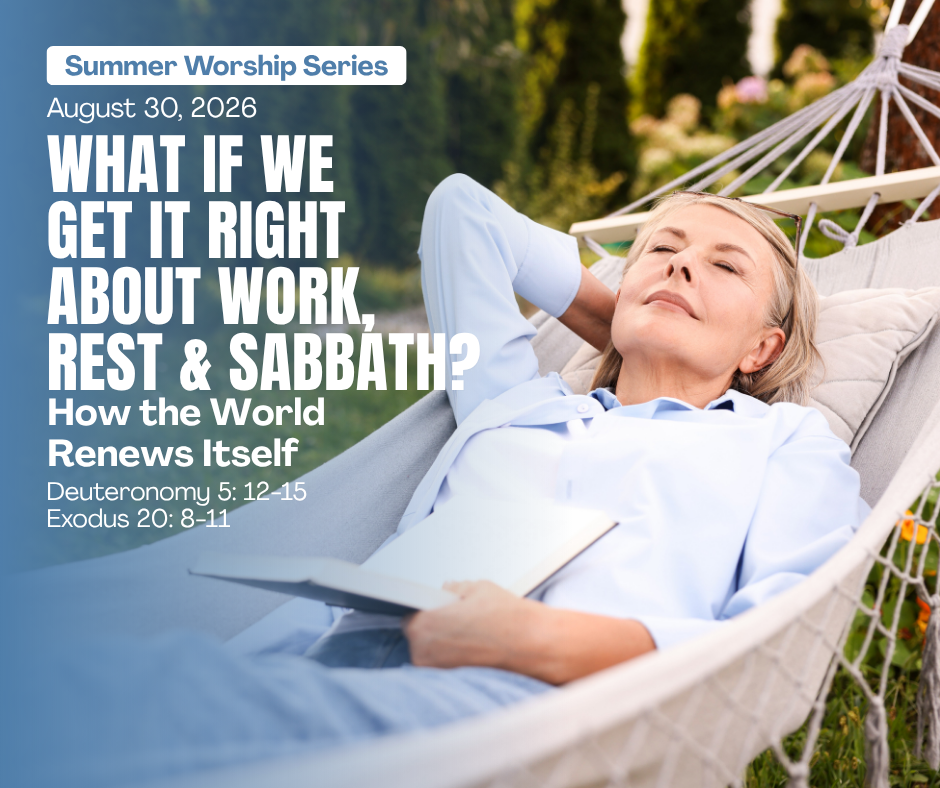
Part XIII: What If We Get It Right About Work, Rest, and Sabbath?
How the World Renews Itself
Deuteronomy 5:12-15
12 “ ‘Observe the Sabbath day and keep it holy, as the Lord your God commanded you. 13 Six days you shall labor and do all your work. 14 But the seventh day is a Sabbath to the Lord your God; you shall not do any work—you, or your son or your daughter, or your male or female slave, or your ox or your donkey, or any of your livestock, or the resident alien in your towns, so that your male and female slave may rest as well as you. 15 Remember that you were a slave in the land of Egypt, and the Lord your God brought you out from there with a mighty hand and an outstretched arm; therefore the Lord your God commanded you to keep the Sabbath day.On a visit to Mt. Sinai Hospital in New York, I pushed the elevator button, and nothing happened. The elevator moved with an agenda of its own, no matter what the passengers did, stopping on every floor. It was frustratingly inefficient, since the normal two-minute ride might be five minutes, and the stairs were much faster. I later learned this happened at every weekly shabbat, because Orthodox Jews could not push buttons on the Sabbath. Curiosity about the practice led me to discover other prohibited Sabbath actions; including driving a car, tearing open a bag of chips, inflating a balloon or water wings, or winding clocks and watches. These are all classified as impermissible work. Fortunately, you can eat lavishly, play games, do puzzles, read, study, and sex is not only permitted but encouraged.
Exodus 20:8-11
8 “Remember the Sabbath day and keep it holy. 9 Six days you shall labor and do all your work. 10 But the seventh day is a Sabbath to the Lord your God; you shall not do any work—you, your son or your daughter, your male or female slave, your livestock, or the alien resident in your towns. 11 For in six days the Lord made heaven and earth, the sea, and all that is in them, but rested the seventh day; therefore the Lord blessed the Sabbath day and consecrated it.
From our outsider perspective, these codes may sound legalistic, even petty or irrelevant. Why base Sabbath restrictions on ancient logic about inventions people never dreamed possible? But think for a moment about what people do on Sundays. Around 30 percent of Americans work on the weekend, because people want to shop, eat out, or other amusements. People catch up on work at home that didn’t get done the rest of the week. In Maine, summer Sundays mean sitting in traffic near Wiscasset. Many of us go to church, but that requires choir rehearsal, handing out bulletins, and coffee hour prep. Aren’t we just as busy on Sundays as every other day? Maybe the Orthodox are on to something. What really fulfills the purpose of the Sabbath?
The word sabbath originally meant to cease. Stop doing the work week, so you can rest, relax, savor and enjoy a day. Does that describe your typical Sunday? This stopping was considered important enough to make it into the Ten Commandments. It’s number four, behind no other gods, graven images and taking God’s name in vain; but before murder, stealing, lying and general mayhem. Why is Sabbath in God’s Top Ten? The Protestant work ethic has taught us to value labor almost above all else. Don’t we honor God with our fifty- or sixty-hour workweeks? Ceasing to work as a divine command acknowledges something simple: if we are going to love God and love our neighbors, we need time to do it. 24 of our 168 weekly hours, in fact.
Did you know there are two different listings two different listings of the Ten Commandments, in Exodus and Deuteronomy. The command to honor the Sabbath is mostly word for word the same. What both versions share is a comprehensive view that life needs time to stop.
On [the Sabbath] you shall not do any work, neither you, nor your son or daughter, nor your male or female servant, nor your ox, your donkey or any of your animals, nor any foreigner residing in your towns.
You can’t outsource your work to any living being. In other scriptures, especially the jubilee commands in Leviticus 25, even land is given a Sabbath. The soil should rest every seven years. Every 50 years, debts should be forgiven. Even money should take a rest. There should be a once in a lifetime chance to wipe the slate clean. Even sports understand the need for an offseason. If football season went all year, some marriages might end, civilization would collapse in exhaustion. Sabbath is essential to a life of shalom, so it’s the fourth commandment.
Exodus and Deuteronomy differ on the why. Exodus puts the focus on creation. “For in six days the Lord made the heavens and the earth, the sea, and all that is in them, but he rested on the seventh day. Therefore, the Lord blessed the Sabbath day and made it holy.” Even God stops. It is in the cycles of creation that things pause and renew. Leaves fall and trees enter a season of rest. Flowers blossom and wither, fruit ripens and drops, and the rhythms of creation continue through seasons of growth and renewal. To continue constant work is to fight against the nature of all creation.
Why does God stop? Does God get tired? Is that why there is always a bad news dump late Fridays, because God is starting Sabbath rest? Genesis says God stopped simply because the work was finished, and God then surveys creation and says, “It is very good.” Maybe divine energy can work 24/7, but Genesis says even God wants to stop and appreciate the work. There is wisdom in knowing when the work is done, and in taking time to savor what is good. Stopping is not just for physical needs, but to take some time to wonder and say, “This all very good.”
Deuteronomy gives a second Sabbath explanation that expands why it is necessary:
Remember that you were slaves in Egypt and that the Lord your God brought you out of there with a mighty hand and an outstretched arm. Therefore, the Lord your God has commanded you to observe the Sabbath day.
A good friend and colleague told me years ago, “Todd, you are doing some great work, but I don’t see your joy.” I drove myself from one accomplishment to the next. I had absorbed too much of our culture’s drive for productivity and success. I felt every moment should be productive. I catch myself still doing this. A few weeks ago, I completed every single thing on my weekly to-do list. I felt a moment of relief, but it did not make me happy.
I learned to have practices that guard against this self-imposed bondage. Sabbath takes some self-discipline as clergy, because we work on the Sabbath. I do three things regularly. I write in my journal every morning when I wake. I write down what was good from the day before. It reminds me that the things I do matter. Writing them down brings them to memory and makes them real. I also plan a mini-Sabbath during the day. I schedule in a walk, or time to eat that isn’t reading at my computer, or a nap. Naps are fulfilling the fourth commandment! It is important to know when something is done. To-do lists are endless. They grow faster than we can complete them. I make a mental short list of the three most important things I need to do, and prioritize them. At the end of the day, I can say, I’m done for now. Tomorrow is a reset. New are God’s mercies every morning.
Deuteronomy gives a second Sabbath explanation that expands why Sabbath is necessary:
Remember that you were slaves in Egypt and that the Lord your God brought you out of there with a mighty hand and an outstretched arm.
The social environment can unjustly rob people of Sabbath rest. Slavery and forced labor not only dehumanize people, it is breaking the command of Sabbath. When wages are so low that people must work multiple jobs and long hours just to survive, we have created a society where Sabbath is impossible. “Remember when you were slaves…” speaks to the necessity of creating a society where Sabbath is possible. If we don’t structure the life of community together, it is hard for a person to find any Sabbath rest.
Deuteronomy also says to remember that God brought the people out of Egypt. Sabbath is the time to stop and reflect on how God works in our lives. If we are always working, never stopping, we start to think that we are the power that drives things. It all depends on us. We can forget that God’s wisdom and grace are already moving among us. We can’t see the Spirit moving if we don’t stop. This stopping goes for congregations too. We can get so caught in choir rehearsals, potlucks, committee meetings, and fund raisers, that we forget what our mission is. Sabbath isn’t just about Sunday mornings, it is a work stoppage to reflect and think about why we are working, are we doing the right things, are we in tune with our vision? So perhaps the invitation of Sabbath is simply this:
Stop.
Stop to remember that we are more than producers and consumers. Our worth is not measured by what we accomplish. Stop to remember that Sabbath belongs to everyone. To children and workers, strangers and animals, even the land itself. If some of us can rest only because others cannot, then something is not yet right.
Stop to rest and renew. We are creatures, not machines. Stop to discern. To ask whether we are doing the right things, whether we remember what matters most, whether we are still listening for the Spirit. And stop to find joy again. The work will never all be finished. There will always be something more to do. But we can stop. We can look around. We can give thanks. We can remember what is good.
And we can trust that, for a while, the world does not rest in our hands alone. God is still God. So stop. And in the stopping, find your joy again.