

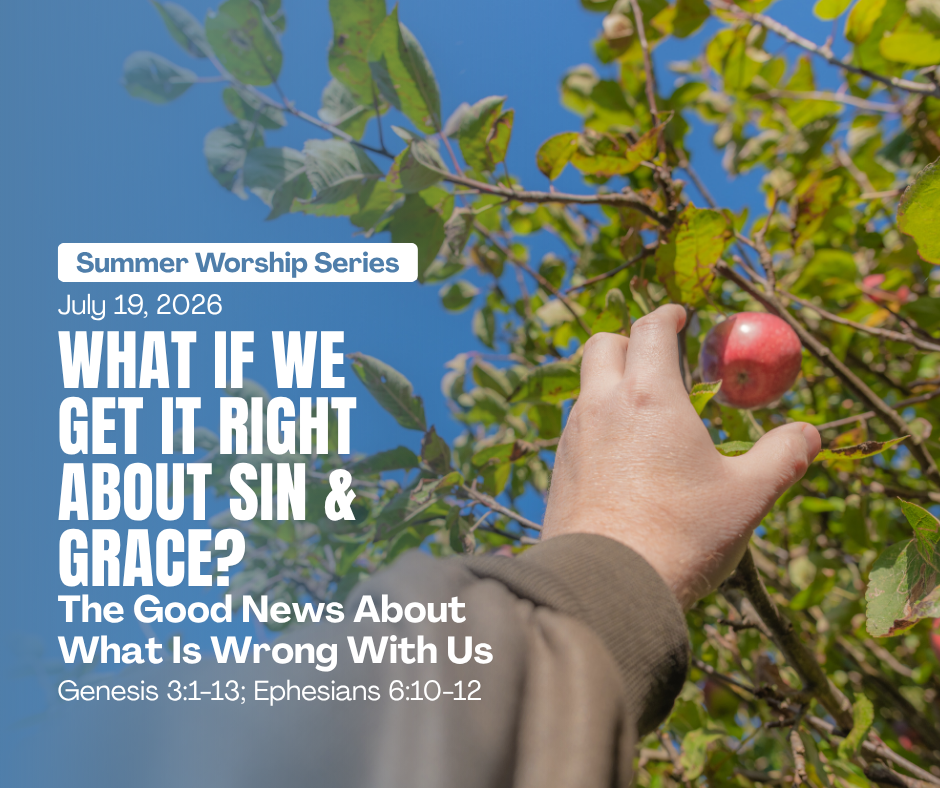
Part VII: What If We Get It Right About Sin & Grace
The Good News About What Is Wrong With Us
Now the serpent was more crafty than any other wild animal that the Lord God had made. He said to the woman, “Did God say, ‘You shall not eat from any tree in the garden’?” 2 The woman said to the serpent, “We may eat of the fruit of the trees in the garden, 3 but God said, ‘You shall not eat of the fruit of the tree that is in the middle of the garden, nor shall you touch it, or you shall die.’ ” 4 But the serpent said to the woman, “You will not die, 5 for God knows that when you eat of it your eyes will be opened, and you will be like God,[a] knowing good and evil.” 6 So when the woman saw that the tree was good for food and that it was a delight to the eyes and that the tree was to be desired to make one wise, she took of its fruit and ate, and she also gave some to her husband, who was with her, and he ate. 7 Then the eyes of both were opened, and they knew that they were naked, and they sewed fig leaves together and made loincloths for themselves.
8 They heard the sound of the Lord God walking in the garden at the time of the evening breeze, and the man and his wife hid themselves from the presence of the Lord God among the trees of the garden. 9 But the LordGod called to the man and said to him, “Where are you?” 10 He said, “I heard the sound of you in the garden, and I was afraid, because I was naked, and I hid myself.” 11 He said, “Who told you that you were naked? Have you eaten from the tree of which I commanded you not to eat?” 12 The man said, “The woman whom you gave to be with me, she gave me fruit from the tree, and I ate.” 13 Then the Lord God said to the woman, “What is this that you have done?” The woman said, “The serpent tricked me, and I ate.”
Genesis 3:1-13
American Christianity is still recovering from Jonathan Edwards’ sermon, “Sinners in the Hands of an Angry God.” Edwards didn’t invent preaching the wrath of God to terrify people into repentance, but he was good at it. Thousands of imitators adopted a simplistic and odd formula. Humans are terrible sinners deserving punishment. Graphic descriptions of sin and its frightening consequences are the best way to create change. God’s grace enters through human brutality executing Jesus on the cross. When we admit how wretched we are, God’s grace makes us pure and fully redeemed. Then, we are ready to tell others how miserable they are, and how good God is. It may sound like I’m being sarcastic, but that is the straightforward logic.
I do not believe this version of the Christian story has the power to make us more kind, more just, or free to pursue the abundant life God intends for us. Nor is it the biblical story of God’s dealing with us. Genesis 3 tells the first story about human sin, and it is a surprisingly better story. To contemplate the Garden of Eden, we need to clear out the invasive thorns that have choked it. As we do, the garden will reveal a faith that takes seriously both our human failings and the steadfast love of God to bring us back to wholeness and relationship.
I like stories that start with a tree. Trees are associated with goodness and abundance, providing shade, fruit, and oxygen. Eden is full of trees through which God’s abundance flows. As Matthew Fox wrote, this is not a story about original sin, it is a story about original blessing. All things are good, and on the sixth day of creation, God says humans are very good. The blessings of trees comes before the serpent. Genesis names the forbidden tree ‘tov w’ra’ (pronounced TOH-v veh-RAH), the Tree of Good and Evil. This Hebrew phrase works like our expressions ‘highs and lows’ or ‘the good, the bad and the ugly.’ It means everything, the whole spectrum. So, this is the tree of all-knowing, of omniscience.
Here is the first thorn we must remove from the garden. It has often been misinterpreted as the tree of moral reasoning. It never made sense to me that God would restrict moral reasoning from humans. Being created in the image of God, in Genesis 1, implies we can reason, make moral choices. The tree isn’t about restricting moral thought. It is about limits. We are human, mortal, sometimes clever, but short-sighted. We are not the final deciders of what is good and true. Nature has limits. Wisdom has limits. Power has limits. The temptation is to believe those limits no longer apply to us. Once we claim God’s place as the final judge of everything, creation begins to unravel.
The serpent has other ideas. It says to Eve, “Did God really say, ‘You must not eat from any tree in the garden’?” The seeds of doubt are planted. The twist of truth is subtle, implying God is restricting her from the fruit of every tree. Are you sure you understand God’s intent? Maybe God is holding out on you, Eve.
Eve clarifies, “We may eat fruit from the trees in the garden, 3 but God did say, ‘You must not eat fruit from the tree that is in the middle of the garden, and you must not touch it, or you will die.’” Eve is holding to the orthodox line, trying to do the right thing. In fact, she adds to the restriction beyond what God said. Don’t even touch it.
“You are not going to die,” chides the snake. You will be like God, you will know the tov w’rah, you will know everything you need to know. Imagine knowing everything. You would have the certainty to make every decision. If you know everything, would you ever worry or wake anxious in the night? Omniscience, confidence, clarity, God-like knowing. Many people expect exactly this gift from their religion. They want certainty. If you bite the fruit, you are initiated with the secret roadmap to success, fulfillment and truth. Don’t we all deserve a bite of that?
Eve thinks this over. It’s a good sales pitch. Listen to how her desire intensifies, “When the woman saw that the fruit of the tree was good for food and pleasing to the eye, and also desirable for gaining wisdom.” The marketing campaign is working. Five minutes ago, she thought she would die if she touched the tree, but now she thinks she might die if she does not have it. In Eve’s desire for the fruit, she forgets any consequences. What about God? What about her good life with Adam in the garden?
The tree is no longer something sacred. It is no longer a holy mystery that is both beyond us, and yet a part of our sacred world. It is now a commodity to be possessed. When a living thing becomes a commodity, we no longer respect its autonomy. We don’t think about its purpose, how taking it will affect the whole. We want it for ourselves.
Eve takes a bite. Didn’t she have enough? Paradise, plenty, harmony with God and creation. But the serpent said, ‘You will know like God knows. You don’t have to accept human limits, or stand in awe of mystery, or live with uncertainty.’ Before we condemn her, we have all sunk our teeth into it. It’s the story of human desire, life without limits, actions without consequences.
And then comes Adam. He is the passive one. Eve wrestles with the serpent and thinks it through. Adam just accepts this major transgression. He had one thing to remember. There were no Ten Commandments yet. Don’t eat from the tree of tov w’rah. Adam acts without a single comment, not even, are you sure? No self-examination. He just hands over his moral agency to someone else. So disappointing. The sin of apathy might be as bad as willfully doing wrong.
So, here is the big moment. Do they think like God yet? What will be the first exciting thought? “Oh my God, I’m naked!” It’s the nightmare you forgot to wear your pants to work come true. So, Adam and Eve quickly fashion some clothes for themselves out of fig leaves. The best they can do is weaving with flimsy, scratchy, sappy fig leaves. All-knowing isn’t all it’s cracked up to be. It leaves Adam and Eve deeply vulnerable and ashamed. Jack Nicholson was right in the movie “A Few Good Men.” We can’t handle the truth.
God now enters from stage left and everyone plays the first game of hide and seek. “Where are you?” God beckons. The man answers, “I heard you and I was naked and afraid.” “Who told you, you were naked? You took the bite, didn’t you?”
“The woman you put here with me—she gave me some fruit from the tree, and I ate it.” 13 Then the Lord God said to the woman, “What is this you have done?” The woman said, “The serpent deceived me, and I ate.”
The bitter fruit of eating from tree of tov w’rah is fear and blame. We mostly know when we have spoken or acted wrongly. But instead of taking responsibility, both characters throw blame around the garden. The man blames God and the woman, who then slams the serpent, who has slithered off. Paradise has not been destroyed by knowledge. It has been fractured by fear and mistrust.
What is a good God to do? The stated punishment was death. But God does not execute the sentence. Instead, God asks a question. Where are you? It is a powerful spiritual question. Where are you right now? God knows they are crouched behind the trees, trying to be invisible. The question is not a search. It is an invitation. Come out. Tell me where you are. The conversation is not over.
Before God names any punishment, God makes them proper clothes. The first act of grace in the Bible is God clothing the people who just ignored God’s trust. The steadfast love does not wait for us to get ourselves together.
This is the good news about what is wrong with us. The diagnosis is honest. We grasp, we hide, we blame. But God searches for us, asks the tender question, provides what we could not manage for ourselves. Grace meets us at the relational level, in our hiding place, before we have found the words.
St. Ignatius wrote that all sin begins in forgetting that life is a gift, forgetting the original blessing. We begin to believe what we have is ours alone, instead of something entrusted to us. Gratitude remembers the truth. Our breath, our freedom, our faith, even our capacity to love, have all been received and they are meant to be shared.
Gratitude opens our hands again. It reminds us that life has always been gift. That is the way back to the garden. Not because gratitude makes us worthy of God’s grace, but because it teaches us to receive the grace that has been there all along, and to pass that gift along to others.