

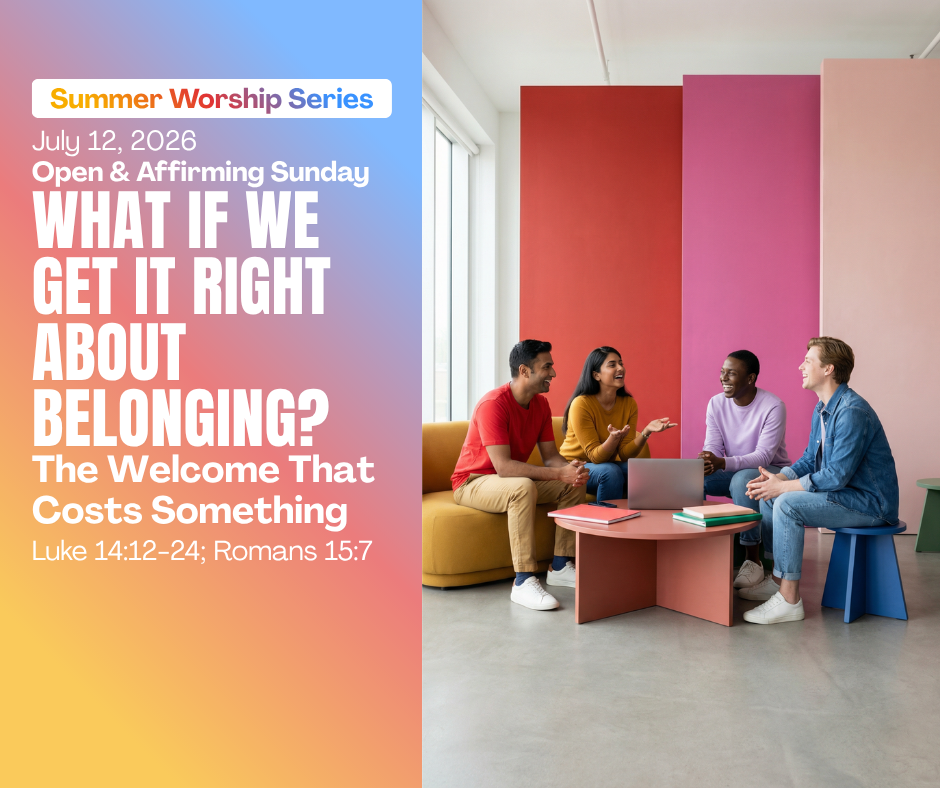
Part VI: What If We Get It Right About Belonging?
The Welcome That Costs Something
Sermon starts at 22:08
Good morning! In my sixth sermon asking “What if we get it right?” I reflected on the topic of belonging and welcome. Saturday we held a Pride event on the Boothbay Town Green. Last year the town refused to put up a rainbow flag on Pride month, so we decided to hold an event across the street, and make everything rainbow. We added a jazz band, lawn games and snacks. About 50 people stopped by, which is good for Boothbay Harbor on a beautiful day and most people are out on the water. What struck me was the number of people who just moved to the area, and were looking for community. They had all driven by the church and seen our banners, but it takes a proactive, extravagant welcome to build a community of belonging. I wrote the sermon before the event, but I think it fits.
7 Welcome one another, therefore, just as Christ has welcomed you, for the glory of God.
Romans 15:7
15 One of the dinner guests, on hearing this, said to him, “Blessed is anyone who will eat bread in the kingdom of God!” 16 Then Jesus[a] said to him, “Someone gave a great dinner and invited many. 17 At the time for the dinner he sent his slave to say to those who had been invited, ‘Come, for everything is ready now.’ 18 But they all alike began to make excuses. The first said to him, ‘I have bought a piece of land, and I must go out and see it; please accept my regrets.’ 19 Another said, ‘I have bought five yoke of oxen, and I am going to try them out; please accept my regrets.’ 20 Another said, ‘I have just been married, and therefore I cannot come.’ 21 So the slave returned and reported this to his master. Then the owner of the house became angry and said to his slave, ‘Go out at once into the streets and lanes of the town and bring in the poor, the crippled, the blind, and the lame.’ 22 And the slave said, ‘Sir, what you ordered has been done, and there is still room.’ 23 Then the master said to the slave, ‘Go out into the roads and lanes, and compel people to come in, so that my house may be filled. 24 For I tell you,[b] none of those who were invited will taste my dinner.’ ”
Luke 14:15-24
This Summer Jeanne and I made a momentous decision to replace our porch furniture. We gave away our four chairs and table and purchased a six chair and table set. For an introvert-leaning couple, this is a bold move. Inviting two extra people for dinner may not seem like much, but to us it is a 50 percent expansion of our hospitality. It’s two more people to incorporate their diet preferences, to remember if their kids got married yet, or their recent health problems. Being a good host is more than making the food, it is about attention to everyone present, creating a deep conversation. An eight-person table would drive us over the edge. A genuine welcome takes attention and energy.
I was recently at an event with 60 people, and I knew maybe 7 of them. I can be quite content to hang back and watch the room. Who is holding court, who is left out? Governor Janet Mills came in, and I watched who made a beeline for her. I must push myself out there to meet people, and if I have three good conversations at a social event, I consider it a success. But I find the social dynamics and etiquette to be exhausting. What I notice is the more I feel like I belong in a group, the more comfortable I am in engaging people, and the less I feel belonging, the more reticent I am.
Welcome and belonging are two sides of the same coin. Without a genuine welcome, no one feels like they belong. And without creating belonging, welcome is not complete, it’s just being nice. Most churches think they are welcoming, they even have signs in the yard that proclaim everyone is welcome. But experience says churches get bogged down in the all the human challenges of forming groups of belonging. We have hierarchies, cliques, gatekeepers, and unwritten rules of behavior you don’t know about until you have broken them. My hope this morning is not to judge churches for being unwelcoming, even hostile to some people, but to acknowledge how hard a genuine welcome truly is. What does it take to do it better? And the measure of God’s extravagant welcome in our scripture lessons is this: can you welcome people when they are different from you, especially when it costs you something?
I am impressed with Jesus’ ability to read the room in Luke 14. He is at the kind of social event that makes me cringe. He accepted a dinner invite to a large gathering at a Pharisee’s house. Ugh! It’s an invitation I wouldn’t want to accept but know I really should go. Before he tells the parable, he watches people competing for the best seats and trying to impress each other. Ancient banquets had strict etiquette for who sat where, who talked when, and who was invited or not, based on social hierarchy. These were not church potlucks, but more like high powered networking events. Today you would take business cards and brush up your elevator speech.
Jesus tells a parable about a host whose banquet to win friends and influence people is about to crash and burn. The first invite list includes all the right people, but some of the RSVPs who said “yes” are now cancelling late. They make polite excuses. I bought a field I must go see. I bought five new oxen and must try them out. I just got married. All these excuses sound somewhat plausible but are still a bit insulting. The first two are missing because of work, and business is business, but it is still rude to cancel late. And it says our wealth is more important than your banquet. And didn’t the third guy know he was getting married ahead of time? That’s lame.
In Jesus’ culture this is very insulting. It’s a disaster for the host because not only is he being socially shamed, but the banquet is ready and he has all this food. I understand his anger. I wonder if there is a modern parallel to church attendance. Most of you remember the days when Sunday used to be a larger banquet. Many churches struggle with the feeling of why don’t more people come? Don’t we have a good choir, and preaching, and community. It’s good for people to come to church. So where is everyone, don’t they like us? We are really nice. Like the host, our first reaction might be anger. We try so hard, so why don’t people come. And the excuses we hear don’t quite ring true. So many churches start blaming the guests. Something must be wrong with them.
But look at what the host does next. Rather than lash out, he does a second round of invites.
‘Go out quickly into the streets and alleys of the town and bring in the poor, the crippled, the blind and the lame.’
This invite is very different than taking all the extra food to the pantries, shelters and soup kitchens. The edginess of the parable is it means inviting all these folks of lower social status to come and mix with the other guests. These folks probably don’t have suits and evening gowns, let alone business cards. What are you going to talk about?
This invite is still not enough. The host says,
‘Go out to the roads and country lanes and compel them to come in, so that my house will be full. 24 I tell you, not one of those who were invited will get a taste of my banquet.’”
Now he wants to invite people “from away.” (That’s a Maine expression for everyone not born here.) The stranger, people without status, people we are not sure what to do with. Remember the host is inviting the island of misfit toys to dine with all his best friends and business associates. This banquet is not going to win friends and influence people. It could get awkward. Some people might leave early and stop inviting you to their parties. But the chairs will be full, the food eaten and if you risk some conversation, you might learn things you never thought about before.
Inviting people to the table isn’t a charity dinner. It is not searching for people who fit our club. Welcoming doesn’t come natural for most of us. Because it stretches our comfort zones. A clergy colleague told us she went to a local Queer Coalition meeting. Even though she is a lesbian, she felt out of place with the younger crowd. She said, “They are addressing issues I’m only becoming aware of. I feel like a tame old cat lady in comparison. I’m still wrapping my mind around non-binary, and the challenges of polyamory. Are we ready with liturgies for weddings of thruples?” You may think we aren’t ready these kinds of marital covenant arrangements, but Jacob in the Bible was married to two sisters, Leah and Rachel. So, they were a thruple.
How do navigate the complex and changing dynamics of gender and sexual orientation in a Christlike manner? First, we must acknowledge we are not going to find simple answers in the Bible. Polygamy was common, even required by law. If your brother died, you were to marry his wife. Paul was skeptical that marriage was a good idea. Searching for proof texts about modern sexuality and gender norms is fruitless. The Bible knows nothing about transgender issues, nonbinary identity, and women having the rights of men happened five minutes ago in human history.
The Bible can’t give us a rulebook for situations it never imagined. What it does give us, consistently and without ambiguity, is a posture. Welcome the other. Welcome the stranger. Love your enemies. Do unto others and you would have them do unto you. In Romans 15:7, Paul is concluding his message to a hostile and divided church on ethics and theology. He doesn’t say which side is correct on complex cultural issues between Gentiles and Jews. Instead, he says, “Welcome one another, therefore, just as Christ has welcomed you, for the glory of God.” The underlying Greek word is much more than toleration or acceptance. It means to embrace someone, bring them into your circle, treat them as a part of your household.
We bought six chairs this summer. Two more places at the table than we needed. That’s what hospitality requires. You prepare for people who aren’t there yet. Too many people have been told by churches that there is no chair for them. Jesus tells a different story. He keeps adding chairs. He keeps widening the circle. He keeps asking us to make room for people who will stretch us, surprise us, and perhaps even change us.
Our task isn’t simply to put a sign on the lawn that says, “All are welcome.” Our task is to become the kind of people for whom that welcome is real. Because welcome isn’t complete until it becomes belonging.
So, this week, as you sit around your own table, or as we gather around this one, perhaps ask yourself: Whose chair is still empty? And what might it cost me to make sure they know it was always meant for them?