
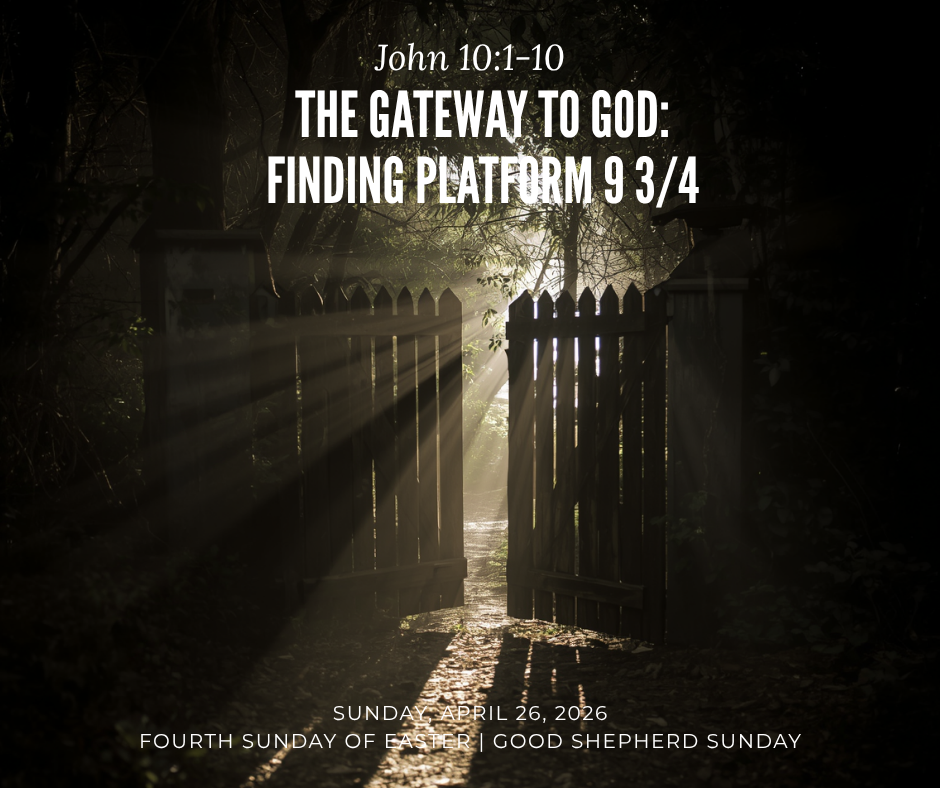
Finding Platform 9 3/4
The Gateway to the Life of God
“Very truly, I tell you, anyone who does not enter the sheepfold by the gate but climbs in by another way is a thief and a bandit. 2 The one who enters by the gate is the shepherd of the sheep. 3 The gatekeeper opens the gate for him, and the sheep hear his voice. He calls his own sheep by name and leads them out. 4 When he has brought out all his own, he goes ahead of them, and the sheep follow him because they know his voice. 5 They will not follow a stranger, but they will run from him because they do not know the voice of strangers.” 6 Jesus used this figure of speech with them, but they did not understand what he was saying to them.
7 So again Jesus said to them, “Very truly, I tell you, I am the gate for the sheep. 8 All who came before me[a] are thieves and bandits, but the sheep did not listen to them. 9 I am the gate. Whoever enters by me will be saved and will come in and go out and find pasture. 10 The thief comes only to steal and kill and destroy. I came that they may have life and have it abundantly.
Jesus says, “I am the gate; whoever enters through me will have salvation.”
I sometimes dream that I’m searching for a doorway. I’m circling a building, looking for the entrance. Or I’m walking a hallway, and I can’t find the right room number. I see room 102 and room 106, but I need room 104. I wander dream hallways from my past; college dorms, a childhood friend’s house, a Cathedral in Siena; Italy, searching in vain for the right door.
If you have had a dream like that, you are not alone. Searching for the secret door is a common motif in dreams and literature. Sometimes you need a clue, like Ali Baba discovering the secret password “Open Sesame!”
We long for the door that will lead to a better life, more freedom, a sense of belonging. At times life is like the movie where we try to escape down a corridor, finding all the doors locked along the way. We can’t turn the knob on a better job, financial security, getting the love we want. When life slams the door in our face, we hope the old proverb is true, when one door closes, another one opens. We live in hope that Door Number One is luxury trip to Aruba, and not the lifetime supply of Cheetos. Sometimes the door we want is so simple. For me, it would be a life that is resonate with meaning and simple joy. We feel so close to the gate, but it hidden, like our strange dreams, so close yet so far from finding our way.
For example, Harry Potter is told he is a wizard and has a train ticket to Hogwarts that boards on Platform 9 3/4. But the London train station has no such platform, so he’s lost. Mrs. Weasley shows up and tells him plainly, “You walk straight at the barrier between platforms nine and ten. Don’t stop and don’t be afraid.” Harry stares at the brick wall in wonder. There are no signs of an opening. People are swarming around him in the busy station, and if he walks into a wall, they will think he is silly. Harry finally finds the courage to move, and charges the wall and emerges on the other side, into a new world that will lead him to Hogwarts.
Finding the gateway to something new requires a different perception. The barriers exist in our minds, if only we can find the vision or attitude to get where we need to go. Carl Jung believed searcher dreams occur when we are at a threshold. Something unconscious is close to us but we can’t yet reach it with our normal outlook. Or we are longing for something new, but we don’t know what it is yet. We stand at a life passage, the next stage in our development. We are trying to integrate a part of our experience, a grief, a failure, but we aren’t quite ready to absorb it. Jung believed these dreams are invitations, trying to help us in our search. Our psyche is beckoning us to look at things in a new way. You can’t move forward in the old way. Instead, you may need to let go and trust to find the true gate.
What if Jesus, describing himself as the gate, is pointing to something more like Platform 9¾ than we’ve imagined? The Pharisee’s interpretation about the meaning of the gate is too concrete, where Jesus was referring to a deeper human experience. A standard interpretation is that Jesus is what we have all been looking for. He is the only way. He is the “Open Sesame.” If you believe in the right way, say the right theological words, you may pass. “Accept Jesus Christ as your Lord and Savior.” Or recite the Apostles’ Creed. Or believe in the transubstantiation of bread and wine to flesh and blood. We turn the gate into our specific entrance formula about who gets in and who is left behind. Clergy become the gatekeepers, the bouncers at heaven’s door, asking for the password. If someone give the wrong answer, they shall not pass! The Pharisee seems stuck here, too literal, too stuck in laws and rules, to understand what the gate is.
Our more open UCC tradition still finds ways to make the gate to God hard to find. We can make the gate behavioral. I need to be a good enough person to get through the gate. I need to do enough good deeds, to achieve something great to be accepted by God. I must be morally pure enough to pull the sword from the stone to be a leader. Our way through the gate is to try to be perfect, or valuable. This kind of quest leaves us anxious before God. Am I in or out? Am I good enough to belong?
When we become anxious, we build false gates — places of certainty and control that feel secure but don’t actually lead to God. The Pharisees were not malicious. They were spiritually anxious, and they built their anxiety into stone: rules, purity codes, pressure to conform. Jesus says they were climbing over the wall rather than coming through the gate. The way of the good shepherd is different — and to understand it, we need to understand the sheepfold itself.
The sheepfold was an open-air enclosure, often made of rock like our many walls here in New England. It was common space shared by all the shepherds in the community. They brought their sheep in for safety in the night, and took turns guarding the gateway. The shepherd’s body was the gate, so they were both gate and gatekeeper for the good of everyone. In the morning each shepherd would call their flock to come out and graze, and the sheep would sort themselves out by knowing the voice of their shepherd.
This rich metaphor challenges our Pharisee-like journey when we try to define and control the gateway to God. If Jesus is the gate, then he is the one who offers the way into a shared common space. He called it the Kingdom of God. Dr. King called it the Beloved Community. It is the space of shalom, where we live together seeking the peace of mutual respect for the common good. It is not a space we can obtain by ourselves, to keep for ourselves. To enter the gate means we agree to live in this kind of relationship. The secret word to pass through is love. It’s so simple we can’t always see it.
In The Lord of the Rings, the Hobbits and Gandalf are stymied by a gate at a mountain pass. Gandalf reads the elvish inscription, “The Doors of Durin, Lord of Moria. Speak, friend, and enter.” What are they supposed to speak? They spend hours on the riddle. Gandalf tries all the spells and word associations he can think of. But the doors stands firmly closed. Suddenly Gandalf laughs as he gets it. He only needs to speak the word “friend” and enter. When he says “friend” the great door opens. All the door asks is that you come in friendship. The secret is simply coming to the door in the right spirit.
We live in a world full of gates. Gates of fear. Gates of certainty. Gates that promise safety if we just believe the right thing, or follow the right people, or stay on the right side.
But Jesus is clear—those gates do not lead to life. “I came that they may have life, and have it abundantly.” Abundant life is not built on fear. It is not sustained by exclusion.
It is not guarded by anxiety. It is found where love opens space—where people are known, where dignity is honored, where grace is real.
Maybe that’s why the gate can feel so hard to see. Because we keep looking for something more complicated. Something we can control. Something we can measure. But Jesus doesn’t give us a test. He gives us himself. Not the password, but a presence. Not the barrier. The gate.
The gate is not something we achieve. It is something we learn to trust. Remember Harry standing before the wall—unsure, afraid, wondering if he will look foolish, and then taking a step anyway. So maybe the question is not, “Am I in or out?”
Maybe the question is:
Where in my life am I still standing in front of the wall…
when the invitation is to trust, and step through?
Because on the other side is not judgment. Not scarcity. Not barely enough. On the other side is life—full, abundant, overflowing with meaning and connection. And it may be closer than we think. Right here—waiting for us to step through.