
Where Fear Ends and Shalom Begins
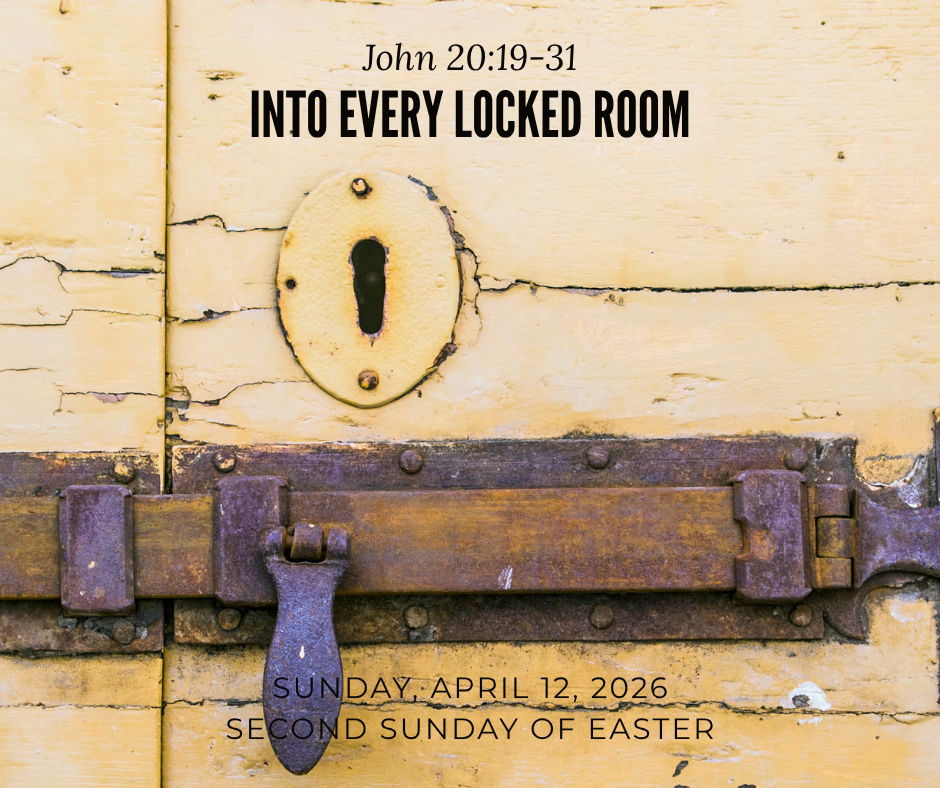
John 20:19-31
19 On the evening of that first day of the week, when the disciples were together, with the doors locked for fear of the Jewish leaders, Jesus came and stood among them and said, “Peace be with you!” 20 After he said this, he showed them his hands and side. The disciples were overjoyed when they saw the Lord.
21 Again Jesus said, “Peace be with you! As the Father has sent me, I am sending you.” 22 And with that he breathed on them and said, “Receive the Holy Spirit. 23 If you forgive anyone’s sins, their sins are forgiven; if you do not forgive them, they are not forgiven.”
24 Now Thomas (also known as Didymus[a]), one of the Twelve, was not with the disciples when Jesus came. 25 So the other disciples told him, “We have seen the Lord!”
But he said to them, “Unless I see the nail marks in his hands and put my finger where the nails were, and put my hand into his side, I will not believe.”
26 A week later his disciples were in the house again, and Thomas was with them. Though the doors were locked, Jesus came and stood among them and said, “Peace be with you!” 27 Then he said to Thomas, “Put your finger here; see my hands. Reach out your hand and put it into my side. Stop doubting and believe.”
28 Thomas said to him, “My Lord and my God!”
29 Then Jesus told him, “Because you have seen me, you have believed;blessed are those who have not seen and yet have believed.”
Good news does not always come in a perfect package that makes our life better in every way. That is why people often say they have some good news and some bad news. The good news is your offer on your first home is approved. But you have a lifetime of maintenance and repairs. Your daughter got a full ride scholarship to her top school, but she is moving away to California. Perhaps the most terrifyingly joyful news is that you are pregnant. And then begins the rollercoaster ride of a lifetime, and there is no getting off.
Good news changes our lives for the better, while it also reshapes us is ways that we do not expect. A new opportunity opens a door, but we must let go of one thing to hold another. Good news can come with new pressures, responsibilities and choices as we follow a new path.
In hindsight, we believe that the post-Easter message that Jesus is risen is good news. But in the moment, the disciples were struggling with what to do. Here is what they know. Mary Magdalen has told them that she met Jesus outside the tomb, that he asked her why she was weeping, and then he spoke her name. She hugged him, so he is not a ghost or an apparition. What do they do with this good, but unbelievable news? They are not singing Alleluia. They are meeting behind locked doors to discern what it all means.
I don’t stand in judgement of them. I lock my doors at night. We lock doors when we are fearful that something bad could happen. Open doors might be OK in Boothbay Harbor, but not in Queens. Sometimes the realistic thing to do when we are afraid is to lock the door.
The disciples just witnessed their teacher arrested after committing no crime, the high priest condemns him before hearing the evidence, then stirs a mob to shout, “Crucify him.” They watched Pilate declare Jesus innocent and execute him anyway. When people entrusted with the common good use power to protect themselves instead of truth and the common good, something fractures. People who see it clearly are not wrong to be afraid.
Many of us know that feeling right now. We have watched institutions we were taught to trust behave without accountability. We don’t fully know what is happening in detention facilities. Cabinet members and generals removed or rewarded based on loyalty rather than truth or law. Words about ending a civilization. Are we wrong to ask how safe we are? I’m not trying to start a debate. I am naming what we are living through because the disciples would recognize it.
James Baldwin wrote that we cannot change what we do not face. We face it by naming what is torn. We name what we fear. Because we cannot receive new life while refusing to name what is breaking. And then—only then—something happens.
Jesus enters the room. If Jesus can enter the locked room, he can enter the mind that is closed to possibilities. He can enter the heart numbed by suffering to bring compassion. He can enter injustice and bring hope where it was hopeless. Jesus can enter the place where we live in fear and be present to us.
As the disciples stare in wonder, he says his first words. Notice he does not say, “Be not afraid,” as most angelic greetings. He says, “Peace be with you.” At first, we might think it is a standard greeting, but Jesus repeats the words three times in this passage, so it must mean more. In the middle of writing, it occurred to me that Jesus spoke of peace at the Last Supper in John 14.
Peace, I leave with you; my peace I give you. I do not give to you as the world gives. Do not let your hearts be troubled and do not be afraid.”
So, Jesus’ words after his resurrection are completing what he said before his death. The peace he gave wasn’t mere assurance, but a tangible, living reality. What kind of peace was he giving, and how might it extend to us even now?
The Greek word Eirene used here generally means the absence of conflict. Most of us would like an end to conflict, but peace is more than just an end to hostility.
The disciples were living during Pax Romana, the Peace of Rome, the famed 200-year period in Roman history where there was little warfare because the legions had conquered most of what could be reached. It was peace through military conquest, of repressing internal dissent, a regime where the man called the Prince of Peace was crucified as a threat to order. No wonder Jesus said I give you peace, not as the world gives.
Jesus more likely spoke in his native Aramaic, saying “Shalom be with you.” Rabbi Jonathan Sacks described it this way:
“Shalom does not mean merely the absence of war or strife. It means completeness, perfection, the harmonious working of a complex system— a state in which everything is in its proper place, and all is at one with the physical and ethical laws governing the universe.”
And the medieval commentator Rabbi Isaac Arama added: “Peace is the thread of grace issuing from God, stringing together all beings….It underlies and sustain the reality and unique existence of each.” When Jesus speaks shalom into that locked room, he is not merely saying: the conflict is over. He is saying: the thread has not broken. Wholeness is here, in this body, in these wounds.
After Jesus says peace be with you a second time, he does something odd and somewhat uncomfortable. He breathes on them. When we sing the song Breath on Me, Breath of God, we think of it as a lovely metaphor representing the closeness of God’s spirit. But generally, I don’t like people breathing on me. I don’t want to know what garlicky thing they ate for lunch. I don’t want their germs. Unless you are my wife Jeanne, back off. If someone is breathing down my neck, it’s menacing. The enemies of Jesus were breathing down the disciples’ necks.
Why is Jesus breathing on them? The answer takes us back to the creation accounts in Genesis 2. There we read an intimate account of God forming the body of the first human from clay. The moment of life occurs when God breathes into the nostrils, and animates the first human with breath. The lungs rise and fall and the human adventure begins. Jesus is reanimating human life as his breath covers the disciples. He is intimately calling forth the creative powers of all life and covering the disciples with his warm breath.
As Jesus does this, he says to them, “Receive the Holy Spirit.” He speaks in the imperative, it is a command. This gift is not for passive reception, not merely forgiveness or blessing, but a command to take in the life of the Spirit. It is John’s Pentecost moment where is sends the disciples back into the turmoil of the world. He sends them with two gifts, shalom and Spirit. They are equipped knowing the deeper harmony at the very heart of the universe and empowered with the life-giving Spirit of creation. These are the resources for all disciples, now and then, to resist and overcome forces of division, destruction and hatred.
And Thomas missed it. He wasn’t in the room. Arriving late to the scene, he demands the tangible proof of the wounded body. Who can believe such things are possible? Thomas gets a bad rap, because every person in the room only felt safe with a locked door. Thomas puts each of us at the scene. He is us when we tremble at the power of Pax Romana and live as if shalom is unattainable. He is us when we think these are nice stories from the past, but the living God no longer acts among us. He is us when we think we missed out because we weren’t in the room with Jesus 2000 years ago.
When Jesus says, “Blessed are those who have not seen and yet have believed,” he is putting all of us in the room. The risen Christ still walks through locked doors of our hearts and minds. And if that is true—then this is true:
Nothing is broken beyond repair. Nothing is beyond healing. We have not seen him with our own eyes. But now we are in the room. The doors we lock out of fear do not keep him out. He still comes. He still speaks peace into our fear. He still breathes life into what feels lifeless. The breath is warm on our cheeks.
“Receive the Holy Spirit.” And then he sends us. Not when everything is resolved.
Not when we are no longer afraid. But now.
So go— and carry that peace into a world that is still afraid. Go—and give away the breath you have received.