
Many Dwelling Places
The Answer to Our Uproar
John 14:1-7
“Do not let your hearts be troubled. You believe in God[a]; believe also in me. 2 My Father’s house has many rooms; if that were not so, would I have told you that I am going there to prepare a place for you? 3 And if I go and prepare a place for you, I will come back and take you to be with me that you also may be where I am. 4 You know the way to the place where I am going.” 5 Thomas said to him, “Lord, we don’t know where you are going, so how can we know the way?”
6 Jesus answered, “I am the way and the truth and the life. No one comes to the Father except through me. 7 If you really know me, you will know[b]my Father as well. From now on, you do know him and have seen him.”
Sometimes I read the Bible, and I want to edit it, not to change it, but to hear it more clearly. A tweak of a word or two makes it more intelligible to the modern ear. Some people think that makes me a heretic, messing with the infallible word of God, making the Bible say what I want. But the truth is translators are always making subtle choices that have far reaching consequences. Understanding a Greek word and coming up with the correct English word is an act of great faith. As Mark Twain quipped, “The difference between the right word and almost the right word, is the difference between lightning and lightning bug.”
There are three famous lines in this text, but you may not have known they belong together in John 14. In God’s house there are many mansions, many rooms. I am the way, the truth and the life. No one comes to God except through me. Translated one way, this passage evokes an intimate faith where God wants to relate to us, dwell with us, and calls us to share in a spirit-enlivened community. But the words have also been translated to inflame division. Verse 6, has the unfortunate legacy of creating the “Jesus-is-the-only-way” mindset of Crusades and Inquisitions against anyone of differing beliefs. So let’s take a faithful walk through the words of this scripture, and sort out what John wants us to know about the life of Jesus. I think we will find strength, comfort and hope for our faith challenges.
The setting is an emotionally intense moment at the Last Supper. Previous to the text, Jesus starts washing the disciples’ feet. Peter refuses to have his feet washed because he thinks it is humiliating for Jesus. Jesus rebukes him and commands them to act in the same servant manner. Then Jesus says he will be betrayed. Judas leaves, Peter says he will be loyal no matter what, and Jesus tells Peter he will deny him three times before the cock crows. Peter is doing his best to be loyal and courageous in the face of coming adversity, but keeps getting it wrong.
Imagine the emotional tone in the room. It’s a moment of pure uproar—and what Jesus offers is not escape from it, but another way to live within it. They have a mole within their ranks, Jesus tells Peter he is in for an epic failure, then commands the disciples to enter the fray with a towel and basin to wash feet as servants. I would feel a headache forming in that moment, the kind that starts pressing at my temples when a meeting has gone completely bonkers. Everyone has lost the thread of the agenda, and things are about to come apart at the seams with blame and accusations.
Just at the right time Jesus calms the stormy sea swirling the room. “Let not your hearts be troubled, believe in God, believe also in me.” Jesus acknowledges the uproar of the moment, but asks that everyone take a breath. “Let not” is in the imperative mode. Jesus is literally saying, “Stop letting your hearts be agitated.” His words are deeper than saying everyone calm down. The disciples must claim the ability to stop the churning, to stop being completely reactive to the moment. It is not inevitable that we must lose our minds under pressure. Instead, Jesus is grounding them back into faithfulness.
“Believe in God, believe in me also.” Here my editor kicks in because “believe” isn’t the best fit. Elsewhere in scripture the Greek “pistis” is translated “faith.” Paul’s letters use the noun form 142 times, and it is always translated faith. Pistes is less about an intellectual belief and more about trust, a relationship of mutual reliance. Here is some fascinating Bible word math. While Paul uses the noun pistis repeatedly, John only uses the verb form pisteuō, never the noun, and he uses it 99 times. For John, faith is not a thing, not a belief we possess, it is an active relationship.
Todd’s 21st century Boothbay translation of Jesus’ words is, “Stop being tossed around by the uproar of the moment. Come back and ground yourself again in faithful trust of the God we know in me, the Christ.”
We all have moments of uproar, when everything feels like too much, and we are being tossed around inside. Provoking our uproar is a business model and political tactic. The algorithms of social media are skewed to provoke anger and reward outrageous views. I don’t think anyone would watch Walter Cronkite today, because it would be boring without all the sarcasm and hyperbole we now hear. Creating outrage pays. If we are not being agitated, we would stop looking at our screens, start living more of our lives, and the economy would suffer. I say this confessionally, not with judgment. One of the most important things we can do to change the world is to choose being grounded in faithful trust instead of provoked fury against your neighbor.
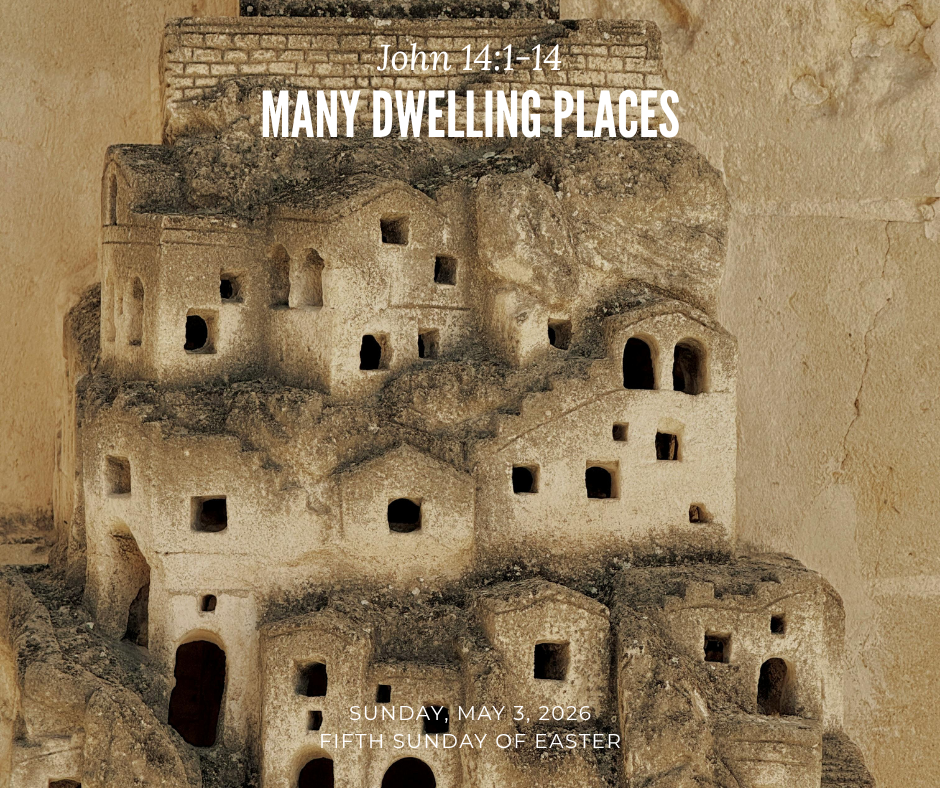
Jesus follows with an assurance that the disciples have a place with God. The King James Bible said, “In my Father’s House there are many mansions.” Our modern view of mansions is an opulent home of the rich, which subtly turns the promise into something that sounds like it belongs to the wealthy. The rest of us will get our reward in heaven. The first New Revised Standard changed the word to “rooms.” We all have a room in the household of God. That is a little better, but I like the latest version better. “God’s House has many dwelling places.”
A dwelling place isn’t just where you live, it is your abiding place, where you are living in the moment. The disciples at Emmaus ask Jesus where he is staying for the night, and invite him to dwell with them for the evening. Jesus uses the verb form of dwelling place in John 15, “I am the vine and you are the branches, abide/dwell in me and I will abide/dwell in you.” Would you rather have a mansion in heaven, or dwell with God? Later in the passage, Jesus says he and God dwell in each other, and wish to dwell within each disciple. He is reminding the disciples that he is inviting them into a rich communion together that stands even in the uproar of the world. Don’t live in tumult, but dwell in God’s household.
My bookshelves hold two massive books by Raymond Brown on the Gospel of John. He notes that dwelling in Hellenistic usage could mean a waystation along a road, a resting place en route, not a final destination. The word carried the sense of temporary shelter that sustains you for the next stage. And if that’s true, if God is meeting us on the journey, then Jesus is not promising a final heavenly address. He is promising that there is a place for you on the road. God has prepared rest stops. You will not collapse from exhaustion between here and there.
Even as we claim Christ as our way, truth, and life, we must hold that confession alongside his own words: there are many dwelling places. When that tension is lost, faith can turn into exclusion. It happened early in the church. By the third century, this passage was used to claim that salvation existed only within the church.
And it cast a long shadow—crusades, inquisitions, centuries of violence in the name of truth. That is not where this passage is leading us. Jesus is not drawing a boundary line, not a system of belief to defend. He is opening a path, a way of being to dwell in. So what does Jesus offer in this moment of uproar? Not a system of belief, but a way of being.
When the noise settles, even just for a moment, you can feel it. Beneath the churn.
Beneath the urgency. Something steady. Because the world will keep stirring the waters. The tumult does not go away. And Jesus does not take us out of it. He teaches us how to dwell within it.
“I am the way”— a path you can walk when the ground feels uncertain.
“I am the truth”—the deeper reality beneath all the noise.
“I am the life”—not someday, but right here, still beating within you.
And in the midst of it all, there are places to dwell. Moments where the heart settles. Where trust returns.Where God is not far away, but already here. And when the noise rises again—and it will—you don’t have to be carried by it.
You can return. To the path. To the truth beneath the surface. To the life already given. And maybe even ask, quietly, “Where are my feet?” And find yourself here again…in the presence of the One who dwells with you even now.